ConvertReference.org

Square Inch to Square Mile and Square Mile to Square Inch Converter (sq_in to sq_mi, sq_mi to sq_in)

sq_in

Review and reference information

Verified by the ConvertReference Technical Standards Team

ConvertReference Technical Standards Team

All values and formulas are validated through our editorial review process and cross-checked against internationally recognized reference standards (NIST, BIPM, CODATA).

View Editorial Standards & Report Corrections

Last reviewed: December 04, 2025

Conversion Factors

1 square inch = 2.49097668605244e-10 square mile
1 square mile = 4014489600 square inch

(Exact factors: 2.49097668605244e-10 and 4014489600)

Sources: NIST · BIPM

About this Square Inch and Square Mile Converter

Easily compare area sizes with this quick unit converter. See the equivalent in square miles when you use square inches. The swap button lets you switch between units. Fast, simple, and reliable for everyday checks.

What are Square inches and Square miles?

What is a Square Inch?

Square inch (in^2) is an area unit equal to a square that is 1 inch on each side. It is defined from the inch, with 1 in^2 = (0.0254 m)^2 = 0.00064516 m^2. It belongs to the Imperial/US customary system of units. Symbol: in^2. Example: a postage stamp about 1 in by 1 in has area ~1 in^2, while a credit card (~3.375 in × 2.125 in) is ~7.18 in^2.

What is a Square Mile?

Square mile (sq mi or mi^2) is an area unit used in the US customary and imperial systems. It equals a square 1 mile on each side: 1 mi^2 = (5280 ft)^2 = 27,878,400 ft^2 = 2,589,988.110336 m^2 = 2.589988110336 km^2. It belongs to the Imperial/US customary system; symbol commonly mi^2 or sq mi. Real‑world size: a square about 1.609 km on each side (roughly 2.59 km^2) or 640 acres.

When to Use Square Inch vs Square Mile

Square Inch Usage

Square inches are used to express small-area measurements in countries that still use imperial/US customary units. Primary users include the United States, the United Kingdom, Canada, and Australia. It appears on consumer products, packaging, and quick-area references where inches are familiar to users.

Square Mile Usage

Primarily used for land area in the United States and, to a lesser extent, in the United Kingdom where imperial units persist. It appears in official statistics and common references for larger areas.

How to Convert Between Square inches and Square miles

Conversion Formulas

Square Inch to Square Mile:
square inch × 2.49097668605244e-10 = square mile

Square Mile to Square Inch:
square mile × 4014489600 = square inch

Step-by-Step Guide

Square Inch to Square Mile

  1. Take your value in square inches.
  2. Multiply by 2.49097668605244e-10.
  3. The result is in square miles.

Square Mile to Square Inch

  1. Take your value in square miles.
  2. Multiply by 4014489600.
  3. The result is in square inches.

Example: Convert 0.25 square inches to square miles.

  • Exact: 0.25 × 2.49097668605244e-10 = 6.22744171513111e-11 square miles.
  • Rounded: approximately 6.22744e-11 square miles.

Example: Convert 5 square miles to square inches.

  • Exact: 5 × 4014489600 = 20072448000 square inches.
  • Rounded: approximately 2.00724e+10 square inches.

History & Context

Square inch and square mile grew from older ways to measure land and cloth. The inch came from body parts and trades in ancient times, while the mile arose from long routes used by travelers. As maps and land records spread, people used the idea of a square inch to describe small patches and a square mile for larger tracts. In Britain and elsewhere, officials and craftspeople adopted regular sizes, and later standards helped builders, merchants, and planners work with these units. Through many centuries they remained important in daily life even as new systems emerged.

Practical Use

Urban planners might need to convert square inches to square miles when a site plan drawn in inches on a scaled blueprint must be expressed as the total area of an urban block to show compliance with zoning rules. This helps turn a tiny feature into a city-scale context. Environmental teams might convert square miles to square inches when comparing a large parcel's area to the footprint of a small sensor or sampling area to calculate density or coverage per unit area. These conversions let planners and scientists relate precise measurements to large-scale land areas.

Common Mistakes When Converting Between Square inches and Square miles

  • Applying the linear inch-to-mile factor directly to square units without squaring it.
  • Assuming square inches and square miles represent the same size.
  • Treating area conversions as if the linear inch-to-mile relationship applies without accounting for the squared nature of area.
  • Relying on rough estimates that ignore how area units scale when moving between square inches and square miles.

Mental Shortcuts for Quick Conversions

Tip 1 (in^2 → mi^2, estimation only): 1 mi^2 ≈ 4.01e9 in^2; use 4.0e9 for quick estimates. Tip 2 (mi^2 → in^2, estimation only): 1 mi^2 ≈ 4.01e9 in^2; for exact results, use a precise converter.

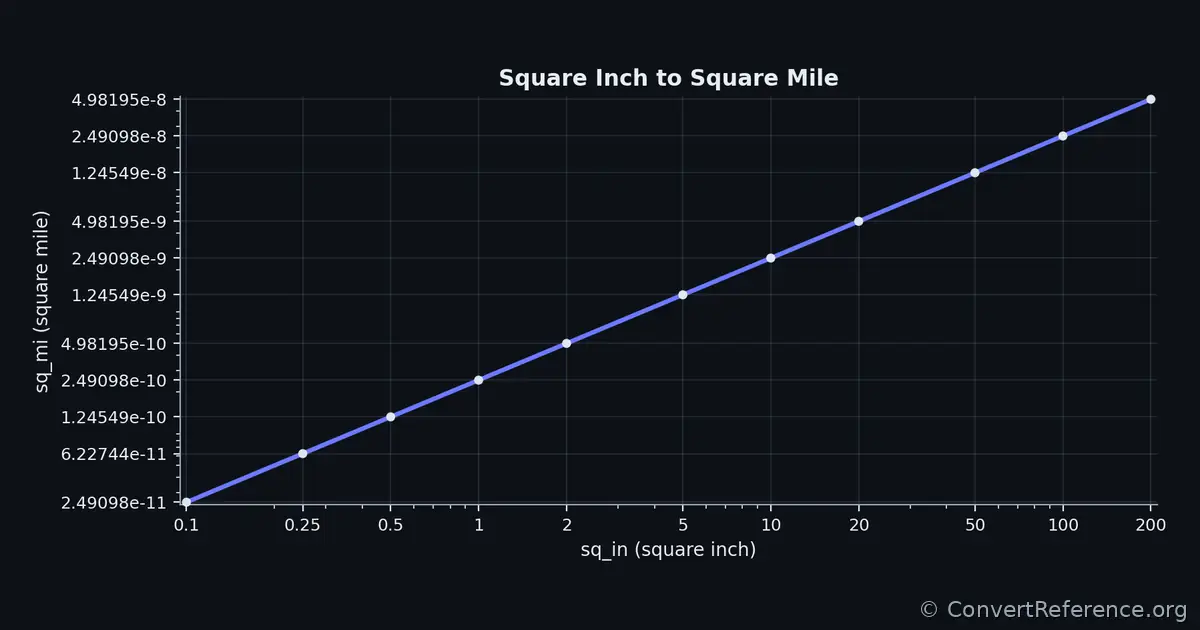
Square inches and Square miles Conversion Graph
Square inches and Square miles Conversion Graph
Conversion graph showing the relationship between square inches and square miles.

Conversion Table for Square Inch and Square Mile

Common conversion values
Square inches Square miles
0.12.49098e-11
0.256.22744e-11
0.51.24549e-10
12.49098e-10
24.98195e-10
51.24549e-9
102.49098e-9
204.98195e-9
501.24549e-8
1002.49098e-8
2004.98195e-8

Values are rounded for display; internal calculations use the exact conversion factors between square inch and square mile (2.49097668605244e-10 and 4014489600).

Dataset & API Access

Programmatic Access

Free JSON API with stable endpoints and predictable keys for automated bidirectional conversions.

Endpoint: https://convertreference.org/api/v1/convert/square-inch-to-square-mile.json

Content Type: application/json

Documentation: View API docs

Licensing

License: CC0 1.0 Universal (Public Domain)

See all datasets

Data & Editorial Process

All numerical values and formulas are generated from the Pint scientific unit library (v0.25), using constants consistent with the BIPM SI Brochure (9th Edition) and NIST Special Publication 811. Explanatory text is drafted with AI assistance and reviewed by ConvertReference editors for clarity and accuracy. This converter is completely free to use, and all calculations are performed locally in your browser and never sent to a server.

  • 2025-12-04 – Generated: Page created using Pint v0.25 verified constants.
  • 2025-12-04 – Reviewed: Verified by ConvertReference editors; no numerical changes required.