ConvertReference.org

Centimeter to Mile and Mile to Centimeter Converter (cm to mi, mi to cm)

cm

Review And Reference Information

Verified by the ConvertReference Technical Standards Team

ConvertReference Technical Standards Team

All values and formulas are validated through our editorial review process and cross-checked against internationally recognized reference standards (NIST, BIPM, CODATA).

View Editorial Standards & Report Corrections

Last reviewed: December 01, 2025

Conversion Factors

1 centimeter = 0.00000621371192237334 mile
1 mile = 160934.4 centimeter

(Exact factors: 0.00000621371192237334 and 160934.4)

Sources: NIST · BIPM

About This Centimeter And Mile Converter

Welcome to our quick centimeter and mile converter. Easily compare measurements across these two units with clear results. Use the swap button to switch between centimeter and mile anytime. Designed for clarity and speed, it helps you get your answer at a glance.

What Are Centimeters And Miles?

What Is A Centimeter?

Centimeter (cm) is a unit of length in the metric/SI system. It equals one hundredth of a meter (1 cm = 0.01 m). It is a base-10 subunit of the meter. Common symbol: cm. Example: a standard paperclip is about 3 cm long.

What Is A Mile?

A mile (mi) is a unit of length in the Imperial and US customary systems. Symbol: mi. Exact relation to base units: 1 mile = 5,280 feet = 1,609.344 meters (foot defined as 0.3048 m). System: Imperial/US customary. Example: about 15 standard American football fields laid end to end.

When To Use Centimeter Vs Mile

Centimeter Usage

Centimeters are used in everyday life in most metric-using countries for measuring height and small dimensions of objects, clothing sizes, and packaging. Primary users include France, Japan, Germany, and Canada.

Mile Usage

The mile remains in use for road distances in the United States, the United Kingdom, and Liberia.

How To Convert Between Centimeters And Miles

Conversion Formulas

Centimeter to Mile:
centimeter × 0.00000621371192237334 = mile

Mile to Centimeter:
mile × 160934.4 = centimeter

Step-by-Step Guide

Centimeter to Mile

  1. Take your value in centimeters.
  2. Multiply by 0.00000621371192237334.
  3. The result is in miles.

Mile to Centimeter

  1. Take your value in miles.
  2. Multiply by 160934.4.
  3. The result is in centimeters.

Example: Convert 0.5 centimeters to miles.

  • Exact: 0.5 × 0.00000621371192237334 = 0.00000310685596118667 miles.
  • Rounded: approximately 0.00000310686 miles.

Example: Convert 5 miles to centimeters.

  • Exact: 5 × 160934.4 = 804672 centimeters.

History & Context

Centimeter arose with the metric system in France, linked to the meter and built to be a simple decimal unit for science and everyday use. It spread with education and international science, becoming common in schools and laboratories around the world. The mile has ancient roots in Rome as a distance of steps, and later it was adopted in England as a long unit used on maps and for travel. In medieval and early modern times many miles existed, but the English mile became standard in many places, guiding roads and commerce for generations. Both units show how people sought easy, regular ways to measure space: the centimeter from a universal decimal system and the mile from local history and trade.

Practical Use

On a hiking map drawn to scale, distances are given in centimeters, so a traveler uses a centimeter-to-mile conversion to estimate how far they must walk in miles. For example, they see a trail length of 2400 cm on the map and want to know its real distance in miles to decide if the route fits into their day. In a different project, a city planner reviewing a long road on a large-scale map measured in miles needs to convert that distance into centimeters on the map to lay out the scale accurately. Converting miles to centimeters helps them draft plans or create a model that matches the map's proportions.

Common Mistakes When Converting Between Centimeters And Miles

  • Treating centimeter to mile conversion as a simple one-to-one swap without adjusting for the difference in unit size.
  • Assuming the numeric value stays the same when converting between centimeters and miles.
  • Relying on everyday intuition or rough estimates instead of applying a proper unit conversion.
  • Mistaking the relationship by thinking miles and centimeters measure length in the same way, so they are interchangeable.

Mental Shortcuts For Quick Conversions

Tip 1 (cm → mile): Remember 1 mile ≈ 161,000 cm; estimate by dividing cm by 161k. Tip 2 (mile → cm): Remember 1 mile ≈ 160,000 cm; estimate by multiplying miles by 160k. For estimation only; use a precise converter when accuracy matters.

Centimeters And Miles Conversion Graph
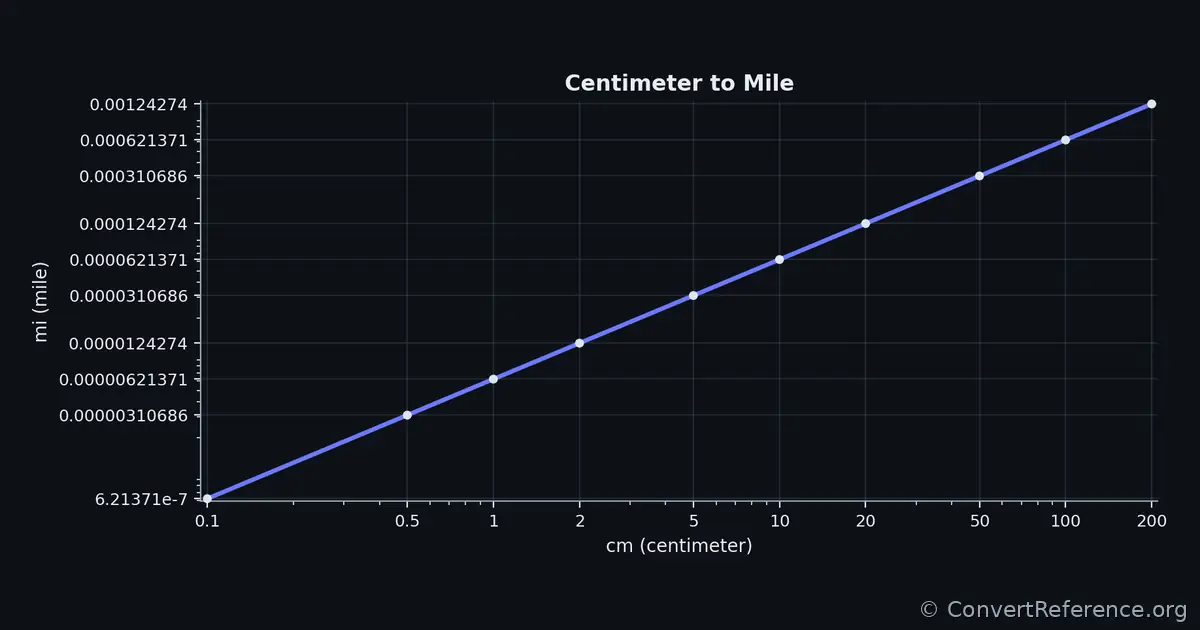
Centimeters and Miles Conversion Graph
Conversion graph showing the relationship between centimeters and miles.

Conversion Table For Centimeters And Miles

Common conversion values
Centimeters Miles
0.16.21371e-7
0.50.00000310686
10.00000621371
20.0000124274
50.0000310686
100.0000621371
200.000124274
500.000310686
1000.000621371
2000.00124274

Values are rounded for display; internal calculations use the exact conversion factors between centimeters and miles (0.00000621371192237334 and 160934.4).

Dataset & API Access

Programmatic Access

Free JSON API with stable endpoints and predictable keys for automated bidirectional conversions.

Endpoint: https://convertreference.org/api/v1/convert/centimeter-to-mile.json

Content Type: application/json

Documentation: View API docs

Licensing

License: CC0 1.0 Universal (Public Domain)

See all datasets

Data & Editorial Process

All numerical values and formulas are generated from the Pint scientific unit library (v0.25), using constants consistent with the BIPM SI Brochure (9th Edition) and NIST Special Publication 811. Explanatory text is drafted with AI assistance and reviewed by ConvertReference editors for clarity and accuracy. This converter is completely free to use, and all calculations are performed locally in your browser and never sent to a server.

  • 2025-12-01 – Generated: Page created using Pint v0.25 verified constants.
  • 2025-12-01 – Reviewed: Verified by ConvertReference editors; no numerical changes required.