ConvertReference.org

Millimeter to Nautical Mile and Nautical Mile to Millimeter Converter (mm to nmi, nmi to mm)

mm

Review And Reference Information

Verified by the ConvertReference Technical Standards Team

ConvertReference Technical Standards Team

All values and formulas are validated through our editorial review process and cross-checked against internationally recognized reference standards (NIST, BIPM, CODATA).

View Editorial Standards & Report Corrections

Last reviewed: December 01, 2025

Conversion Factors

1 millimeter = 5.39956803455724e-7 nautical mile
1 nautical mile = 1852000 millimeter

(Exact factors: 5.39956803455724e-7 and 1852000)

Sources: NIST · BIPM

About This Millimeter And Nautical Mile Converter

Welcome to the Millimeter to Nautical Mile Converter, your quick measurement buddy. This tool helps you compare measurements between millimeters and nautical miles. Use the swap button to switch the direction between the two units. Explore with different values to see how these units relate.

What Are Millimeters And Nautical Miles?

What Is A Millimeter?

Millimeter (mm) is a metric unit of length in the SI system. It is defined as one thousandth of a meter. 1 mm = 0.001 meters. Real-world: a typical credit card is about 0.76 mm thick.

What Is A Nautical Mile?

Definition: A nautical mile is a unit of length used in navigation. It equals 1,852 meters exactly. It is not an SI base unit, but is accepted for use with SI; widely used in maritime and aviation navigation. Symbol: nmi (often written NM). Example: A ship traveling 20 nautical miles covers about 37.04 kilometers.

When To Use Millimeter Vs Nautical Mile

Millimeter Usage

Millimeter is a metric unit for small lengths used in everyday measurement in countries that use the metric system. It is common in consumer products and product labeling. Primary users include Germany, France, Japan, and Canada.

Nautical Mile Usage

Nautical mile is used for measuring longer sea-related distances and in geographic and surveying definitions in several countries. It is used in the United States, United Kingdom, Canada, and Australia.

How To Convert Between Millimeters And Nautical Miles

Conversion Formulas

Millimeter to Nautical Mile:
millimeter × 5.39956803455724e-7 = nautical mile

Nautical Mile to Millimeter:
nautical mile × 1852000 = millimeter

Step-by-Step Guide

Millimeter to Nautical Mile

  1. Take your value in millimeters.
  2. Multiply by 5.39956803455724e-7.
  3. The result is in nautical miles.

Nautical Mile to Millimeter

  1. Take your value in nautical miles.
  2. Multiply by 1852000.
  3. The result is in millimeters.

Example: Convert 20 millimeters to nautical miles.

  • Exact: 20 × 5.39956803455724e-7 = 0.0000107991360691145 nautical miles.
  • Rounded: approximately 0.0000107991 nautical miles.

Example: Convert 5 nautical miles to millimeters.

  • Exact: 5 × 1852000 = 9260000 millimeters.
  • Rounded: approximately 9.26e+6 millimeters.

History & Context

Millimeter grew from the metric system developed in France, where scientists defined the meter as a basic length and later cut it into smaller parts for precision work; as the metric system spread, the millimeter became a standard unit in science, industry, and daily measuring tools, used for tiny lengths in laboratories, factories, and design. The nautical mile arose from sailors who mapped the sea with the geometry of the earth, linking distance to the globe so charts and routes could stay consistent across oceans; it became the main unit for navigation and for reporting speed in ships, later adopted worldwide for air travel and international charts. International standards then tied both units to global measurements to ensure consistent use across nations.

Practical Use

On a nautical chart, a navigator might measure a distance in millimeters on the map and need to convert that to nautical miles to estimate travel distance. This helps plan fuel, time, and safety margins for a voyage. In reverse, when laying out a route, the navigator may know the required distance as a certain number of nautical miles and convert it to millimeters on the chart to mark the course precisely. These conversions keep chart readings aligned with real-world distances during navigation.

Common Mistakes When Converting Between Millimeters And Nautical Miles

  • Assuming millimeters and nautical miles share the same length scale and applying a simple decimal shift.
  • Treating nautical miles as metric units and using metric shortcuts instead of the official definition.
  • Converting in the wrong direction by applying the same steps for millimeters to nautical miles and nautical miles to millimeters without adjustment.
  • Rounding or truncating intermediate results without verifying the unit definitions.

Mental Shortcuts For Quick Conversions

Tip 1 (mm → NM): 1 NM = 1,852,000 mm; estimate by mm ÷ 1,852,000 (≈ mm × 0.00000054). Tip 2 (NM → mm): NM × 1,852,000. For accuracy, use a precise converter.

Millimeters And Nautical Miles Conversion Graph
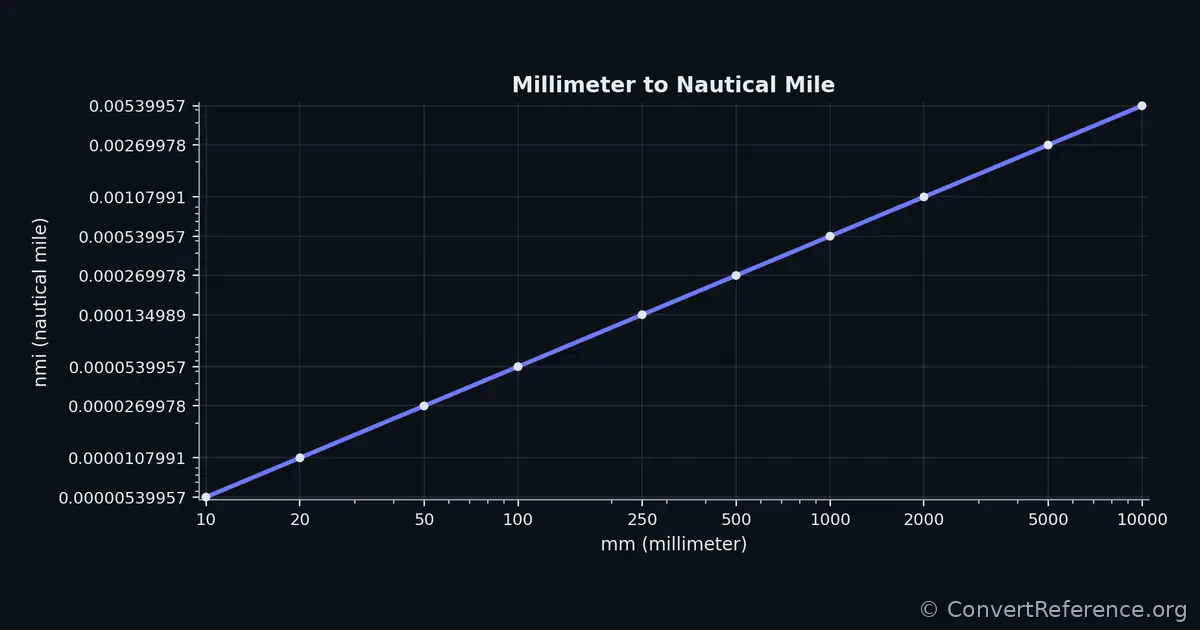
Millimeters and Nautical miles Conversion Graph
Conversion graph showing the relationship between millimeters and nautical miles.

Conversion Table For Millimeters And Nautical Miles

Common conversion values
Millimeters Nautical miles
100.00000539957
200.0000107991
500.0000269978
1000.0000539957
2500.000134989
5000.000269978
10000.000539957
20000.00107991
50000.00269978
100000.00539957

Values are rounded for display; internal calculations use the exact conversion factors between millimeters and Nautical Miles (5.39956803455724e-7 and 1852000).

Dataset & API Access

Programmatic Access

Free JSON API with stable endpoints and predictable keys for automated bidirectional conversions.

Endpoint: https://convertreference.org/api/v1/convert/millimeter-to-nautical-mile.json

Content Type: application/json

Documentation: View API docs

Licensing

License: CC0 1.0 Universal (Public Domain)

See all datasets

Data & Editorial Process

All numerical values and formulas are generated from the Pint scientific unit library (v0.25), using constants consistent with the BIPM SI Brochure (9th Edition) and NIST Special Publication 811. Explanatory text is drafted with AI assistance and reviewed by ConvertReference editors for clarity and accuracy. This converter is completely free to use, and all calculations are performed locally in your browser and never sent to a server.

  • 2025-12-01 – Generated: Page created using Pint v0.25 verified constants.
  • 2025-12-01 – Reviewed: Verified by ConvertReference editors; no numerical changes required.