ConvertReference.org

Yard to Nautical Mile and Nautical Mile to Yard Converter (yd to nmi, nmi to yd)

yd

Review And Reference Information

Verified by the ConvertReference Technical Standards Team

ConvertReference Technical Standards Team

All values and formulas are validated through our editorial review process and cross-checked against internationally recognized reference standards (NIST, BIPM, CODATA).

View Editorial Standards & Report Corrections

Last reviewed: December 01, 2025

Conversion Factors

1 yard = 0.000493736501079914 nautical mile
1 nautical mile = 2025.37182852143 yard

(Exact factors: 0.000493736501079914 and 2025.37182852143)

Sources: NIST · BIPM

About This Yard And Nautical Mile Converter

Effortlessly explore lengths in yards and nautical miles with this quick converter. See the nautical mile result for any yard value in one clear view. Use the swap button to switch between units. Start with any yard value and get the matching nautical miles instantly.

What Are Yards And Nautical Miles?

What Is A Yard?

Yard is a unit of length in the Imperial and US customary systems. It equals 3 feet (36 inches) or exactly 0.9144 meters. Symbol: yd. Example: a standard doorway width is about 1 yard (roughly 0.9 meters).

What Is A Nautical Mile?

A nautical mile is a unit of distance used in maritime and aviation. It is defined as exactly 1,852 meters (equal to one minute of latitude on a meridian; 1 degree = 60 nautical miles). It is a non-SI unit accepted for use with SI. Symbol: nm (also NM or nmi). Example: 5 nautical miles ≈ 9.26 km, so a ship 5 nm offshore is about 9.26 km from shore.

When To Use Yard Vs Nautical Mile

Yard Usage

Yard is used for everyday length in countries that use the imperial or US customary system. Primary users include the United States, United Kingdom, Canada, and Australia. A yard equals 3 feet (36 inches) and is commonly used to measure lawns, furniture, and fabrics.

Nautical Mile Usage

Nautical miles are used in official distance definitions and legal references in several countries, including the United States, the United Kingdom, Canada, and Australia.

How To Convert Between Yards And Nautical Miles

Conversion Formulas

Yard to Nautical Mile:
yard × 0.000493736501079914 = nautical mile

Nautical Mile to Yard:
nautical mile × 2025.37182852143 = yard

Step-by-Step Guide

Yard to Nautical Mile

  1. Take your value in yards.
  2. Multiply by 0.000493736501079914.
  3. The result is in nautical miles.

Nautical Mile to Yard

  1. Take your value in nautical miles.
  2. Multiply by 2025.37182852143.
  3. The result is in yards.

Example: Convert 0.5 yards to nautical miles.

  • Exact: 0.5 × 0.000493736501079914 = 0.000246868250539957 nautical miles.
  • Rounded: approximately 0.000246868 nautical miles.

Example: Convert 5 nautical miles to yards.

  • Exact: 5 × 2025.37182852143 = 10126.8591426072 yards.
  • Rounded: approximately 10126.9 yards.

History & Context

Yard origins go back to medieval England. The length was kept as a standard by rulers and traders and was based on a physical stick kept by authorities. Different places used similar lengths, and over time a common yard formed part of the English measuring system. The nautical mile comes from sea travel and navigation. Sailors used the shape of the Earth and the idea of angles to measure distance at sea, tying travel to a small part of a circle. As ships sailed farther, these units spread in trade and on maps.

Practical Use

In harbor navigation training, a navigator reviews a waypoint distance described in yards on a local plan and converts it to nautical miles to plot the course on standard maritime charts. During the approach to a harbor, the crew uses distances in nautical miles from the chart and converts them to yards to set up a safe approach path and reference points on the deck. This helps align charted channels and buoys, which are labeled in nautical miles, with yard-based measurements used for mooring lines and dock spacing. Having both conversions supports precise navigation and safe operations in mixed measurement systems.

Common Mistakes When Converting Between Yards And Nautical Miles

  • Assuming yards and nautical miles have the same length.
  • Confusing nautical miles with statute miles in a conversion.
  • Using a yard as if it were a nautical mile.
  • Failing to reverse the operation when converting back from nautical miles to yards.

Mental Shortcuts For Quick Conversions

Yard to NM: 1 NM ≈ 2025 yd; estimate by dividing yards by 2025. NM to Yard: multiply NM by 2025. Note: these are rough estimates; use a precise converter for accuracy.

Yards And Nautical Miles Conversion Graph
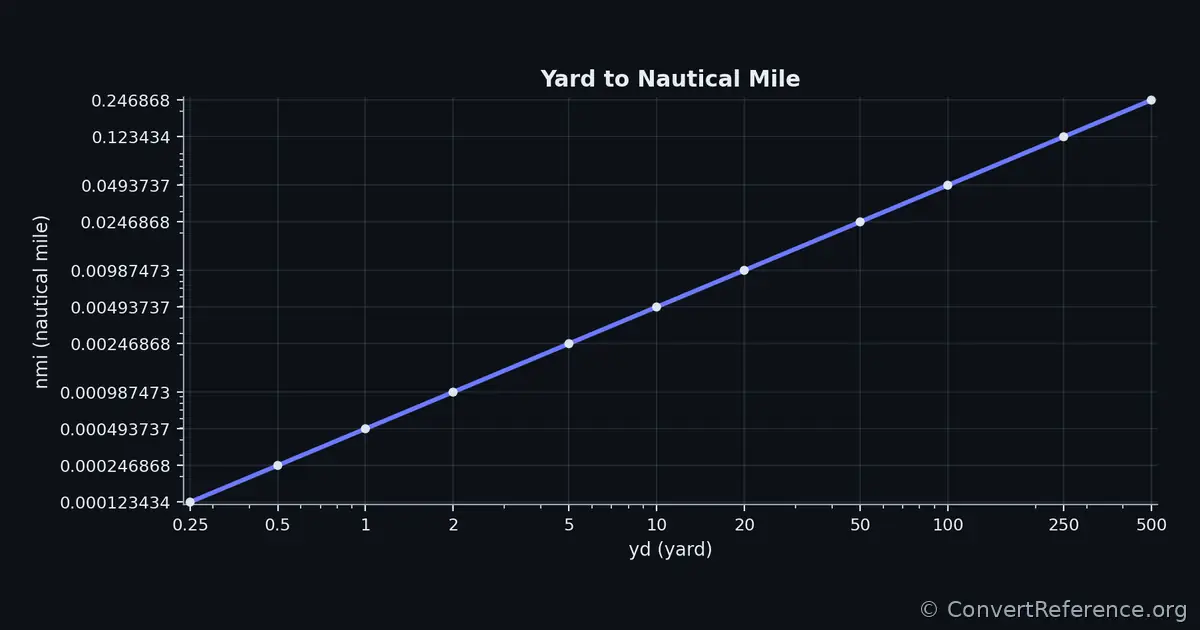
Yards and Nautical miles Conversion Graph
Conversion graph showing the relationship between yards and nautical miles.

Conversion Table For Yards And Nautical Miles

Common conversion values
Yards Nautical miles
0.250.000123434
0.50.000246868
10.000493737
20.000987473
50.00246868
100.00493737
200.00987473
500.0246868
1000.0493737
2500.123434
5000.246868

Values are rounded for display; internal calculations use the exact conversion factors between yards and Nautical Miles (0.000493736501079914 and 2025.37182852143).

Dataset & API Access

Programmatic Access

Free JSON API with stable endpoints and predictable keys for automated bidirectional conversions.

Endpoint: https://convertreference.org/api/v1/convert/yard-to-nautical-mile.json

Content Type: application/json

Documentation: View API docs

Licensing

License: CC0 1.0 Universal (Public Domain)

See all datasets

Data & Editorial Process

All numerical values and formulas are generated from the Pint scientific unit library (v0.25), using constants consistent with the BIPM SI Brochure (9th Edition) and NIST Special Publication 811. Explanatory text is drafted with AI assistance and reviewed by ConvertReference editors for clarity and accuracy. This converter is completely free to use, and all calculations are performed locally in your browser and never sent to a server.

  • 2025-12-01 – Generated: Page created using Pint v0.25 verified constants.
  • 2025-12-01 – Reviewed: Verified by ConvertReference editors; no numerical changes required.