ConvertReference.org

Hour To Day Converter

h

Review And Reference Information

Verified by the ConvertReference Technical Standards Team

ConvertReference Technical Standards Team

All values and formulas are validated through our editorial review process and cross-checked against internationally recognized reference standards (NIST, BIPM, CODATA).

View Editorial Standards & Report Corrections

Last reviewed: December 08, 2025

Conversion Factors

1 hour = 0.0416666666666667 day
1 day = 24 hour

(Exact factors: 0.0416666666666667 and 24)

Sources: NIST · BIPM

About This Hour And Day Converter

This handy tool helps you view your time in days. See how your hours map to days at a glance. You can click the swap button to switch between units. Use it for quick, clear comparisons of time across units.

What Are Hours And Days?

What Is An Hour?

An hour is a unit of time equal to 60 minutes or 3,600 seconds. It is defined in terms of the SI base unit second (1 h = 3,600 s) and is commonly used with SI. Symbol: h (also hr in some contexts). Real-world example: a typical movie lasts about 2 hours.

What Is A Day?

Day: a unit of time equal to 24 hours—the mean solar day, the average length of one Earth rotation relative to the Sun. In SI terms, 1 day = 86,400 seconds. It is not a base SI unit but is accepted for use with SI; symbol: d. Example: from sunrise to sunrise is about one day; 7 days ≈ 1 week.

When To Use Hour Vs Day

Hour Usage

The hour is used to express time durations and clock times in daily life. People plan activities by hours, and timetables show hours. Four primary countries where it is used are the United States, the United Kingdom, Canada, and Australia.

Day Usage

Day is a standard unit of time used for daily life and civil timekeeping, defining calendars, routines, and schedules. It is used worldwide, including the United States, United Kingdom, India, and Japan.

How To Convert Between Hours And Days

Conversion Formulas

Hour to Day:
hour × 0.0416666666666667 = day

Day to Hour:
day × 24 = hour

Step-by-Step Guide

Hour to Day

  1. Take your value in hours.
  2. Multiply by 0.0416666666666667.
  3. The result is in days.

Day to Hour

  1. Take your value in days.
  2. Multiply by 24.
  3. The result is in hours.

Example: Convert 2 hours to days.

  • Exact: 2 × 0.0416666666666667 = 0.0833333333333333 days.
  • Rounded: approximately 0.0833333 days.

Example: Convert 5 days to hours.

  • Exact: 5 × 24 = 120 hours.

History & Context

Long ago people watched the sun to tell time and split days into parts of light and dark. Ancient builders used sundials and jars of water to mark these parts, while the idea of hours grew from the need to pace daily life. In monasteries, time was kept in named periods that guided prayers and work. With clever gears, machines began to show equal moments for day and night, tying the day to a steady rhythm rather than natural change alone. The word hour comes from old words for time, and as clocks spread, cities shared a common rhythm that helped travel, work, and study.

Practical Use

An airline dispatcher might need to convert hours to days to present overall flight time across several legs as a single, readable duration for customers. This makes it easier to communicate scheduling and catch any long delays at a glance. Conversely, a film production manager might need to convert days to hours to allocate precise studio time, crew hours, and equipment usage. Having a quick day-to-hour conversion on this page helps with accurate scheduling and budgeting.

Common Mistakes When Converting Between Hours And Days

  • Treating hours and days as the same unit and ignoring the difference in scale.
  • Converting in the wrong direction and labeling the result with the incorrect unit.
  • Ignoring contextual meanings of a day and applying the wrong unit.
  • Relying on rough estimates or memory instead of using a consistent conversion approach.

Mental Shortcuts For Quick Conversions

Tip 1 (hour→day): 24 hours = 1 day — a quick rule of thumb. Tip 2 (day→hour): 1 day = 24 hours — a quick rule of thumb. Note: for estimation only; use a precise converter when accuracy matters.

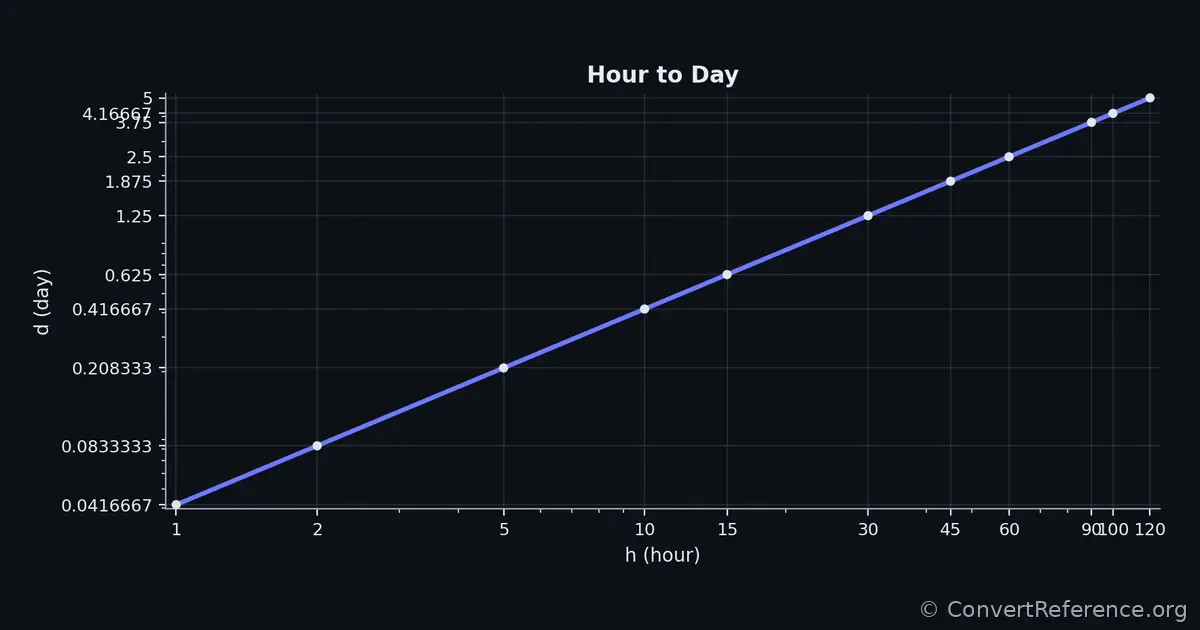
Hours And Days Conversion Graph

Hours and Days Conversion Graph
Conversion graph showing the relationship between hours and days.

Conversion Table For Hour And Day

Common conversion values
Hours Days
10.0416667
20.0833333
50.208333
100.416667
150.625
301.25
451.875
602.5
903.75
1004.16667
1205

Values are rounded for display; internal calculations use the exact conversion factors between hour and day (0.0416666666666667 and 24).

Dataset & API Access

Programmatic Access

Free JSON API with stable endpoints and predictable keys for automated bidirectional conversions.

Endpoint: https://convertreference.org/api/v1/convert/hour-to-day.json

Content Type: application/json

Documentation: View API docs

Licensing

License: CC0 1.0 Universal (Public Domain)

See all datasets

Data & Editorial Process

All numerical values and formulas are generated from the Pint scientific unit library (v0.25), using constants consistent with the BIPM SI Brochure (9th Edition) and NIST Special Publication 811. Explanatory text is drafted with AI assistance and reviewed by ConvertReference editors for clarity and accuracy. This converter is completely free to use, and all calculations are performed locally in your browser and never sent to a server.

  • 2025-12-08 – Generated: Page created using Pint v0.25 verified constants.
  • 2025-12-08 – Reviewed: Verified by ConvertReference editors; no numerical changes required.