ConvertReference.org

Week To Month Converter

week

Review And Reference Information

Verified by the ConvertReference Technical Standards Team

ConvertReference Technical Standards Team

All values and formulas are validated through our editorial review process and cross-checked against internationally recognized reference standards (NIST, BIPM, CODATA).

View Editorial Standards & Report Corrections

Last reviewed: December 08, 2025

Conversion Factors

1 week = 0.229979466119096 month
1 month = 4.34821428571429 week

(Exact factors: 0.229979466119096 and 4.34821428571429)

Sources: NIST · BIPM

About This Week And Month Converter

Easily explore time in weeks and months with this simple tool. Use the swap button to switch between units at any moment. See results clearly as you compare durations and plan ahead. Designed for quick, intuitive use, it helps you focus on what matters.

What Are Weeks And Months?

What Is A Week?

A week is a time unit equal to seven days. Exact relations: 1 day = 24 hours; 1 hour = 3,600 seconds; so 1 week = 7 days = 168 hours = 604,800 seconds. System: time measurement; not an SI base unit but defined from seconds. Symbol: wk. Example: a typical workweek is about 40 hours (5 days × 8 hours).

What Is A Month?

Month (mo) is a calendar time unit. It represents the period from a given date to the same date in the next calendar month. Month lengths vary: 28–31 days. In the SI system, time is measured in seconds, but month is a non-SI unit used with SI. A mean calendar month is 30.436875 days (about 2,629,746 seconds). Example: from March 1 to April 1 is one calendar month; typically about 30 days.

When To Use Week Vs Month

Week Usage

Week is used worldwide in calendars, scheduling, payroll, education terms, and project planning, organizing time into seven-day cycles. It follows Sunday- or Monday-based weeks in many places. Primary users: United States, United Kingdom, Canada, Australia.

Month Usage

Months are a global time unit used to divide the year into 12 periods. They appear in calendars for scheduling, budgeting, and record-keeping. In the United States, United Kingdom, Canada, and Australia, months are used to track dates and durations, as in many other countries worldwide.

How To Convert Between Weeks And Months

Conversion Formulas

Week to Month:
week × 0.229979466119096 = month

Month to Week:
month × 4.34821428571429 = week

Step-by-Step Guide

Week to Month

  1. Take your value in weeks.
  2. Multiply by 0.229979466119096.
  3. The result is in months.

Month to Week

  1. Take your value in months.
  2. Multiply by 4.34821428571429.
  3. The result is in weeks.

Example: Convert 2 weeks to months.

  • Exact: 2 × 0.229979466119096 = 0.459958932238193 months.
  • Rounded: approximately 0.459959 months.

Example: Convert 5 months to weeks.

  • Exact: 5 × 4.34821428571429 = 21.7410714285714 weeks.
  • Rounded: approximately 21.7411 weeks.

History & Context

People in ancient Mesopotamia and Egypt kept calendars by watching the Sun and the Moon, which led to early ways to measure days and months. The week as a repeating cycle came from Babylonian astronomy and later passed to Jews and Christians, then spread through the Roman world. The month grew from the Moon's phases, and many cultures named months after gods or events. Over long periods rulers and scholars adjusted the calendar to fit seasons and work, and religious ideas helped keep the system in use as societies changed.

Practical Use

People planning a fitness program might need to convert week to month to estimate their total monthly training volume from weekly workouts. If they complete four workouts per week, they can estimate roughly 16 workouts in a month to set goals and track progress. Conversely, someone scheduling a project or subscription could need to convert month to week to allocate tasks or billing, such as breaking a monthly plan into four or five weekly milestones to keep the timeline on track.

Common Mistakes When Converting Between Weeks And Months

  • Assuming all months have the same length when converting from weeks to months.
  • Using a fixed number of weeks to represent a month across different months ignores calendar variability.
  • Applying the same week to month conversion in both directions without considering how calendar lengths differ can mislead results.
  • Treating weeks and months as directly interchangeable because they are both time units can produce inconsistent results.

Mental Shortcuts For Quick Conversions

Tip 1 (week → month): 4 weeks ≈ 1 month as a quick estimate; months vary. Tip 2 (month → week): 1 month ≈ 4 weeks as a quick estimate; for more accuracy, about 4.3 weeks (30–31 days). This is for estimation only; use a precise converter when exact values are needed.

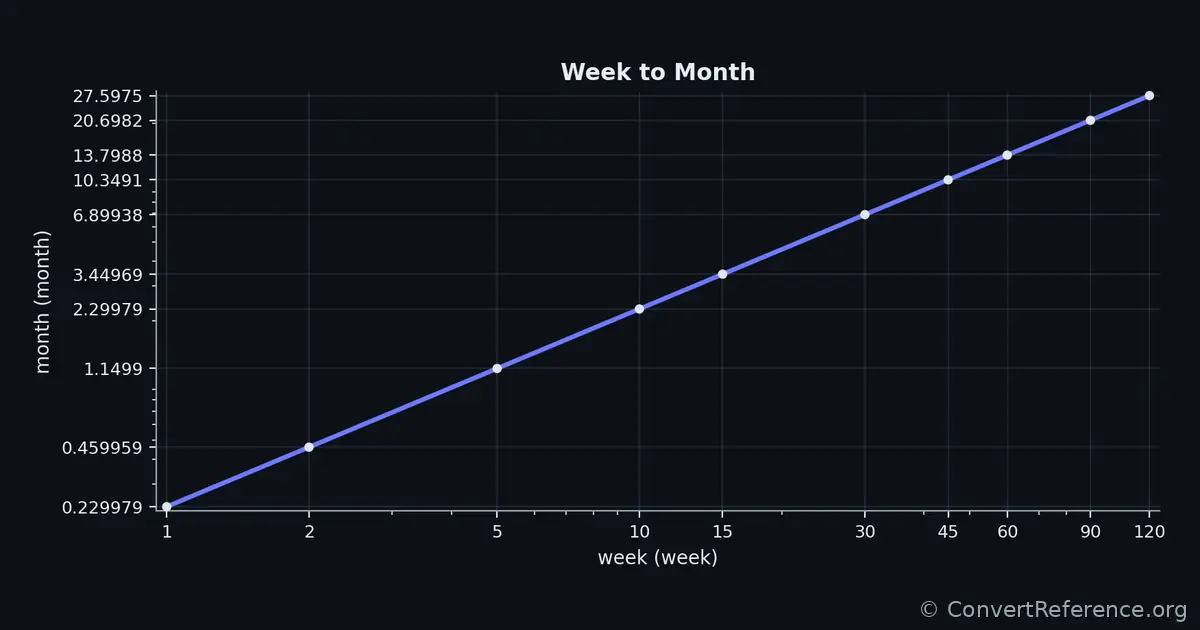
Weeks And Months Conversion Graph

Weeks and Months Conversion Graph
Conversion graph showing the relationship between weeks and months.

Conversion Table For Week And Month

Common conversion values
Weeks Months
10.229979
20.459959
51.1499
102.29979
153.44969
306.89938
4510.3491
6013.7988
9020.6982
12027.5975

Values are rounded for display; internal calculations use the exact conversion factors between week and month (0.229979466119096 and 4.34821428571429).

Dataset & API Access

Programmatic Access

Free JSON API with stable endpoints and predictable keys for automated bidirectional conversions.

Endpoint: https://convertreference.org/api/v1/convert/week-to-month.json

Content Type: application/json

Documentation: View API docs

Licensing

License: CC0 1.0 Universal (Public Domain)

See all datasets

Data & Editorial Process

All numerical values and formulas are generated from the Pint scientific unit library (v0.25), using constants consistent with the BIPM SI Brochure (9th Edition) and NIST Special Publication 811. Explanatory text is drafted with AI assistance and reviewed by ConvertReference editors for clarity and accuracy. This converter is completely free to use, and all calculations are performed locally in your browser and never sent to a server.

  • 2025-12-08 – Generated: Page created using Pint v0.25 verified constants.
  • 2025-12-08 – Reviewed: Verified by ConvertReference editors; no numerical changes required.