ConvertReference.org

Cubic Centimeter To Cubic Inch Converter

cc

Review And Reference Information

Verified by the ConvertReference Technical Standards Team

ConvertReference Technical Standards Team

All values and formulas are validated through our editorial review process and cross-checked against internationally recognized reference standards (NIST, BIPM, CODATA).

View Editorial Standards & Report Corrections

Last reviewed: December 07, 2025

Conversion Factors

1 cubic centimeter = 0.0610237440947323 cubic inch
1 cubic inch = 16.387064 cubic centimeter

(Exact factors: 0.0610237440947323 and 16.387064)

Sources: NIST · BIPM

About This Cubic Centimeter And Cubic Inch Converter

Welcome to our quick unit converter for cubic centimeters and cubic inches. Compare values between these two units with a clear, easy-to-read display. Use the swap button to switch between units. Fast, simple, and designed for quick reference whenever you need a size check.

What Are Cubic Centimeters And Cubic Inches?

What Is A Cubic Centimeter?

A cubic centimeter (cm^3), also written as cc, is a metric volume unit. It is defined as the volume of a cube 1 cm on each edge. In base SI units, 1 cm^3 = 1 × 10^-6 m^3, and 1 cm^3 = 1 mL. It belongs to the metric system; symbol cm^3 or cc. Real-world: a sugar cube is about 1 cm on each side, volume ~1 cm^3.

What Is A Cubic Inch?

Definition: A cubic inch is a unit of volume in the US customary and imperial systems, equal to the volume of a cube 1 inch on each side. Relationship: 1 in^3 = 16.387064 cm^3 = 0.000016387064 m^3 = 1/1728 ft^3. System: US customary/imperial. Symbol: in^3. Example: a cube 1 in on each side holds about 16.4 mL (≈0.55 US fl oz), similar to a small ice cube.

When To Use Cubic Centimeter Vs Cubic Inch

Cubic Centimeter Usage

Cubic centimeter (cc) is a small-volume unit widely used in medicine for dosages and syringe measurements, and in basic laboratory measurements for liquids. It is commonly encountered in medical contexts in several countries. Primary users: United Kingdom, India, Canada, Australia.

Cubic Inch Usage

Cubic inch is used in the United States, Canada, United Kingdom, and Australia for certain consumer measurements and labeling, often in legacy or traditional contexts. It remains familiar for small-volume quantities in everyday products.

How To Convert Between Cubic Centimeters And Cubic Inches

Conversion Formulas

Cubic Centimeter to Cubic Inch:
cubic centimeter × 0.0610237440947323 = cubic inch

Cubic Inch to Cubic Centimeter:
cubic inch × 16.387064 = cubic centimeter

Step-by-Step Guide

Cubic Centimeter to Cubic Inch

  1. Take your value in cubic centimeters.
  2. Multiply by 0.0610237440947323.
  3. The result is in cubic inches.

Cubic Inch to Cubic Centimeter

  1. Take your value in cubic inches.
  2. Multiply by 16.387064.
  3. The result is in cubic centimeters.

Example: Convert 2 cubic centimeters to cubic inches.

  • Exact: 2 × 0.0610237440947323 = 0.122047488189465 cubic inches.
  • Rounded: approximately 0.122047 cubic inches.

Example: Convert 5 cubic inches to cubic centimeters.

  • Exact: 5 × 16.387064 = 81.93532 cubic centimeters.
  • Rounded: approximately 81.9353 cubic centimeters.

History & Context

Historically, the cubic centimetre grew with the metric system as scientists and engineers sought a simple way to measure volumes. The centimetre came from a metric unit of length and was extended into dimensions to describe volume. The cubic centimetre became a convenient unit for medicines, labs, and everyday use as education and industry spread the metric system worldwide. The cubic inch traces back to the old English and imperial systems, where the inch and its derivatives were used for many crafts and trades. A cube built from inches defined its volume, and the term fits into maps, tools, and early science in Britain and America.

Practical Use

In a medical or laboratory setting, technicians sometimes need to convert cubic centimeters to cubic inches to compare syringe volumes or reagent containers labeled in cm^3 with equipment readouts in in^3. For instance, a 5 cm^3 sample would be about 0.305 in^3, enabling quick checks against an instrument that shows volume in cubic inches. In packaging or automotive contexts, engineers may need to convert cubic inches to cubic centimeters when a part's capacity is specified in in^3 but the project documentation uses metric cm^3. Knowing that 1 in^3 is 16.387 cm^3 ensures accurate data entry and compatibility across unit systems.

Common Mistakes When Converting Between Cubic Centimeters And Cubic Inches

  • Assuming cubic centimeters and cubic inches are the same size.
  • Using a length-based conversion for a cubic measurement.
  • Converting only one dimension instead of the entire three-dimensional volume.
  • Relying on a rough estimate without checking compatibility of cubic units.

Mental Shortcuts For Quick Conversions

CM^3 to in^3: 1 cm^3 ≈ 0.061 in^3 (multiply by 0.061). In^3 to CM^3: 1 in^3 ≈ 16.387 cm^3 (multiply by 16.4). For estimation only; use a precise converter when precision matters.

Cubic Centimeters And Cubic Inches Conversion Graph
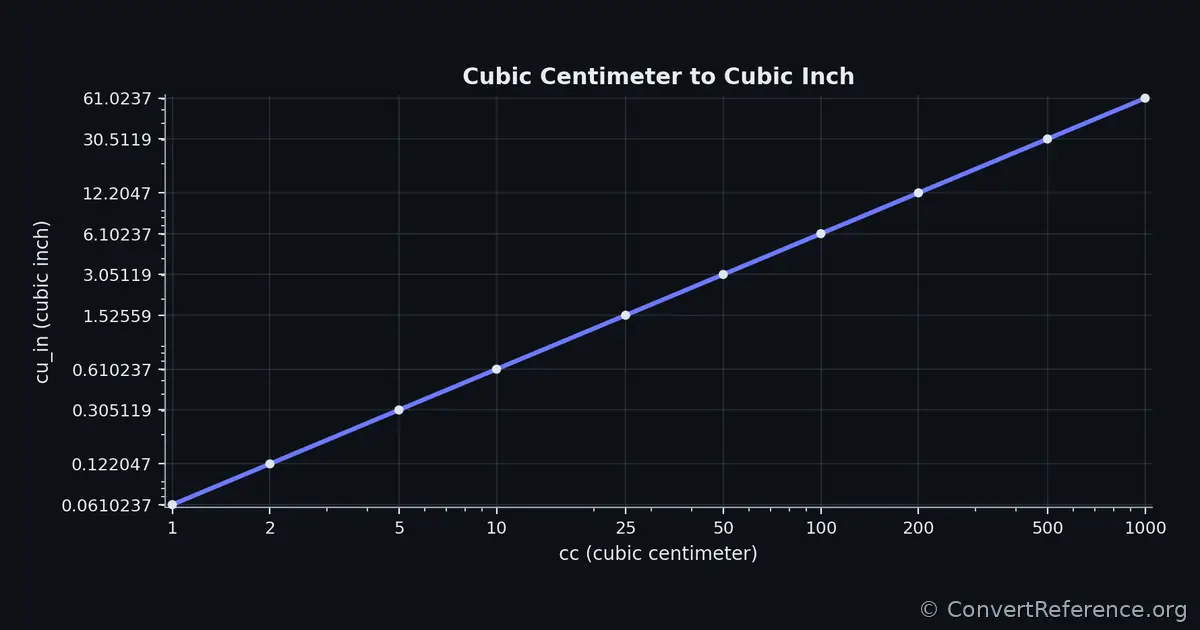
Cubic centimeters and Cubic inches Conversion Graph
Conversion graph showing the relationship between cubic centimeters and cubic inches.

Conversion Table For Cubic Centimeter And Cubic Inch

Common conversion values
Cubic centimeters Cubic inches
10.0610237
20.122047
50.305119
100.610237
251.52559
503.05119
1006.10237
20012.2047
50030.5119
100061.0237

Values are rounded for display; internal calculations use the exact conversion factors between cubic centimeter and cubic inch (0.0610237440947323 and 16.387064).

Dataset & API Access

Programmatic Access

Free JSON API with stable endpoints and predictable keys for automated bidirectional conversions.

Endpoint: https://convertreference.org/api/v1/convert/cubic-centimeter-to-cubic-inch.json

Content Type: application/json

Documentation: View API docs

Licensing

License: CC0 1.0 Universal (Public Domain)

See all datasets

Data & Editorial Process

All numerical values and formulas are generated from the Pint scientific unit library (v0.25), using constants consistent with the BIPM SI Brochure (9th Edition) and NIST Special Publication 811. Explanatory text is drafted with AI assistance and reviewed by ConvertReference editors for clarity and accuracy. This converter is completely free to use, and all calculations are performed locally in your browser and never sent to a server.

  • 2025-12-07 – Generated: Page created using Pint v0.25 verified constants.
  • 2025-12-07 – Reviewed: Verified by ConvertReference editors; no numerical changes required.