ConvertReference.org

Pint To Cubic Foot Converter

pt

Review And Reference Information

Verified by the ConvertReference Technical Standards Team

ConvertReference Technical Standards Team

All values and formulas are validated through our editorial review process and cross-checked against internationally recognized reference standards (NIST, BIPM, CODATA).

View Editorial Standards & Report Corrections

Last reviewed: December 07, 2025

Conversion Factors

1 pint = 0.0167100694444444 cubic foot
1 cubic foot = 59.8441558441558 pint

(Exact factors: 0.0167100694444444 and 59.8441558441558)

Sources: NIST · BIPM

About This Pint And Cubic Foot Converter

This quick converter helps you compare values in pints and cubic feet. Use the swap button to switch between pint and cubic foot views. Clear results update as you explore different values. Designed for fast, confident checks when you need quick unit clarity.

What Are Pints And Cubic Feet?

What Is A Pint?

Pint (pt) is a unit of volume used in British Imperial and US customary systems. Two common sizes: imperial pint = 568.26125 mL (≈0.568 L); US pint = 473.176473 mL (≈0.473 L). Abbreviation: pt. In Imperial, 1 pt = 20 UK fl oz; in US, 1 pt = 16 US fl oz. Real-world: a pint of milk is about 473 mL (US) or 568 mL (UK).

What Is A Cubic Foot?

Definition: A cubic foot is a unit of volume used in the US customary and Imperial systems. It is the volume of a cube 1 foot long on each side. In SI base units, 1 ft^3 = 0.028316846592 m^3 (exact). The usual symbol is ft^3 (ft³). Example: a cube 1 ft on each side has a volume of 1 ft^3.

When To Use Pint Vs Cubic Foot

Pint Usage

Used as a standard unit in the United Kingdom and Ireland (imperial pint, 568 ml). It is also encountered in the United States and Canada for beverages in various settings. These four countries are the primary users of the pint.

Cubic Foot Usage

Cubic foot is used in the United States and Canada as a common non-metric unit of volume for everyday measurements, and for some consumer and building contexts, with metric values used alongside it.

How To Convert Between Pints And Cubic Feet

Conversion Formulas

Pint to Cubic Foot:
pint × 0.0167100694444444 = cubic foot

Cubic Foot to Pint:
cubic foot × 59.8441558441558 = pint

Step-by-Step Guide

Pint to Cubic Foot

  1. Take your value in pints.
  2. Multiply by 0.0167100694444444.
  3. The result is in cubic feet.

Cubic Foot to Pint

  1. Take your value in cubic feet.
  2. Multiply by 59.8441558441558.
  3. The result is in pints.

Example: Convert 7 pints to cubic feet.

  • Exact: 7 × 0.0167100694444444 = 0.116970486111111 cubic feet.
  • Rounded: approximately 0.11697 cubic feet.

Example: Convert 5 cubic feet to pints.

  • Exact: 5 × 59.8441558441558 = 299.220779220779 pints.
  • Rounded: approximately 299.221 pints.

History & Context

Pint began as a local English liquid measure used for beer, ale, and wine in markets and taverns. In medieval towns, different places kept different pint sizes, so a pint from a market did not match the pint used in other places. Over time authorities worked to standardize measures, and the pint became a common unit in trade and daily life, shaping how people bought drinks and measured goods. The cubic foot grew from the same old system of length based on the foot. It describes space as the volume of a cube made from that unit. Builders, merchants, and seafaring trade used it for rooms, timber, and cargo. In colonial times and later, the cubic foot remained a main way to express volume, even as metric systems spread.

Practical Use

Someone organizing a compact beverage cabinet might need to convert pints to cubic feet to estimate how much liquid storage space a shelf can hold. Conversely, when planning the total capacity of a kegging system or fridge measured in cubic feet, they would convert that volume to pints to understand how many pints of beverage fit inside. This kind of conversion helps in budgeting space and supplies, and an online unit converter page can make the switch between pint and cubic foot quick and clear.

Common Mistakes When Converting Between Pints And Cubic Feet

  • Confusing the pint with the cubic foot and treating them as the same size.
  • Mixing up imperial pints and US pints without noting which system is being used.
  • Using a dry pint instead of a liquid pint without accounting for the type.
  • Assuming the same conversion in both directions without recognizing that the direction matters.

Mental Shortcuts For Quick Conversions

Pint → ft³: use the 60-pint rule—1 pint ≈ 0.0167 ft³ (about 1/60). ft³ → pint: ≈ 60 pints per ft³. Note: estimation only; for precise results, use a converter.

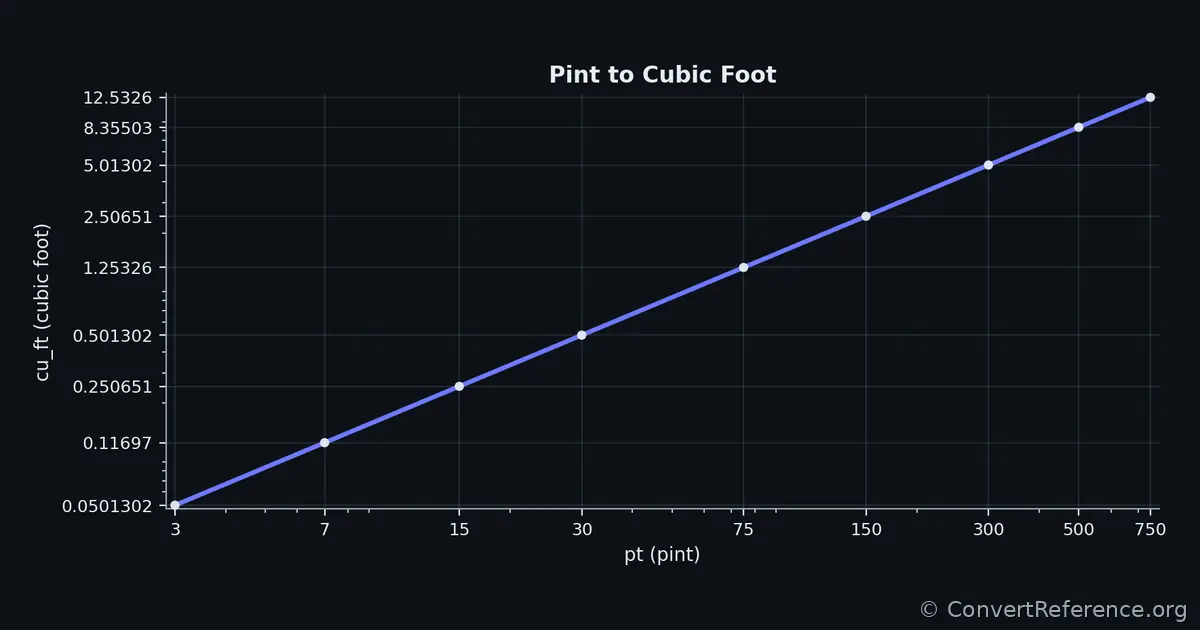
Pints And Cubic Feet Conversion Graph

Pints and Cubic feet Conversion Graph
Conversion graph showing the relationship between pints and cubic feet.

Conversion Table For Pint And Cubic Foot

Common conversion values
Pints Cubic feet
30.0501302
70.11697
150.250651
300.501302
751.25326
1502.50651
3005.01302
5008.35503
75012.5326

Values are rounded for display; internal calculations use the exact conversion factors between pint and cubic foot (0.0167100694444444 and 59.8441558441558).

Dataset & API Access

Programmatic Access

Free JSON API with stable endpoints and predictable keys for automated bidirectional conversions.

Endpoint: https://convertreference.org/api/v1/convert/pint-to-cubic-foot.json

Content Type: application/json

Documentation: View API docs

Licensing

License: CC0 1.0 Universal (Public Domain)

See all datasets

Data & Editorial Process

All numerical values and formulas are generated from the Pint scientific unit library (v0.25), using constants consistent with the BIPM SI Brochure (9th Edition) and NIST Special Publication 811. Explanatory text is drafted with AI assistance and reviewed by ConvertReference editors for clarity and accuracy. This converter is completely free to use, and all calculations are performed locally in your browser and never sent to a server.

  • 2025-12-07 – Generated: Page created using Pint v0.25 verified constants.
  • 2025-12-07 – Reviewed: Verified by ConvertReference editors; no numerical changes required.