ConvertReference.org

Meter to Inch and Inch to Meter Converter (m to in, in to m)

m

Review And Reference Information

Verified by the ConvertReference Technical Standards Team

ConvertReference Technical Standards Team

All values and formulas are validated through our editorial review process and cross-checked against internationally recognized reference standards (NIST, BIPM, CODATA).

View Editorial Standards & Report Corrections

Last reviewed: December 01, 2025

Conversion Factors

1 meter = 39.3700787401575 inch
1 inch = 0.0254 meter

(Exact factors: 39.3700787401575 and 0.0254)

Sources: NIST · BIPM

About This Meter And Inch Converter

This tool makes it easy to view measurements in meters and inches. Explore values in both directions with a simple interface designed for clarity. Use the swap button to switch between units anytime. Fast, simple, and reliable for everyday measuring tasks.

What Are Meters And Inches?

What Is A Meter?

Meter is the SI base unit of length. It is defined as the distance light travels in vacuum in 1/299,792,458 of a second. Symbol: m. System: SI (International System of Units). Real-world example: a standard soccer field is about 100 meters long.

What Is An Inch?

An inch (in, symbol: in or ″) is a unit of length in the Imperial and United States customary systems. It equals exactly 0.0254 meters and is 1/12 of a foot. Abbreviation: in or ″. Real-world example: a standard ruler is 12 inches long, about one foot.

When To Use Meter Vs Inch

Meter Usage

Meter is the base unit of length in the metric system and is used for most everyday measurements in many countries. It serves as the standard in science, education, and commerce. Primary examples include Germany, Japan, Brazil, and India.

Inch Usage

An inch is used in everyday measurement in the United States, the United Kingdom, Canada, and Australia. It is used alongside metric units for items such as screen sizes, furniture dimensions, and clothing measurements, reflecting customary measurement practices in these countries.

How To Convert Between Meters And Inches

Conversion Formulas

Meter to Inch:
meter × 39.3700787401575 = inch

Inch to Meter:
inch × 0.0254 = meter

Step-by-Step Guide

Meter to Inch

  1. Take your value in meters.
  2. Multiply by 39.3700787401575.
  3. The result is in inches.

Inch to Meter

  1. Take your value in inches.
  2. Multiply by 0.0254.
  3. The result is in meters.

Example: Convert 0.25 meters to inches.

  • Exact: 0.25 × 39.3700787401575 = 9.84251968503937 inches.
  • Rounded: approximately 9.84252 inches.

Example: Convert 5 inches to meters.

  • Exact: 5 × 0.0254 = 0.127 meters.

History & Context

Meter and inch tell different stories of science, trade, and authority. The meter was created in France during a time of reform to unify many local measures and was defined by a natural reference length and kept as a physical bar, then formalized and promoted through international agreements that spread its use. The inch grew from older English and related traditions, rooted in everyday objects and body parts, and travelled with ships and merchants as measurement standards spread across the English speaking world. Over time, both units show how societies moved from local practice to coordinated rules, linking crafts, science, and commerce through shared standards.

Practical Use

In a U.S. home renovation, a contractor reviewing metric blueprints may need to convert meters to inches to determine inventory like trim and fittings. For the reverse, when a designer orders a panel or mounting bracket specified in inches, they convert inches to meters to confirm it will fit in the intended metric space. The online converter page helps users switch between these units quickly during planning.

Common Mistakes When Converting Between Meters And Inches

  • Confusing meters with inches and applying the wrong unit in the calculation.
  • Assuming the same numeric value works for both directions without adjusting for the unit change.
  • Rounding or truncating results too early instead of keeping precision until the final step.
  • Using an unreliable source or method that does not clearly specify the units involved.

Mental Shortcuts For Quick Conversions

Tip 1 (meter to inch): 1 m ≈ 39 in; for quick estimates, use 40 in. Tip 2 (inch to meter): 1 in ≈ 0.025 m. Note: for estimation only; use a precise converter in most situations.

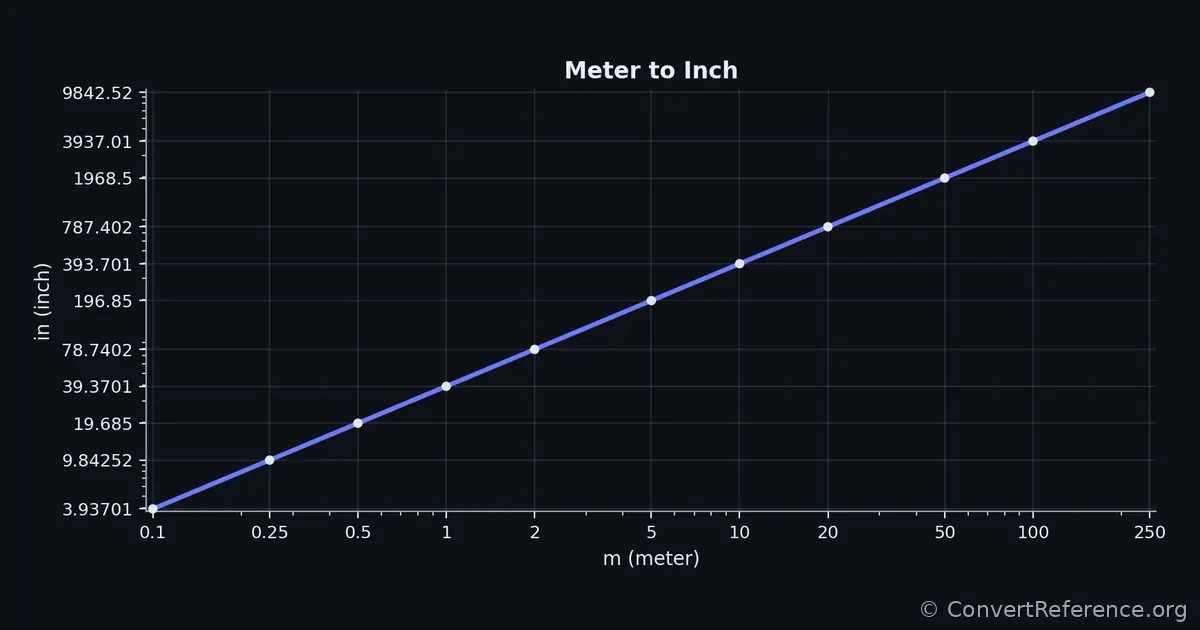
Meters And Inches Conversion Graph

Meters and Inches Conversion Graph
Conversion graph showing the relationship between meters and inches.

Conversion Table For Meters And Inches

Common conversion values
Meters Inches
0.13.93701
0.259.84252
0.519.685
139.3701
278.7402
5196.85
10393.701
20787.402
501968.5
1003937.01
2509842.52

Values are rounded for display; internal calculations use the exact conversion factors between meters and inches (39.3700787401575 and 0.0254).

Dataset & API Access

Programmatic Access

Free JSON API with stable endpoints and predictable keys for automated bidirectional conversions.

Endpoint: https://convertreference.org/api/v1/convert/meter-to-inch.json

Content Type: application/json

Documentation: View API docs

Licensing

License: CC0 1.0 Universal (Public Domain)

See all datasets

Data & Editorial Process

All numerical values and formulas are generated from the Pint scientific unit library (v0.25), using constants consistent with the BIPM SI Brochure (9th Edition) and NIST Special Publication 811. Explanatory text is drafted with AI assistance and reviewed by ConvertReference editors for clarity and accuracy. This converter is completely free to use, and all calculations are performed locally in your browser and never sent to a server.

  • 2025-12-01 – Generated: Page created using Pint v0.25 verified constants.
  • 2025-12-01 – Reviewed: Verified by ConvertReference editors; no numerical changes required.