ConvertReference.org

Millimeter to Inch and Inch to Millimeter Converter (mm to in, in to mm)

mm

Review And Reference Information

Verified by the ConvertReference Technical Standards Team

ConvertReference Technical Standards Team

All values and formulas are validated through our editorial review process and cross-checked against internationally recognized reference standards (NIST, BIPM, CODATA).

View Editorial Standards & Report Corrections

Last reviewed: December 01, 2025

Conversion Factors

1 millimeter = 0.0393700787401575 inch
1 inch = 25.4 millimeter

(Exact factors: 0.0393700787401575 and 25.4)

Sources: NIST · BIPM

About This Millimeter And Inch Converter

This handy online tool helps you work with millimeters and inches. Effortlessly explore measurements in your preferred unit. Use the swap button to switch between millimeters and inches. Get clear results right here, every time.

What Are Millimeters And Inches?

What Is A Millimeter?

Millimeter (mm) is a unit of length in the metric SI system, equal to 1/1000 of a meter (1e-3 m). It is a derived SI unit from the base meter. Symbol: mm. Example: the thickness of a credit card is about 0.76 mm.

What Is An Inch?

Inch (in) is a unit of length in the Imperial and US customary systems. It is defined as exactly 1/12 of a foot, or exactly 0.0254 meters. It belongs to the imperial/US customary system; symbol: in. Example: a standard paper clip is about 1 inch long.

When To Use Millimeter Vs Inch

Millimeter Usage

Millimeter is a standard metric unit of length used for everyday measurements and product dimensions in many countries. It is common across Europe and Asia, among other regions. Primary users include Germany, France, Japan, and India.

Inch Usage

An inch is a customary unit used in daily life in the United States, and in the United Kingdom, Canada, and Australia, for measuring objects and consumer products. It sits alongside metric units in many settings, reflecting historical usage.

How To Convert Between Millimeters And Inches

Conversion Formulas

Millimeter to Inch:
millimeter × 0.0393700787401575 = inch

Inch to Millimeter:
inch × 25.4 = millimeter

Step-by-Step Guide

Millimeter to Inch

  1. Take your value in millimeters.
  2. Multiply by 0.0393700787401575.
  3. The result is in inches.

Inch to Millimeter

  1. Take your value in inches.
  2. Multiply by 25.4.
  3. The result is in millimeters.

Example: Convert 10 millimeters to inches.

  • Exact: 10 × 0.0393700787401575 = 0.393700787401575 inches.
  • Rounded: approximately 0.393701 inches.

Example: Convert 5 inches to millimeters.

  • Exact: 5 × 25.4 = 127 millimeters.

History & Context

Historically, the inch came from England as a practical measure used by tradesmen and builders, growing from everyday references such as parts of a finger or thumb, and later standard rulers helped unify lengths across towns and markets. In contrast, the millimeter belongs to the metric family born in France, where reformers sought a universal way to describe lengths. The metric idea centered on a base unit for length and its smaller steps, making precise measurement easy for science, manufacturing, and education. As these paths spread, the inch remained common in some places, while millimeters became widespread in science and industry, reflecting different traditions of measurement shaping daily and technical work.

Practical Use

A carpenter measuring a metal rod with a metric ruler often needs to convert millimeters to inches to match a standard inch-sized component. That conversion helps ensure screws, fittings, or drill bits labeled in inches will fit the project correctly. When mounting a device with holes specified in inches, you must convert to millimeters to drill accurately. Similarly, a designer exporting a blueprint in inches may convert to millimeters to feed a metric 3D printer and maintain precise dimensions.

Common Mistakes When Converting Between Millimeters And Inches

  • Assuming millimeters and inches are the same unit.
  • Confusing the symbols for millimeters and inches.
  • Using the same method for both directions without considering which unit you start from.
  • Relying on rough mental estimates instead of checking the correct conversion relationship.

Mental Shortcuts For Quick Conversions

MM → inches: 25.4 mm ≈ 1 in; estimate by dividing millimeters by 25. Inch → MM: 1 in ≈ 25.4 mm; estimate by multiplying inches by 25. Note: for estimation only; use a precise converter in most situations.

Millimeters And Inches Conversion Graph
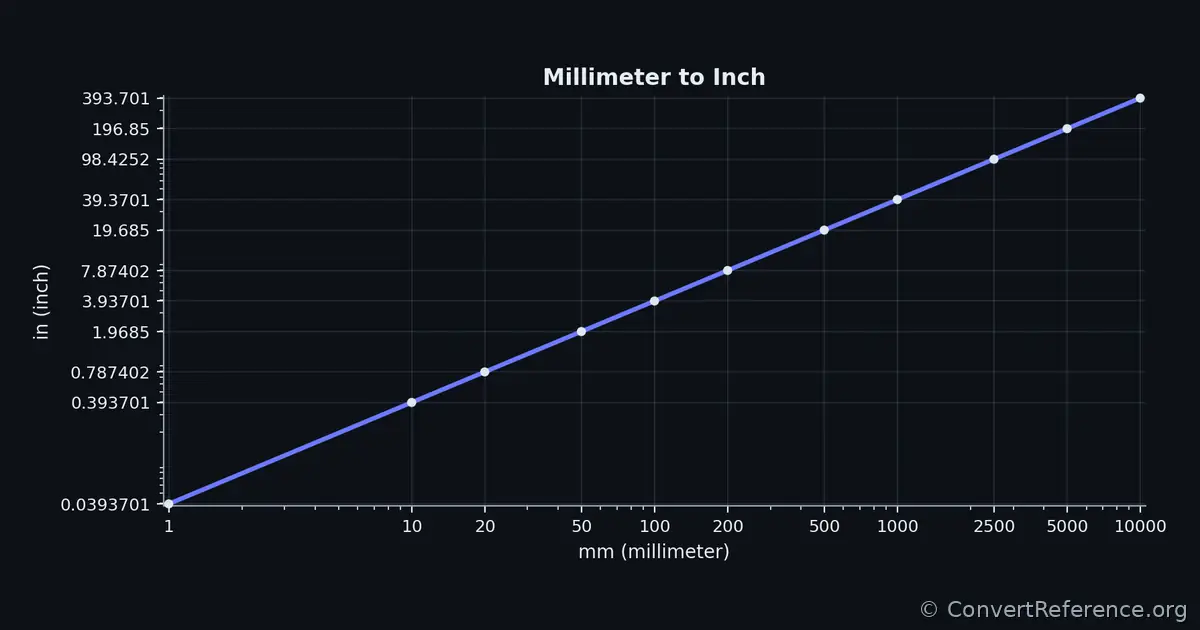
Millimeters and Inches Conversion Graph
Conversion graph showing the relationship between millimeters and inches.

Conversion Table For Millimeters And Inches

Common conversion values
Millimeters Inches
10.0393701
100.393701
200.787402
501.9685
1003.93701
2007.87402
50019.685
100039.3701
250098.4252
5000196.85
10000393.701

Values are rounded for display; internal calculations use the exact conversion factors between millimeters and inches (0.0393700787401575 and 25.4).

Dataset & API Access

Programmatic Access

Free JSON API with stable endpoints and predictable keys for automated bidirectional conversions.

Endpoint: https://convertreference.org/api/v1/convert/millimeter-to-inch.json

Content Type: application/json

Documentation: View API docs

Licensing

License: CC0 1.0 Universal (Public Domain)

See all datasets

Data & Editorial Process

All numerical values and formulas are generated from the Pint scientific unit library (v0.25), using constants consistent with the BIPM SI Brochure (9th Edition) and NIST Special Publication 811. Explanatory text is drafted with AI assistance and reviewed by ConvertReference editors for clarity and accuracy. This converter is completely free to use, and all calculations are performed locally in your browser and never sent to a server.

  • 2025-12-01 – Generated: Page created using Pint v0.25 verified constants.
  • 2025-12-01 – Reviewed: Verified by ConvertReference editors; no numerical changes required.