ConvertReference.org

Millimeter to Meter and Meter to Millimeter Converter (mm to m, m to mm)

mm

Review And Reference Information

Verified by the ConvertReference Technical Standards Team

ConvertReference Technical Standards Team

All values and formulas are validated through our editorial review process and cross-checked against internationally recognized reference standards (NIST, BIPM, CODATA).

View Editorial Standards & Report Corrections

Last reviewed: December 01, 2025

Conversion Factors

1 millimeter = 0.001 meter
1 meter = 1000 millimeter

(Exact factors: 0.001 and 1000)

Sources: NIST · BIPM

About This Millimeter And Meter Converter

Welcome to the quick and handy millimeter–meter converter. Switch between millimeters and meters with a single swap button. Compare values quickly and confidently as you switch units. Get fast, clear results every time you use this tool.

What Are Millimeters And Meters?

What Is A Millimeter?

Millimeter (mm) is a length unit in the metric system and the SI. It is defined as 1 mm = 0.001 meters (1/1000 of a meter). Symbol: mm. Real-world example: a credit card is about 0.76 mm thick.

What Is A Meter?

Meter (symbol m) is the SI base unit of length. It is defined as the distance light travels in vacuum in 1/299,792,458 of a second, tying length to the second. It belongs to the International System of Units (SI). Example: a standard doorway is about 2 meters tall, so a meter is about half that height.

When To Use Millimeter Vs Meter

Millimeter Usage

Meter Usage

Meters are the standard unit of length in many countries, including France, Germany, Japan, and Brazil. They appear in everyday measurement, education, and scientific work, and are part of the widely adopted metric system used globally.

How To Convert Between Millimeters And Meters

Conversion Formulas

Millimeter to Meter:
millimeter × 0.001 = meter

Meter to Millimeter:
meter × 1000 = millimeter

Step-by-Step Guide

Millimeter to Meter

  1. Take your value in millimeters.
  2. Multiply by 0.001.
  3. The result is in meters.

Meter to Millimeter

  1. Take your value in meters.
  2. Multiply by 1000.
  3. The result is in millimeters.

Example: Convert 70 millimeters to meters.

  • Exact: 70 × 0.001 = 0.07 meters.

Example: Convert 5 meters to millimeters.

  • Exact: 5 × 1000 = 5000 millimeters.

History & Context

Millimeter and meter grew from the same French idea to replace many local lengths with a single ruler. The meter was created in France during the rise of modern science as a standard defined by the length of a bar kept as a reference. As science progressed, the meter was fixed by nature using the speed of light, making it precise and stable beyond any physical object. The millimeter appeared as a scaled down unit of the meter, giving scientists and engineers a practical way to measure tiny things. The system spread worldwide through science, education, and trade, shaping everyday life and industry.

Practical Use

In manufacturing, a component's thickness is often specified in millimeters, so designers convert 2.4 mm to 0.0024 m to fit it into meter-based drawings. This mm-to-meter conversion helps ensure tolerances align with systems that use meters. When installing a fence, you might know the post length as 2.0 m and convert it to 2000 mm to plan for precise cuts. Being able to switch between millimeters and meters keeps measurements consistent across projects that use different metric units.

Common Mistakes When Converting Between Millimeters And Meters

  • Assuming millimeters and meters are the same size.
  • Trying to convert by simply adding millimeters to meters.
  • Believing milli means a larger unit than meter.
  • Ignoring the unit difference and keeping the numeric value unchanged when switching between millimeters and meters.

Mental Shortcuts For Quick Conversions

mm to m: Move the decimal three places to the left (1000 mm ≈ 1 m). For estimation only; use a precise converter for exact results. m to mm: Move the decimal three places to the right (1 m ≈ 1000 mm). For estimation only; use a precise converter for exact results.

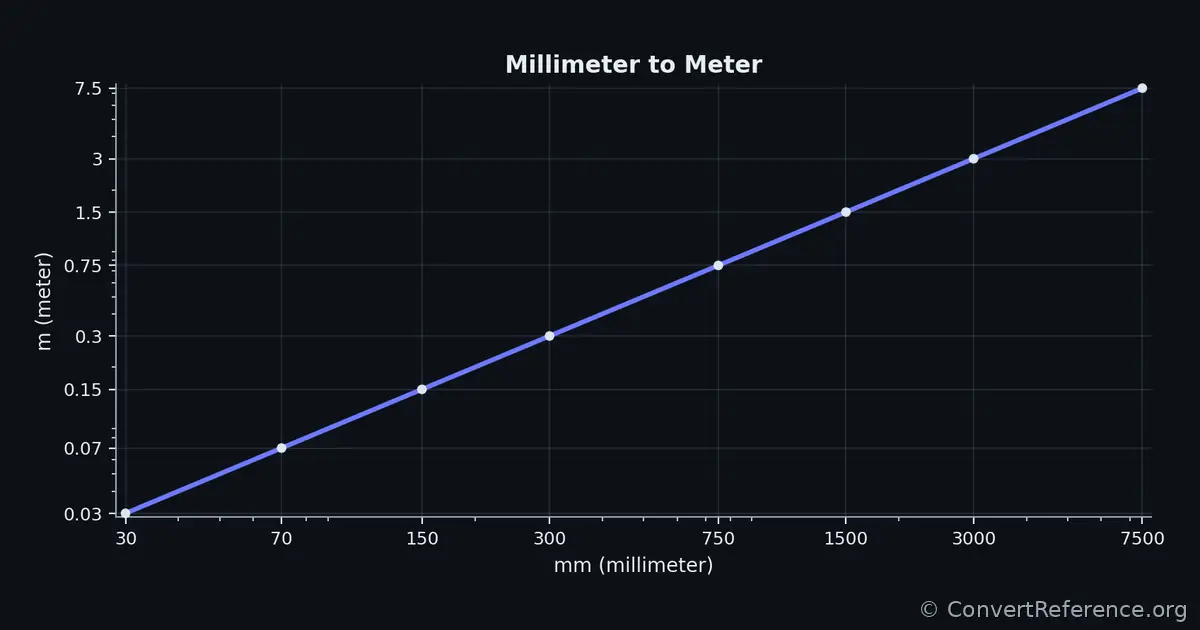
Millimeters And Meters Conversion Graph
Millimeters and Meters Conversion Graph
Conversion graph showing the relationship between millimeters and meters.

Conversion Table For Millimeters And Meters

Common conversion values
Millimeters Meters
300.03
700.07
1500.15
3000.3
7500.75
15001.5
30003
75007.5

Values are rounded for display; internal calculations use the exact conversion factors between millimeters and meters (0.001 and 1000).

Dataset & API Access

Programmatic Access

Free JSON API with stable endpoints and predictable keys for automated bidirectional conversions.

Endpoint: https://convertreference.org/api/v1/convert/millimeter-to-meter.json

Content Type: application/json

Documentation: View API docs

Licensing

License: CC0 1.0 Universal (Public Domain)

See all datasets

Data & Editorial Process

All numerical values and formulas are generated from the Pint scientific unit library (v0.25), using constants consistent with the BIPM SI Brochure (9th Edition) and NIST Special Publication 811. Explanatory text is drafted with AI assistance and reviewed by ConvertReference editors for clarity and accuracy. This converter is completely free to use, and all calculations are performed locally in your browser and never sent to a server.

  • 2025-12-01 – Generated: Page created using Pint v0.25 verified constants.
  • 2025-12-01 – Reviewed: Verified by ConvertReference editors; no numerical changes required.