ConvertReference.org

Micrometer to Meter and Meter to Micrometer Converter (µm to m, m to µm)

µm

Review And Reference Information

Verified by the ConvertReference Technical Standards Team

ConvertReference Technical Standards Team

All values and formulas are validated through our editorial review process and cross-checked against internationally recognized reference standards (NIST, BIPM, CODATA).

View Editorial Standards & Report Corrections

Last reviewed: December 01, 2025

Conversion Factors

1 micrometer = 0.000001 meter
1 meter = 1000000 micrometer

(Exact factors: 0.000001 and 1000000)

Sources: NIST · BIPM

About This Micrometer And Meter Converter

Welcome to the micrometer–meter converter, a quick and friendly tool for comparing small and large units. Enter your value in micrometers and view the result in meters. Users can click the swap button to change between units. The clean interface keeps things simple and focused.

What Are Micrometers And Meters?

What Is A Micrometer?

A micrometer (μm) is a unit of length in the metric/SI system. It equals one millionth of a meter (1 μm = 1×10^-6 m). The common abbreviation is μm. Real-world example: a red blood cell is about 6–8 μm in diameter.

What Is A Meter?

Meter: the base unit of length in the International System of Units (SI). It is defined as the distance light travels in vacuum in 1/299,792,458 of a second, so it is independent of other units. Symbol: m. Real-world example: a standard doorway is about 2 meters tall.

When To Use Micrometer Vs Meter

Micrometer Usage

The micrometer (micrometre) is a metric unit used to measure very small lengths with high precision. It is widely used in science and technology, and is standard in education and research in many countries, including the United States, United Kingdom, Canada, and Australia.

Meter Usage

Meters are the standard unit of length in the metric system and are used for everyday measurement in many countries, including Canada, the United Kingdom, Australia, and Japan.

How To Convert Between Micrometers And Meters

Conversion Formulas

Micrometer to Meter:
micrometer × 0.000001 = meter

Meter to Micrometer:
meter × 1000000 = micrometer

Step-by-Step Guide

Micrometer to Meter

  1. Take your value in micrometers.
  2. Multiply by 0.000001.
  3. The result is in meters.

Meter to Micrometer

  1. Take your value in meters.
  2. Multiply by 1000000.
  3. The result is in micrometers.

Example: Convert 0.5 micrometers to meters.

  • Exact: 0.5 × 0.000001 = 5e-7 meters.

Example: Convert 5 meters to micrometers.

  • Exact: 5 × 1000000 = 5000000 micrometers.
  • Rounded: approximately 5e+6 micrometers.

History & Context

The meter was created in France as a practical way to unite length for science and trade. A committee chose a real length and produced a metal bar to serve as the reference. This effort grew into the metric system, later adopted around the world, guiding maps, clocks, and factories. The idea tied measurement to universal standards rather than local tools. The micrometer appeared as a tool to measure small gaps with a fine screw and moving parts. It gave makers and scientists new accuracy, helping metalwork, watchmaking, and experiments.

Practical Use

One common situation is when a microscope stage movement specified in micrometers must be expressed in meters to feed an automation system, for example 2500 micrometers equals 0.0025 meters. That micrometer-to-meter conversion helps ensure tiny steps are handled correctly in a larger unit. A second situation is when a lithography tool's design feature length, given in meters, must be checked against tolerances reported in micrometers, so 0.01 meters becomes 10,000 micrometers.

Common Mistakes When Converting Between Micrometers And Meters

  • Treating micrometers and meters as the same unit.
  • Using the same value for micrometers and meters without adjusting the scale.
  • Forgetting that micrometers are smaller and misplacing the decimal during conversion.
  • Assuming the conversion direction does not matter and applying the same rule in both ways.

Mental Shortcuts For Quick Conversions

μm to m: Shift the decimal 6 places left (1 μm ≈ 0.000001 m). For estimation only; use a precise converter in most cases. m to μm: Shift the decimal 6 places right (1 m ≈ 1,000,000 μm). For estimation only; use a precise converter in most cases.

Micrometers And Meters Conversion Graph
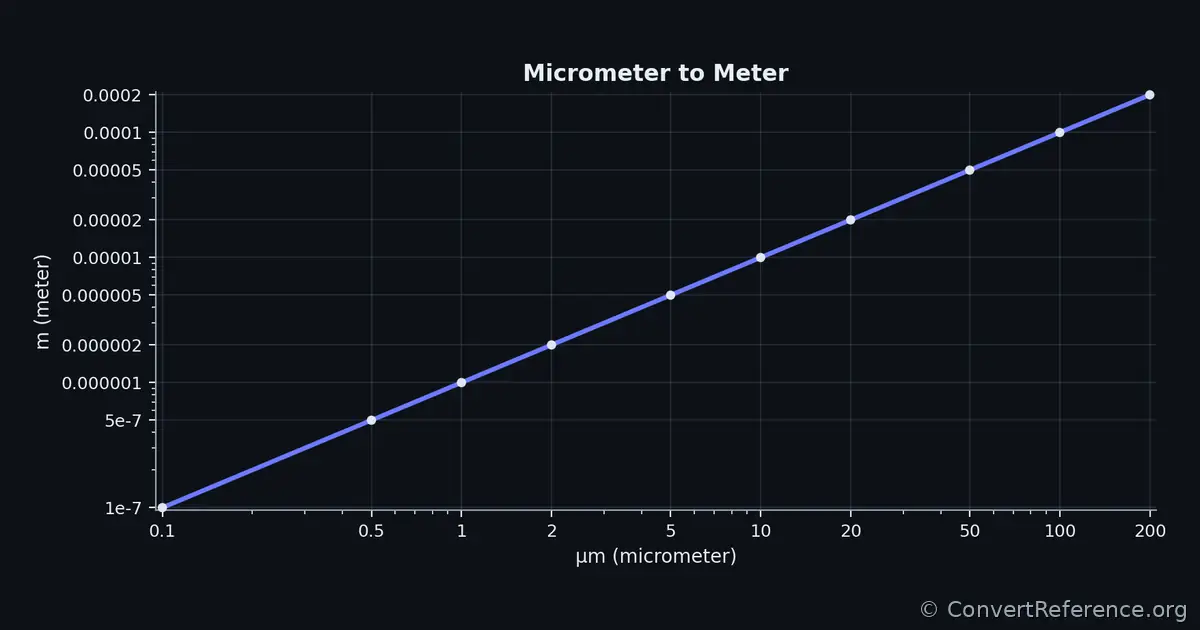
Micrometers and Meters Conversion Graph
Conversion graph showing the relationship between micrometers and meters.

Conversion Table For Micrometers And Meters

Common conversion values
Micrometers Meters
0.11e-7
0.55e-7
10.000001
20.000002
50.000005
100.00001
200.00002
500.00005
1000.0001
2000.0002

Values are rounded for display; internal calculations use the exact conversion factors between micrometers and meters (0.000001 and 1000000).

Dataset & API Access

Programmatic Access

Free JSON API with stable endpoints and predictable keys for automated bidirectional conversions.

Endpoint: https://convertreference.org/api/v1/convert/micrometer-to-meter.json

Content Type: application/json

Documentation: View API docs

Licensing

License: CC0 1.0 Universal (Public Domain)

See all datasets

Data & Editorial Process

All numerical values and formulas are generated from the Pint scientific unit library (v0.25), using constants consistent with the BIPM SI Brochure (9th Edition) and NIST Special Publication 811. Explanatory text is drafted with AI assistance and reviewed by ConvertReference editors for clarity and accuracy. This converter is completely free to use, and all calculations are performed locally in your browser and never sent to a server.

  • 2025-12-01 – Generated: Page created using Pint v0.25 verified constants.
  • 2025-12-01 – Reviewed: Verified by ConvertReference editors; no numerical changes required.