ConvertReference.org

Micrometer to Centimeter and Centimeter to Micrometer Converter (µm to cm, cm to µm)

µm

Review And Reference Information

Verified by the ConvertReference Technical Standards Team

ConvertReference Technical Standards Team

All values and formulas are validated through our editorial review process and cross-checked against internationally recognized reference standards (NIST, BIPM, CODATA).

View Editorial Standards & Report Corrections

Last reviewed: December 01, 2025

Conversion Factors

1 micrometer = 0.0001 centimeter
1 centimeter = 10000 micrometer

(Exact factors: 0.0001 and 10000)

Sources: NIST · BIPM

About This Micrometer And Centimeter Converter

This quick tool helps you compare measurements between micrometers and centimeters. The interface is clean and fast, designed for immediate results. Use the swap button to change between units whenever you need. Explore different values with confidence as the results appear right away.

What Are Micrometers And Centimeters?

What Is A Micrometer?

Micrometer (μm) is a length in the SI metric system equal to one millionth of a meter. 1 μm = 1×10^-6 meters (base unit: meter). Example: a typical human hair is about 70 μm in diameter.

What Is A Centimeter?

Centimeter (cm) is a unit of length in the metric system. It is a subdivision of the meter in the SI base-unit system: 1 cm = 0.01 m; 1 m = 100 cm. Symbol: cm. Real-world example: the width of a standard pencil eraser is about 1 cm.

When To Use Micrometer Vs Centimeter

Micrometer Usage

Micrometer (µm) is the SI unit for very small lengths used in science, education, and general technical measurement to describe microscopic features. It is used in the United States, United Kingdom, Germany, and Japan.

Centimeter Usage

Centimeter is part of the metric system and is used for everyday measurements in many countries. It is commonly used to measure height, objects' dimensions, and small lengths in households in Canada, Germany, Japan, and Australia.

How To Convert Between Micrometers And Centimeters

Conversion Formulas

Micrometer to Centimeter:
micrometer × 0.0001 = centimeter

Centimeter to Micrometer:
centimeter × 10000 = micrometer

Step-by-Step Guide

Micrometer to Centimeter

  1. Take your value in micrometers.
  2. Multiply by 0.0001.
  3. The result is in centimeters.

Centimeter to Micrometer

  1. Take your value in centimeters.
  2. Multiply by 10000.
  3. The result is in micrometers.

Example: Convert 20 micrometers to centimeters.

  • Exact: 20 × 0.0001 = 0.002 centimeters.

Example: Convert 5 centimeters to micrometers.

  • Exact: 5 × 10000 = 50000 micrometers.

History & Context

Micrometer and centimeter are units that grew with the rise of precision science and the metric idea. The centimeter appeared as a practical fraction of the meter when the metric plan spread, giving a convenient length for everyday use and science. The micrometer joined the family as people wanted finer scales for tools and measurements, especially in metalwork, craft, and labs. The word micrometer also names a small instrument that can measure tiny gaps with careful screw motion, while the centimeter became common on rulers and measuring tapes used wherever the metric system was adopted. Together these units show the move from many local measures to shared, reliable standards.

Practical Use

In a coating quality check, technicians might measure a film thickness in micrometers and need to compare it to a specification written in centimeters. In this case they convert micrometers to centimeters, using that 1 centimeter equals 10,000 micrometers, to report the thickness against the spec. For centimeter to micrometer, engineers fabricating tiny features on a microfluidic device receive tolerances in centimeters and must convert them to micrometers to set machine tools accurately. Performing both conversions helps keep measurements consistent across documentation and manufacturing steps.

Common Mistakes When Converting Between Micrometers And Centimeters

  • A common mistake is assuming a centimeter and a micrometer measure the same length.
  • A common mistake is converting in the wrong direction.
  • Another mistake is confusing micrometers with millimeters and using the wrong unit.
  • People sometimes neglect how the scale difference affects the result when switching between micrometers and centimeters.

Mental Shortcuts For Quick Conversions

μm to cm: move the decimal 4 places left (divide by 10,000). Estimation only; use a precise converter when needed. cm to μm: move the decimal 4 places right (multiply by 10,000). Estimation only; use a precise converter when needed.

Micrometers And Centimeters Conversion Graph
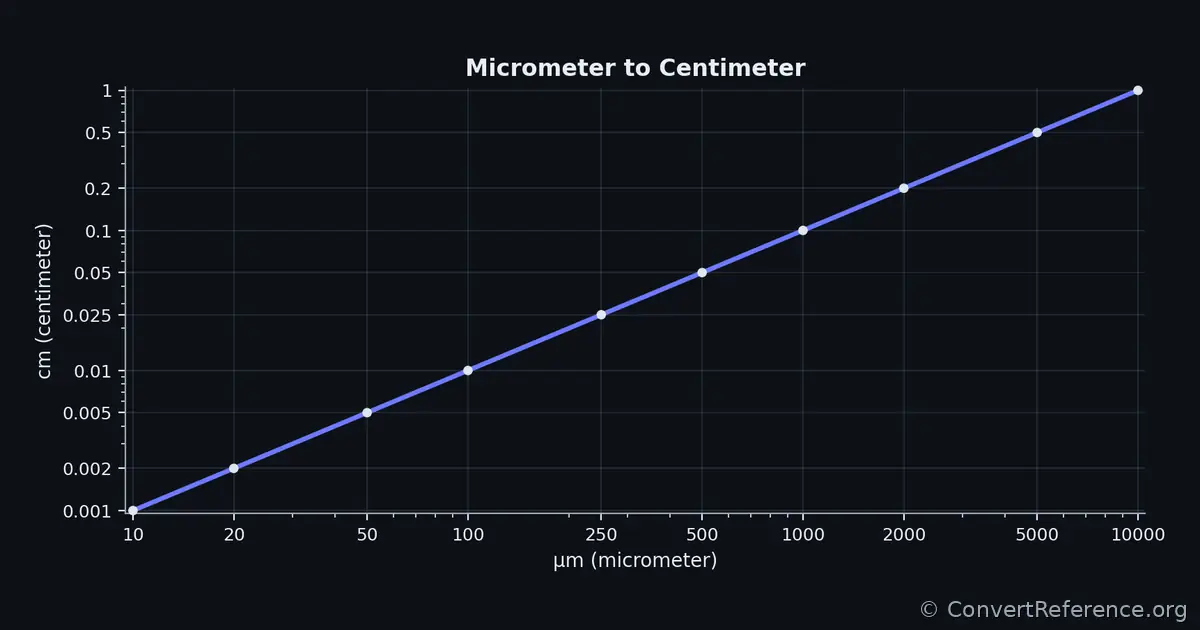
Micrometers and Centimeters Conversion Graph
Conversion graph showing the relationship between micrometers and centimeters.

Conversion Table For Micrometers And Centimeters

Common conversion values
Micrometers Centimeters
100.001
200.002
500.005
1000.01
2500.025
5000.05
10000.1
20000.2
50000.5
100001

Values are rounded for display; internal calculations use the exact conversion factors between micrometers and centimeters (0.0001 and 10000).

Dataset & API Access

Programmatic Access

Free JSON API with stable endpoints and predictable keys for automated bidirectional conversions.

Endpoint: https://convertreference.org/api/v1/convert/micrometer-to-centimeter.json

Content Type: application/json

Documentation: View API docs

Licensing

License: CC0 1.0 Universal (Public Domain)

See all datasets

Data & Editorial Process

All numerical values and formulas are generated from the Pint scientific unit library (v0.25), using constants consistent with the BIPM SI Brochure (9th Edition) and NIST Special Publication 811. Explanatory text is drafted with AI assistance and reviewed by ConvertReference editors for clarity and accuracy. This converter is completely free to use, and all calculations are performed locally in your browser and never sent to a server.

  • 2025-12-01 – Generated: Page created using Pint v0.25 verified constants.
  • 2025-12-01 – Reviewed: Verified by ConvertReference editors; no numerical changes required.