ConvertReference.org

Millimeter to Kilometer and Kilometer to Millimeter Converter (mm to km, km to mm)

mm

Review And Reference Information

Verified by the ConvertReference Technical Standards Team

ConvertReference Technical Standards Team

All values and formulas are validated through our editorial review process and cross-checked against internationally recognized reference standards (NIST, BIPM, CODATA).

View Editorial Standards & Report Corrections

Last reviewed: December 01, 2025

Conversion Factors

1 millimeter = 0.000001 kilometer
1 kilometer = 1000000 millimeter

(Exact factors: 0.000001 and 1000000)

Sources: NIST · BIPM

About This Millimeter And Kilometer Converter

Welcome to our quick unit converter for millimeters and kilometers. Work with millimeters and kilometers in a clean, easy-to-use interface. If you need a different pairing, you can click the swap button to switch between units. Get your result instantly and continue with your work.

What Are Millimeters And Kilometers?

What Is A Millimeter?

Millimeter (mm) is a unit of length in the metric (SI) system. It equals one-thousandth of a meter (1 mm = 0.001 m). Symbol: mm. Real-world example: a standard credit card is about 0.76 mm thick.

What Is A Kilometer?

Kilometer (km) is a unit of length in the metric system, equal to 1,000 meters (1 km = 1000 m). It is a derived SI unit. Symbol: km. Real-world example: a city block is about 0.1 km; a typical short bike ride may be around 5 km.

When To Use Millimeter Vs Kilometer

Millimeter Usage

Millimeter is a metric unit used for precise length in science, medicine, manufacturing, and consumer products. It is standard in metric-using countries for everyday measurements, product specifications, and technical data. Primary users include Canada, United Kingdom, Germany, and Japan.

Kilometer Usage

The kilometer is used as the standard unit for measuring road distances and everyday lengths in many countries, including France, Germany, Japan, and Canada.

How To Convert Between Millimeters And Kilometers

Conversion Formulas

Millimeter to Kilometer:
millimeter × 0.000001 = kilometer

Kilometer to Millimeter:
kilometer × 1000000 = millimeter

Step-by-Step Guide

Millimeter to Kilometer

  1. Take your value in millimeters.
  2. Multiply by 0.000001.
  3. The result is in kilometers.

Kilometer to Millimeter

  1. Take your value in kilometers.
  2. Multiply by 1000000.
  3. The result is in millimeters.

Example: Convert 50 millimeters to kilometers.

  • Exact: 50 × 0.000001 = 0.00005 kilometers.

Example: Convert 5 kilometers to millimeters.

  • Exact: 5 × 1000000 = 5000000 millimeters.
  • Rounded: approximately 5e+6 millimeters.

History & Context

Millimeter and kilometer trace their origins to the creation of the metric system in Europe, where a basic unit of length called the meter was chosen to standardize measurements. The system uses simple names that describe size without guessing at value, so the millimeter marks a tiny part of the meter and the kilometer a large multiple. Over the years scientists, engineers, and educators promoted the idea, and many countries adopted it for science, industry, and daily life. The result is a shared language of length used worldwide in maps, design, and trade.

Practical Use

On a road construction plan, a trench is drawn as 2,500,000 millimeters, which converts to 2.5 kilometers in real life, helping planners gauge the overall length. In another scenario, a long highway span is recorded as several kilometers, and engineers convert that distance into millimeters, such as 4 kilometers equaling 4,000,000 millimeters, for precise manufacturing or simulation inputs. This keeps project communication clear whether the team discusses small scale plans or large scale distances. The rule of thumb is to translate between millimeters and kilometers depending on whether fine detail or long distance context is needed.

Common Mistakes When Converting Between Millimeters And Kilometers

  • People treat millimeters and kilometers as the same size.
  • They assume you should always multiply when converting to a larger unit instead of dividing.
  • They think the numeric value increases when converting to a larger unit.
  • They try to add zeros to the value instead of changing the unit.

Mental Shortcuts For Quick Conversions

MM to KM: 1 km = 1,000,000 mm; move the decimal 6 places left (estimation only). KM to MM: move the decimal 6 places right (multiply by 1,000,000) (estimation only).

Millimeters And Kilometers Conversion Graph
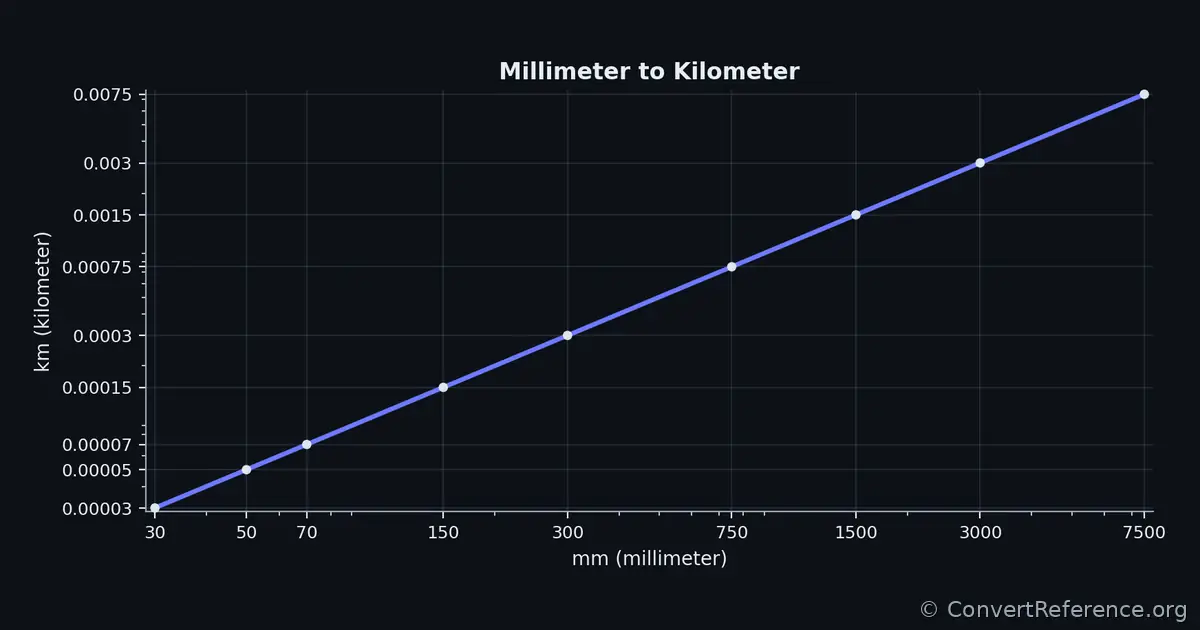
Millimeters and Kilometers Conversion Graph
Conversion graph showing the relationship between millimeters and kilometers.

Conversion Table For Millimeters And Kilometers

Common conversion values
Millimeters Kilometers
300.00003
500.00005
700.00007
1500.00015
3000.0003
7500.00075
15000.0015
30000.003
75000.0075

Values are rounded for display; internal calculations use the exact conversion factors between millimeters and kilometers (0.000001 and 1000000).

Dataset & API Access

Programmatic Access

Free JSON API with stable endpoints and predictable keys for automated bidirectional conversions.

Endpoint: https://convertreference.org/api/v1/convert/millimeter-to-kilometer.json

Content Type: application/json

Documentation: View API docs

Licensing

License: CC0 1.0 Universal (Public Domain)

See all datasets

Data & Editorial Process

All numerical values and formulas are generated from the Pint scientific unit library (v0.25), using constants consistent with the BIPM SI Brochure (9th Edition) and NIST Special Publication 811. Explanatory text is drafted with AI assistance and reviewed by ConvertReference editors for clarity and accuracy. This converter is completely free to use, and all calculations are performed locally in your browser and never sent to a server.

  • 2025-12-01 – Generated: Page created using Pint v0.25 verified constants.
  • 2025-12-01 – Reviewed: Verified by ConvertReference editors; no numerical changes required.