ConvertReference.org

Millimeter to Yard and Yard to Millimeter Converter (mm to yd, yd to mm)

mm

Review And Reference Information

Verified by the ConvertReference Technical Standards Team

ConvertReference Technical Standards Team

All values and formulas are validated through our editorial review process and cross-checked against internationally recognized reference standards (NIST, BIPM, CODATA).

View Editorial Standards & Report Corrections

Last reviewed: December 01, 2025

Conversion Factors

1 millimeter = 0.00109361329833771 yard
1 yard = 914.4 millimeter

(Exact factors: 0.00109361329833771 and 914.4)

Sources: NIST · BIPM

About This Millimeter And Yard Converter

This fast tool helps you work with millimeters and yards. Enter a value in millimeters to view the result in yards. Tap the swap button to switch between units. It's simple, clear, and ready whenever you need a quick measurement check.

What Are Millimeters And Yards?

What Is A Millimeter?

Millimeter (mm) is a metric unit of length in the SI system. It is defined as one thousandth of a meter: 1 mm = 0.001 m (and 1 m = 1000 mm). The meter is the base unit of length in SI. Common symbol: mm. Real-world example: a credit card is about 0.76 mm thick.

What Is A Yard?

Yard (yd) is a unit of length in the US customary and British imperial systems. It equals 3 feet or 36 inches, and is defined as exactly 0.9144 meters. The symbol is yd. It is defined by the metre: 1 yd = 0.9144 m. Real-world example: a standard yardstick in classrooms is 1 yard long (36 inches).

When To Use Millimeter Vs Yard

Millimeter Usage

Millimeters are the standard metric unit for short lengths and are used in most metric-using countries for everyday measurements and product dimensions. Common examples include Canada, Germany, Japan, and Australia.

Yard Usage

Yards are used as a customary unit of length in the United States, the United Kingdom, Canada, and Liberia.

How To Convert Between Millimeters And Yards

Conversion Formulas

Millimeter to Yard:
millimeter × 0.00109361329833771 = yard

Yard to Millimeter:
yard × 914.4 = millimeter

Step-by-Step Guide

Millimeter to Yard

  1. Take your value in millimeters.
  2. Multiply by 0.00109361329833771.
  3. The result is in yards.

Yard to Millimeter

  1. Take your value in yards.
  2. Multiply by 914.4.
  3. The result is in millimeters.

Example: Convert 70 millimeters to yards.

  • Exact: 70 × 0.00109361329833771 = 0.0765529308836396 yards.
  • Rounded: approximately 0.0765529 yards.

Example: Convert 5 yards to millimeters.

  • Exact: 5 × 914.4 = 4572 millimeters.

History & Context

Millimeter and yard have rich histories when societies sought reliable ways to measure length. The millimeter grew from the metric system born in France during a time of reform, where lengths were divided in decimal steps and a meter was chosen as a universal unit for science and trade. The idea spread with scientific expeditions, international trade, and standard education, helping manufacturers make compatible parts and plans across lands. The yard comes from early English use, tied to stable standards kept in royal and city authorities, with the aim of common length for land, construction, and commerce. Over centuries, rulers and lawmakers formalized a yard as a defined measure in law, fueling global connections through the later imperial system and its spread. Both units reflect a long

Practical Use

In interior decorating, someone may measure trim or tile spacing in millimeters and convert to yards to order fabric or wallpaper sold by the yard. For instance, a border tile of 250 mm converts to about 0.274 yards. On a separate task, a carpet installer could measure the room length in yards and convert to millimeters to get precise cut lengths for manufacturing, such as 5 yards equaling 4572 millimeters.

Common Mistakes When Converting Between Millimeters And Yards

  • Assuming millimeters and yards are the same size and can be used interchangeably.
  • Converting in the wrong direction by treating the larger unit as if it were the smaller one.
  • Assuming metric and imperial units are directly interchangeable without performing any conversion.
  • Rounding too early in the process leads to imprecise results.

Mental Shortcuts For Quick Conversions

MM→yd: 1 yd ≈ 914 mm; quick estimate: 900 mm ≈ 1 yd (mm ÷ 900 ≈ yd). Estimation only; for precise results, use a calculator or converter. yd→mm: 1 yd ≈ 914 mm; quick estimate: yd × 900 ≈ mm. Estimation only; for precise results, use a calculator or converter.

Millimeters And Yards Conversion Graph
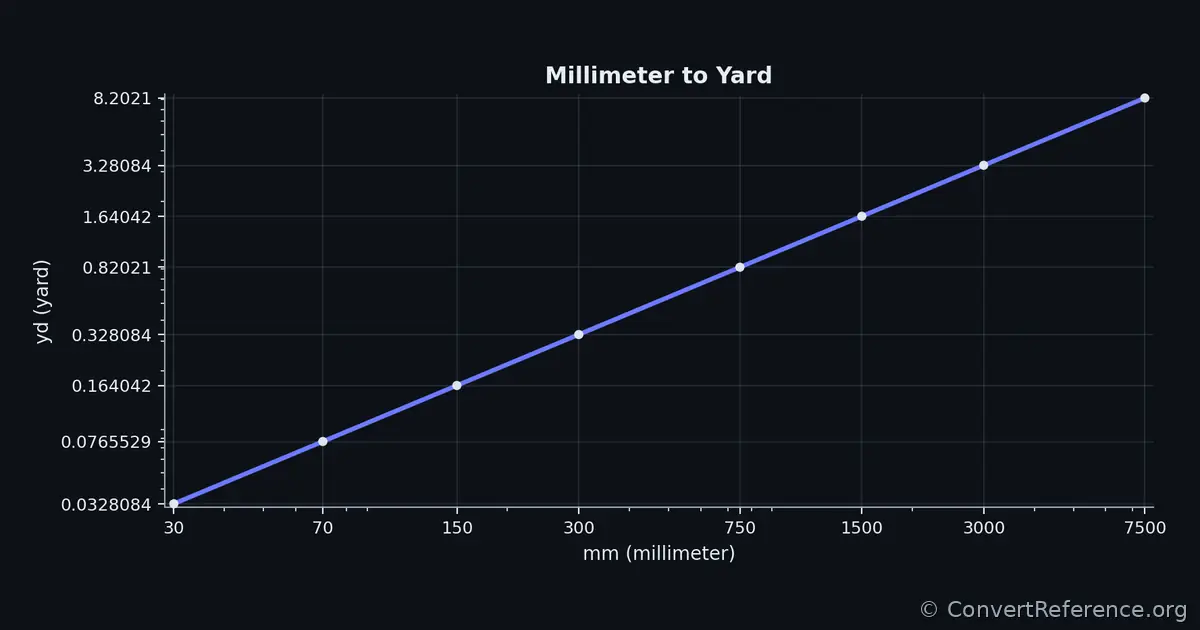
Millimeters and Yards Conversion Graph
Conversion graph showing the relationship between millimeters and yards.

Conversion Table For Millimeters And Yards

Common conversion values
Millimeters Yards
300.0328084
700.0765529
1500.164042
3000.328084
7500.82021
15001.64042
30003.28084
75008.2021

Values are rounded for display; internal calculations use the exact conversion factors between millimeters and yards (0.00109361329833771 and 914.4).

Dataset & API Access

Programmatic Access

Free JSON API with stable endpoints and predictable keys for automated bidirectional conversions.

Endpoint: https://convertreference.org/api/v1/convert/millimeter-to-yard.json

Content Type: application/json

Documentation: View API docs

Licensing

License: CC0 1.0 Universal (Public Domain)

See all datasets

Data & Editorial Process

All numerical values and formulas are generated from the Pint scientific unit library (v0.25), using constants consistent with the BIPM SI Brochure (9th Edition) and NIST Special Publication 811. Explanatory text is drafted with AI assistance and reviewed by ConvertReference editors for clarity and accuracy. This converter is completely free to use, and all calculations are performed locally in your browser and never sent to a server.

  • 2025-12-01 – Generated: Page created using Pint v0.25 verified constants.
  • 2025-12-01 – Reviewed: Verified by ConvertReference editors; no numerical changes required.