ConvertReference.org

Kilogram To Long Ton Converter

kg

Review And Reference Information

Verified by the ConvertReference Technical Standards Team

ConvertReference Technical Standards Team

All values and formulas are validated through our editorial review process and cross-checked against internationally recognized reference standards (NIST, BIPM, CODATA).

View Editorial Standards & Report Corrections

Last reviewed: December 07, 2025

Conversion Factors

1 kilogram = 0.000984206527611061 long ton
1 long ton = 1016.0469088 kilogram

(Exact factors: 0.000984206527611061 and 1016.0469088)

Sources: NIST · BIPM

About This Kilogram And Long Ton Converter

This tool lets you explore quantities in kilograms and long tons with ease. See results clearly as you work between the two units. Use the swap button to switch between kilograms and long tons. It's fast, simple, and designed to help you compare values at a glance.

What Are Kilograms And Long Tons?

What Is A Kilogram?

Kilogram (kg) is the SI base unit of mass. It belongs to the SI system. It is defined by fixing the Planck constant h to exactly 6.62607015×10^-34 J·s; the kilogram is not defined in terms of another base unit. Example: a liter of water at room temperature has a mass of about 1 kilogram.

What Is A Long Ton?

A long ton is a mass unit used in the British Imperial system. It equals 2,240 pounds avoirdupois, or exactly 1,016.0469088 kilograms (1 LT = 2,240 × 0.45359237 kg). Abbreviation: LT (or long ton). Real-world example: a typical compact car weighs about 1 long ton.

When To Use Kilogram Vs Long Ton

Kilogram Usage

The kilogram is the SI base unit of mass used worldwide in science, education, and commerce, and for everyday measurements. It is the standard mass unit in most countries. Primary users include Germany, France, Japan, and Australia.

Long Ton Usage

Long ton is a legacy unit still used in the United Kingdom and Ireland. It appears in historical documents and in contexts where Imperial measurements persist, but modern practice is largely metric.

How To Convert Between Kilograms And Long Tons

Conversion Formulas

Kilogram to Long Ton:
kilogram × 0.000984206527611061 = long ton

Long Ton to Kilogram:
long ton × 1016.0469088 = kilogram

Step-by-Step Guide

Kilogram to Long Ton

  1. Take your value in kilograms.
  2. Multiply by 0.000984206527611061.
  3. The result is in long tons.

Long Ton to Kilogram

  1. Take your value in long tons.
  2. Multiply by 1016.0469088.
  3. The result is in kilograms.

Example: Convert 0.005 kilograms to long tons.

  • Exact: 0.005 × 0.000984206527611061 = 0.0000049210326380553 long tons.
  • Rounded: approximately 0.00000492103 long tons.

Example: Convert 5 long tons to kilograms.

  • Exact: 5 × 1016.0469088 = 5080.234544 kilograms.
  • Rounded: approximately 5080.23 kilograms.

History & Context

During the French Revolution, France created a new measurement system and chose the kilogram as the basic unit of mass. The kilogram was defined by a physical object, a carefully made metal cylinder kept as the standard, with copies kept at science institutes to share the same mass. The move spread across science and trade, and the metric system, with the kilogram at its heart, guided many countries toward standard weighing. In Britain, a rival system used a large unit called the long ton for heavy goods like coal and ships, reflecting local needs and rules. These histories show how different places shaped how people measure weight and how today those ideas help connect measurements around the world.

Practical Use

On a global freight page, a buyer might need to convert kilograms to long tons to compare a shipment's weight with carriers that quote limits in long tons, for example turning 12,000 kg into about 11.0 long tons. In warehouse planning, staff may also convert long tons to kilograms to determine payloads for pallets and containers that are specified in metric mass. This helpful conversion supports safety checks, tariff calculations, and seamless switching between metric and imperial units when using the online converter.

Common Mistakes When Converting Between Kilograms And Long Tons

  • Confusing the long ton with the metric ton and using the wrong unit for the result.
  • Mistaking the long ton for the short ton and applying the wrong reference unit.
  • Using a conversion method that assumes pounds are the base instead of correctly relating kilograms to long tons.
  • Rounding or approximating the result without preserving the intended precision or unit context.

Mental Shortcuts For Quick Conversions

Kg to long ton: 1 kg ≈ 0.000984 long tons (about 0.001). Long ton to kg: 1 long ton ≈ 1016 kg (about 1000 kg). Note: for estimation only; use a precise converter for most situations.

Kilograms And Long Tons Conversion Graph
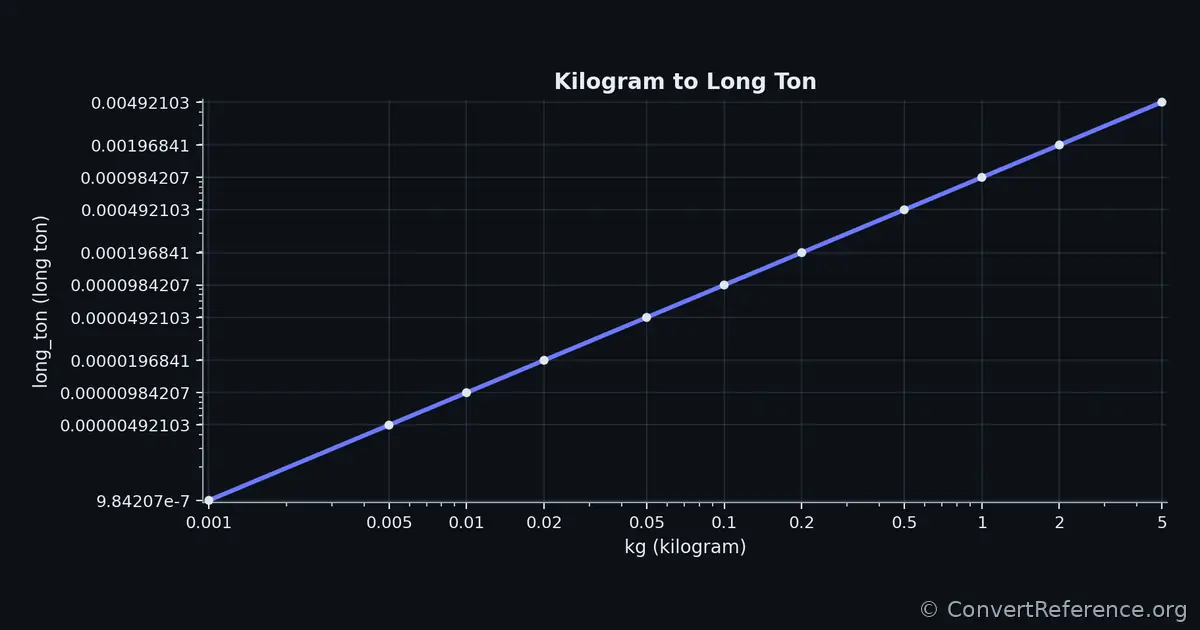
Kilograms and Long tons Conversion Graph
Conversion graph showing the relationship between kilograms and long tons.

Conversion Table For Kilogram And Long Ton

Common conversion values
Kilograms Long tons
0.0019.84207e-7
0.0050.00000492103
0.010.00000984207
0.020.0000196841
0.050.0000492103
0.10.0000984207
0.20.000196841
0.50.000492103
10.000984207
20.00196841
50.00492103

Values are rounded for display; internal calculations use the exact conversion factors between kilogram and long ton (0.000984206527611061 and 1016.0469088).

Dataset & API Access

Programmatic Access

Free JSON API with stable endpoints and predictable keys for automated bidirectional conversions.

Endpoint: https://convertreference.org/api/v1/convert/kilogram-to-long-ton.json

Content Type: application/json

Documentation: View API docs

Licensing

License: CC0 1.0 Universal (Public Domain)

See all datasets

Data & Editorial Process

All numerical values and formulas are generated from the Pint scientific unit library (v0.25), using constants consistent with the BIPM SI Brochure (9th Edition) and NIST Special Publication 811. Explanatory text is drafted with AI assistance and reviewed by ConvertReference editors for clarity and accuracy. This converter is completely free to use, and all calculations are performed locally in your browser and never sent to a server.

  • 2025-12-07 – Generated: Page created using Pint v0.25 verified constants.
  • 2025-12-07 – Reviewed: Verified by ConvertReference editors; no numerical changes required.