ConvertReference.org

Metric Ton To Pound Converter

t

Review And Reference Information

Verified by the ConvertReference Technical Standards Team

ConvertReference Technical Standards Team

All values and formulas are validated through our editorial review process and cross-checked against internationally recognized reference standards (NIST, BIPM, CODATA).

View Editorial Standards & Report Corrections

Last reviewed: December 07, 2025

Conversion Factors

1 metric ton = 2204.62262184878 pound
1 pound = 0.00045359237 metric ton

(Exact factors: 2204.62262184878 and 0.00045359237)

Sources: NIST · BIPM

About This Metric Ton And Pound Converter

Convert metric tons to pounds quickly with this handy tool. Enter your value in metric tons and see the result in pounds at a glance. You can click the swap button to change between units. Designed for clarity and speed, it helps you compare measurements with confidence.

What Are Metric Tons And Pounds?

What Is A Metric Ton?

A metric ton (tonne), symbol t, is a unit of mass in the metric system. It equals 1,000 kilograms (kg); the kilogram is the SI base unit, so a tonne is not a base unit. Therefore 1 t = 1,000 kg. It belongs to the SI metric system. Real-world example: a small passenger car weighs about 1 tonne.

What Is A Pound?

Pound (lb) is a unit of mass in the avoirdupois system, used in US customary and British imperial units. It is defined exactly as 0.45359237 kilograms. Symbol: lb. 1 lb = 16 oz. Example: a loaf of bread weighs about 1 lb.

When To Use Metric Ton Vs Pound

Metric Ton Usage

Metric ton (tonne) is the standard mass unit in the metric system and is used in many countries, including Germany, India, Canada, and Australia, for trade, statistics, and everyday measurement.

Pound Usage

The pound (lb) is used as a mass unit in several countries, notably the United States and the United Kingdom for everyday weights, and in Ireland and Canada in non-metric contexts.

How To Convert Between Metric Tons And Pounds

Conversion Formulas

Metric Ton to Pound:
metric ton × 2204.62262184878 = pound

Pound to Metric Ton:
pound × 0.00045359237 = metric ton

Step-by-Step Guide

Metric Ton to Pound

  1. Take your value in metric tons.
  2. Multiply by 2204.62262184878.
  3. The result is in pounds.

Pound to Metric Ton

  1. Take your value in pounds.
  2. Multiply by 0.00045359237.
  3. The result is in metric tons.

Example: Convert 1 metric tons to pounds.

  • Exact: 1 × 2204.62262184878 = 2204.62262184878 pounds.
  • Rounded: approximately 2204.62 pounds.

Example: Convert 5 pounds to metric tons.

  • Exact: 5 × 0.00045359237 = 0.00226796185 metric tons.
  • Rounded: approximately 0.00226796 metric tons.

History & Context

Mass measures have long evolved from local habits to named units. The metric system grew in France as a simple, universal system for science and trade, and the metric ton was created to fit beside smaller units like the gram and the liter, giving industry a clear, steady way to count big quantities. The name tonne comes from French roots and the system spread with international science and commerce. The pound has older roots in England, tied to everyday weights used by merchants and craftsmen. It traveled with ships and empire, later being stabilized into standardized forms in the growing British and American worlds. These paths show how units shape and reflect trade, science, and daily life.

Practical Use

International freight planners often need to convert metric tons to pounds to estimate shipping costs and label cargo in pounds for carriers. For a U.S. facility receiving overseas shipments, weight may be tracked in pounds but reported in metric tons for regulatory reporting. Conversely, when a global supplier quotes materials in pounds for the American market, buyers may convert those pounds back to metric tons to compare with metric-ton price quotes. These conversions help keep budgeting, procurement, and compliance consistent across international operations.

Common Mistakes When Converting Between Metric Tons And Pounds

  • Confusing metric ton with a short ton and using the wrong baseline for the conversion.
  • Treating pounds and kilograms as interchangeable without performing the correct unit conversion.
  • Applying the same factor in both directions without adjusting for whether you are converting to pounds or from pounds.
  • Rounding results too early, which masks the true relationship between the units.

Mental Shortcuts For Quick Conversions

Metric ton → pounds: multiply by about 2,200 (1 t ≈ 2,204.6 lb). Pound → metric ton: divide by about 2,200 (1 lb ≈ 0.00045 t). Note: for estimation only; use a precise converter for accuracy.

Metric Tons And Pounds Conversion Graph
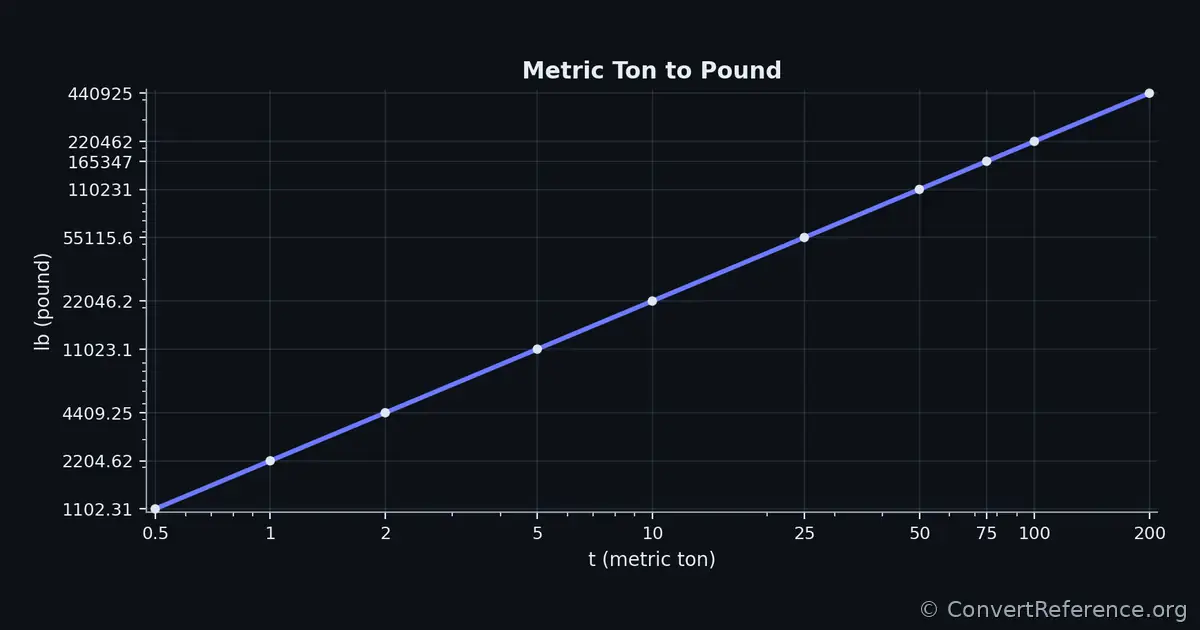
Metric tons and Pounds Conversion Graph
Conversion graph showing the relationship between metric tons and pounds.

Conversion Table For Metric Ton And Pound

Common conversion values
Metric tons Pounds
0.51102.31
12204.62
24409.25
511023.1
1022046.2
2555115.6
50110231
75165347
100220462
200440925

Values are rounded for display; internal calculations use the exact conversion factors between metric ton and pound (2204.62262184878 and 0.00045359237).

Dataset & API Access

Programmatic Access

Free JSON API with stable endpoints and predictable keys for automated bidirectional conversions.

Endpoint: https://convertreference.org/api/v1/convert/metric-ton-to-pound.json

Content Type: application/json

Documentation: View API docs

Licensing

License: CC0 1.0 Universal (Public Domain)

See all datasets

Data & Editorial Process

All numerical values and formulas are generated from the Pint scientific unit library (v0.25), using constants consistent with the BIPM SI Brochure (9th Edition) and NIST Special Publication 811. Explanatory text is drafted with AI assistance and reviewed by ConvertReference editors for clarity and accuracy. This converter is completely free to use, and all calculations are performed locally in your browser and never sent to a server.

  • 2025-12-07 – Generated: Page created using Pint v0.25 verified constants.
  • 2025-12-07 – Reviewed: Verified by ConvertReference editors; no numerical changes required.