ConvertReference.org

Milligram To Metric Ton Converter

mg

Review And Reference Information

Verified by the ConvertReference Technical Standards Team

ConvertReference Technical Standards Team

All values and formulas are validated through our editorial review process and cross-checked against internationally recognized reference standards (NIST, BIPM, CODATA).

View Editorial Standards & Report Corrections

Last reviewed: December 07, 2025

Conversion Factors

1 milligram = 1e-9 metric ton
1 metric ton = 1000000000 milligram

(Exact factors: 1e-9 and 1000000000)

Sources: NIST · BIPM

About This Milligram And Metric Ton Converter

Welcome to the simple milligram to metric ton converter, designed for quick checks. Use the swap button to switch between units and compare values in either direction. This tool provides fast, clear results without unnecessary fuss. It's built for accuracy and ease of use in everyday measurement tasks.

What Are Milligrams And Metric Tons?

What Is A Milligram?

Milligram (mg) is a mass unit in the SI system. It equals one thousandth of a gram: 1 mg = 0.001 g. Since 1 g = 0.001 kg, 1 mg = 0.000001 kg (1e-6 kg). Symbol: mg. It is a subunit of the gram in the metric system. Real-world example: a standard aspirin tablet is about 325 mg.

What Is A Metric Ton?

Metric ton (tonne) is the mass unit equal to exactly 1,000 kilograms. It belongs to the metric (SI) system. Symbol: t. Exact relation: 1 t = 1,000 kg (1,000,000 g). Real-world example: a typical passenger car weighs about 1 tonne.

When To Use Milligram Vs Metric Ton

Milligram Usage

Milligram measures small masses in medicine, nutrition labeling, pharmacology, and science. It is widely used in the United States, United Kingdom, India, and Japan as a standard metric unit.

Metric Ton Usage

Metric ton (tonne) is used for expressing mass in the metric system in many countries. It is common in Canada, the United Kingdom, Germany and Australia, where mass for trade and everyday goods is often stated in tonnes and reflected in statistics, reporting, and consumer measurements.

How To Convert Between Milligrams And Metric Tons

Conversion Formulas

Milligram to Metric Ton:
milligram × 1e-9 = metric ton

Metric Ton to Milligram:
metric ton × 1000000000 = milligram

Step-by-Step Guide

Milligram to Metric Ton

  1. Take your value in milligrams.
  2. Multiply by 1e-9.
  3. The result is in metric tons.

Metric Ton to Milligram

  1. Take your value in metric tons.
  2. Multiply by 1000000000.
  3. The result is in milligrams.

Example: Convert 31.6979 milligrams to metric tons.

  • Exact: 31.6979 × 1e-9 = 3.16978638492223e-8 metric tons.
  • Rounded: approximately 3.16979e-8 metric tons.

Example: Convert 5 metric tons to milligrams.

  • Exact: 5 × 1000000000 = 5000000000 milligrams.
  • Rounded: approximately 5e+9 milligrams.

History & Context

The milligram grew with the metric system in France during the era of reforms, when scientists adopted a decimal set of weight units to replace many local scales. It is a tiny fraction of the gram and came into use in medicine, chemistry, and lab work as measurement became precise. The metric ton, or tonne, was created as a larger unit to handle industrial quantities and international trade, helping ships, factories, and markets speak a common mass language. Both units reflect a move toward simple, universal standards that spread from Europe to many parts of the world in the modern era.

Practical Use

In a pharmaceutical manufacturing setting, analysts may need to convert milligrams of a precise additive to the total batch mass in metric tons to determine the dose per large production run. In a bulk chemical shipment, safety evaluators may instead convert the shipment's mass from metric tons to milligrams to calculate the total amount of a trace contaminant present in the entire load. This way, scaling from tiny ingredient quantities to enormous batch weights and vice versa ensures regulatory compliance and accurate safety assessments.

Common Mistakes When Converting Between Milligrams And Metric Tons

  • Treating milligrams and metric tons as if they are the same size.
  • Confusing milligrams with grams and applying that mistake to metric tons.
  • Assuming there is a direct one-to-one conversion between milligrams and metric tons.
  • Ignoring the large scale difference and treating the units as interchangeable.

Mental Shortcuts For Quick Conversions

Tip 1: mg to metric ton — 1 ton = 1,000,000,000 mg; convert by dividing by 1,000,000,000 (move the decimal 9 places left). Tip 2: metric ton to mg — multiply by 1,000,000,000 (move the decimal 9 places right). Note: this is for estimation only; use a precise converter for important calculations.

Milligrams And Metric Tons Conversion Graph
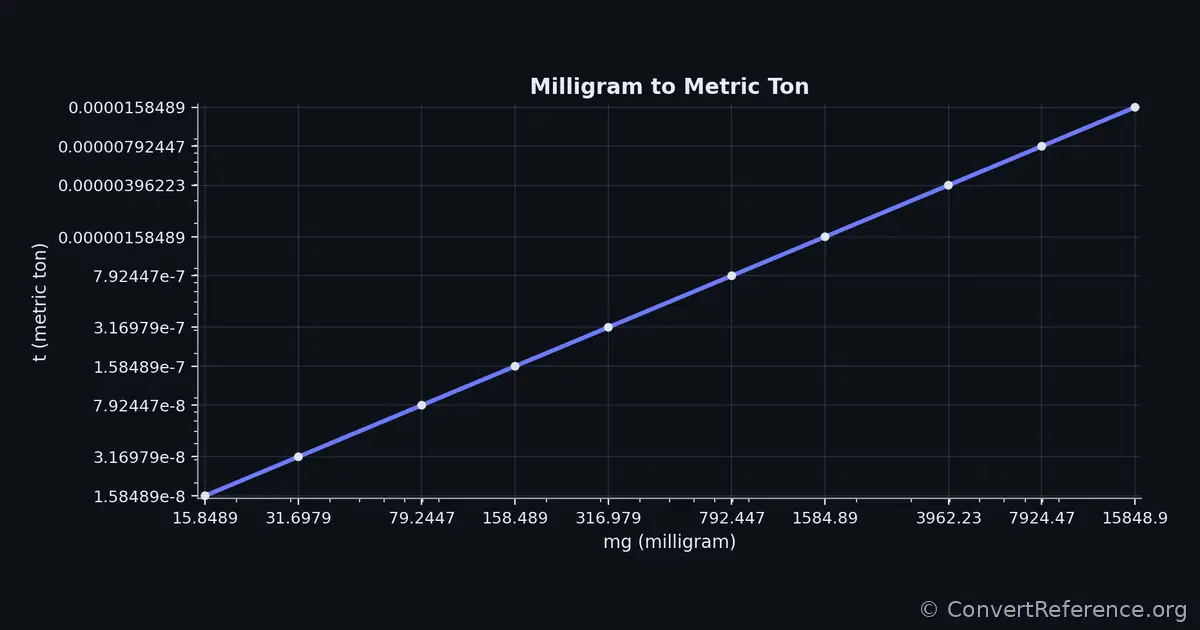
Milligrams and Metric tons Conversion Graph
Conversion graph showing the relationship between milligrams and metric tons.

Conversion Table For Milligram And Metric Ton

Common conversion values
Milligrams Metric tons
15.84891.58489e-8
31.69793.16979e-8
79.24477.92447e-8
158.4891.58489e-7
316.9793.16979e-7
792.4477.92447e-7
1584.890.00000158489
3962.230.00000396223
7924.470.00000792447
15848.90.0000158489

Values are rounded for display; internal calculations use the exact conversion factors between milligram and metric ton (1e-9 and 1000000000).

Dataset & API Access

Programmatic Access

Free JSON API with stable endpoints and predictable keys for automated bidirectional conversions.

Endpoint: https://convertreference.org/api/v1/convert/milligram-to-metric-ton.json

Content Type: application/json

Documentation: View API docs

Licensing

License: CC0 1.0 Universal (Public Domain)

See all datasets

Data & Editorial Process

All numerical values and formulas are generated from the Pint scientific unit library (v0.25), using constants consistent with the BIPM SI Brochure (9th Edition) and NIST Special Publication 811. Explanatory text is drafted with AI assistance and reviewed by ConvertReference editors for clarity and accuracy. This converter is completely free to use, and all calculations are performed locally in your browser and never sent to a server.

  • 2025-12-07 – Generated: Page created using Pint v0.25 verified constants.
  • 2025-12-07 – Reviewed: Verified by ConvertReference editors; no numerical changes required.