ConvertReference.org

Milligram To Kilogram Converter

mg

Review And Reference Information

Verified by the ConvertReference Technical Standards Team

ConvertReference Technical Standards Team

All values and formulas are validated through our editorial review process and cross-checked against internationally recognized reference standards (NIST, BIPM, CODATA).

View Editorial Standards & Report Corrections

Last reviewed: December 07, 2025

Conversion Factors

1 milligram = 0.000001 kilogram
1 kilogram = 1000000 milligram

(Exact factors: 0.000001 and 1000000)

Sources: NIST · BIPM

About This Milligram And Kilogram Converter

Welcome to the Milligram–Kilogram Converter, a simple tool for comparing tiny and larger units. It keeps the focus on milligrams and kilograms, showing you the corresponding value clearly. Use the swap button to switch between units at any time. Explore a range of quantities and find the right unit for your needs.

What Are Milligrams And Kilograms?

What Is A Milligram?

Milligram (mg) is a unit of mass in the SI system. It equals one thousandth of a gram: 1 mg = 0.001 g = 1e-6 kg. Common symbol: mg. It is a submultiple of the gram and part of SI. Real-world example: a grain of table salt is about 60 mg.

What Is A Kilogram?

Kilogram (kg) is the SI base unit of mass. It is defined by fixing the Planck constant h to exactly 6.62607015×10^-34 J·s; it is not defined in terms of another base unit. It belongs to the International System of Units (SI). Its symbol is kg. Example: a liter of water has a mass of about 1 kg.

When To Use Milligram Vs Kilogram

Milligram Usage

Milligram (mg) is a standard unit of mass in the metric system used to measure very small weights. It appears on medication and supplement labels, scientific data, and consumer product information. It is used in countries such as United States, United Kingdom, India, and Canada.

Kilogram Usage

Kilograms are the standard unit of mass in the metric system and are used worldwide in science, education, healthcare, and daily life. They are used in the United States, the United Kingdom, Canada, and Australia.

How To Convert Between Milligrams And Kilograms

Conversion Formulas

Milligram to Kilogram:
milligram × 0.000001 = kilogram

Kilogram to Milligram:
kilogram × 1000000 = milligram

Step-by-Step Guide

Milligram to Kilogram

  1. Take your value in milligrams.
  2. Multiply by 0.000001.
  3. The result is in kilograms.

Kilogram to Milligram

  1. Take your value in kilograms.
  2. Multiply by 1000000.
  3. The result is in milligrams.

Example: Convert 31.6979 milligrams to kilograms.

  • Exact: 31.6979 × 0.000001 = 0.0000316978638492223 kilograms.
  • Rounded: approximately 0.0000316979 kilograms.

Example: Convert 5 kilograms to milligrams.

  • Exact: 5 × 1000000 = 5000000 milligrams.
  • Rounded: approximately 5e+6 milligrams.

History & Context

Milligram and kilogram are part of the metric system, a modern approach developed in France to unite science and trade by standardizing mass. The kilogram became the base mass standard, defined by a physical artifact made of platinum and iridium that was kept in a safe place and used to compare other weights. The milligram arose as a small division of that same system, used for precise work in science and medicine. Over time, definitions moved from fixed objects to universal references tied to nature, helping measurements stay consistent around the world.

Practical Use

On an online unit converter page, a pharmacist might need to convert a small medication dose from milligrams to kilograms to align with body mass-based dosing calculations. For example, 5 mg becomes 0.000005 kg, which can be used in software that requires kilograms. In another case, a manufacturer with a batch weight recorded in kilograms may convert it to milligrams for precise labeling, since 1 kg equals 1,000,000 mg. Using the converter keeps both directions quick and accurate.

Common Mistakes When Converting Between Milligrams And Kilograms

  • Confusing milligrams with kilograms and treating the units as interchangeable.
  • Forgetting to adjust the unit when switching from milligrams to kilograms.
  • Misinterpreting a weight expressed in milligrams as if it were in kilograms.
  • Assuming the same numeric value applies to both units without accounting for their different magnitudes.

Mental Shortcuts For Quick Conversions

Mg→kg: move the decimal six places left (1,000,000 mg = 1 kg). Kg→mg: move the decimal six places right (1 kg = 1,000,000 mg). For estimation only; use a precise converter when accuracy matters.

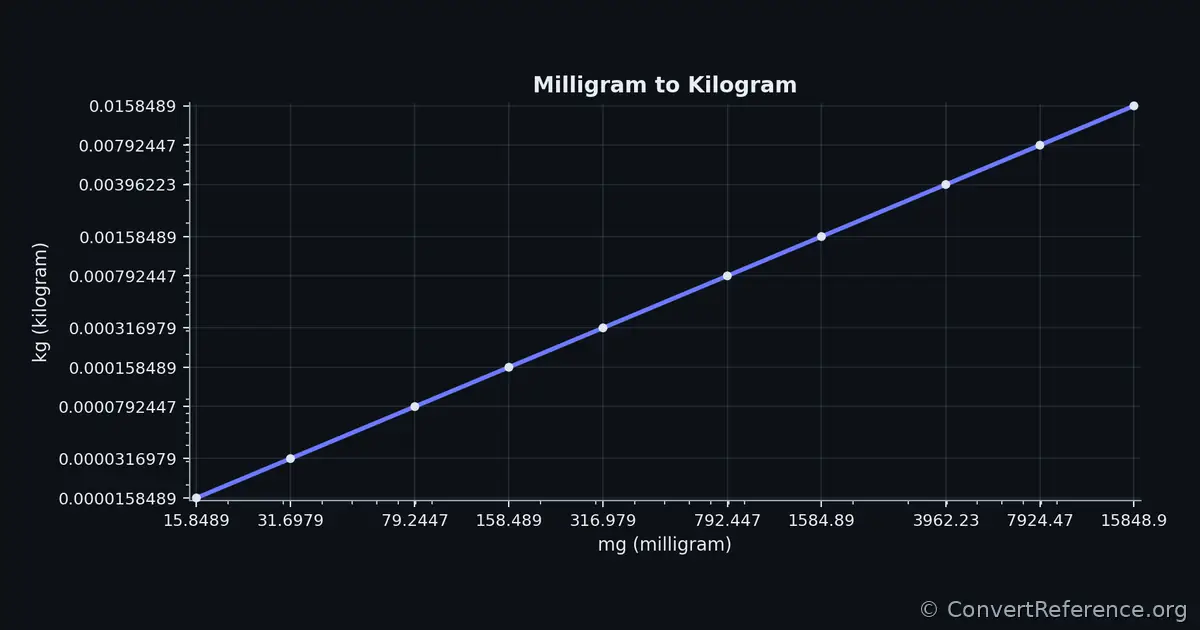
Milligrams And Kilograms Conversion Graph
Milligrams and Kilograms Conversion Graph
Conversion graph showing the relationship between milligrams and kilograms.

Conversion Table For Milligram And Kilogram

Common conversion values
Milligrams Kilograms
15.84890.0000158489
31.69790.0000316979
79.24470.0000792447
158.4890.000158489
316.9790.000316979
792.4470.000792447
1584.890.00158489
3962.230.00396223
7924.470.00792447
15848.90.0158489

Values are rounded for display; internal calculations use the exact conversion factors between milligram and kilogram (0.000001 and 1000000).

Dataset & API Access

Programmatic Access

Free JSON API with stable endpoints and predictable keys for automated bidirectional conversions.

Endpoint: https://convertreference.org/api/v1/convert/milligram-to-kilogram.json

Content Type: application/json

Documentation: View API docs

Licensing

License: CC0 1.0 Universal (Public Domain)

See all datasets

Data & Editorial Process

All numerical values and formulas are generated from the Pint scientific unit library (v0.25), using constants consistent with the BIPM SI Brochure (9th Edition) and NIST Special Publication 811. Explanatory text is drafted with AI assistance and reviewed by ConvertReference editors for clarity and accuracy. This converter is completely free to use, and all calculations are performed locally in your browser and never sent to a server.

  • 2025-12-07 – Generated: Page created using Pint v0.25 verified constants.
  • 2025-12-07 – Reviewed: Verified by ConvertReference editors; no numerical changes required.