ConvertReference.org

Milligram To Stone Converter

mg

Review And Reference Information

Verified by the ConvertReference Technical Standards Team

ConvertReference Technical Standards Team

All values and formulas are validated through our editorial review process and cross-checked against internationally recognized reference standards (NIST, BIPM, CODATA).

View Editorial Standards & Report Corrections

Last reviewed: December 07, 2025

Conversion Factors

1 milligram = 1.5747304441777e-7 stone
1 stone = 6350293.18 milligram

(Exact factors: 1.5747304441777e-7 and 6350293.18)

Sources: NIST · BIPM

About This Milligram And Stone Converter

Welcome to our quick unit tool for milligrams and stones. Type a value in milligrams and view the result in stones. Use the swap button to switch between units. Clear, fast results help you compare measurements with ease.

What Are Milligrams And Stones?

What Is A Milligram?

Milligram (mg) is a unit of mass in the SI system. It is defined as one-thousandth of a gram; 1 mg = 1e-3 g, and since 1 g = 0.001 kg, 1 mg = 1e-6 kg. System: SI; the base unit for mass is the kilogram (kg). Symbol: mg. Real-world example: a typical aspirin tablet is about 325 mg.

What Is A Stone?

Stone is a unit of mass used in the UK and other Commonwealth countries. It belongs to the Imperial/UK customary system. It equals 14 pounds, exactly 6.35029318 kilograms. The usual abbreviation is 'st'. Example: a large bag of potatoes (~14 lb) weighs about 1 stone.

When To Use Milligram Vs Stone

Milligram Usage

Milligram is a standard SI unit of mass used worldwide, especially in medicine, nutrition labeling, and scientific measurements; primary users include the United States, United Kingdom, Germany, and Japan.

Stone Usage

Stone is used globally for buildings, paving, monuments, and decorative work. Examples include India, the United Kingdom, Italy, and Brazil, where quarry stone and finished stone products are common in architecture, public spaces, and homes.

How To Convert Between Milligrams And Stones

Conversion Formulas

Milligram to Stone:
milligram × 1.5747304441777e-7 = stone

Stone to Milligram:
stone × 6350293.18 = milligram

Step-by-Step Guide

Milligram to Stone

  1. Take your value in milligrams.
  2. Multiply by 1.5747304441777e-7.
  3. The result is in stones.

Stone to Milligram

  1. Take your value in stones.
  2. Multiply by 6350293.18.
  3. The result is in milligrams.

Example: Convert 15.8489 milligrams to stones.

  • Exact: 15.8489 × 1.5747304441777e-7 = 0.0000024957795609385 stones.
  • Rounded: approximately 0.00000249578 stones.

Example: Convert 5 stones to milligrams.

  • Exact: 5 × 6350293.18 = 31751465.9 milligrams.
  • Rounded: approximately 3.17515e+7 milligrams.

History & Context

Milligram arose with the spread of the metric system in Europe and beyond, when scientists and merchants wanted a small unit of mass that could be used with ordinary balances. It belonged to a framework that treats mass in decimal steps, helping science and medicine compare and share results. The stone is a traditional British weight used for weighing people and goods; it varied in use across towns and markets and stood alongside other local measures in daily life. Over time stone and milligram show how people moved from old trading weights to precise science, while still reflecting the simple need to compare amount and size with steady scales.

Practical Use

In a medical dosing app, a clinician might need to convert very small quantities measured in milligrams into stones so a patient who tracks weight in stones can see how a tiny dose relates to their body mass. A patient education page could present the relationship as a weight-equivalent, helping someone interpret medication amounts in familiar units without changing the actual dosage. In a lab or manufacturing setting, a test sample weighed in stones might be converted to milligrams to match mg-based reporting and quality specifications. Converting in both directions allows clear, patient-friendly display while preserving precise unit measurements for records.

Common Mistakes When Converting Between Milligrams And Stones

  • Assuming milligrams and stones are the same unit and can be swapped without changing the meaning.
  • Treating the conversion as if the numeric amount stays the same when moving from milligrams to stones.
  • Confusing the unit system by applying metric thinking to a British imperial conversion.
  • Overlooking rounding rules and precision when switching between milligrams and stones.

Mental Shortcuts For Quick Conversions

Tip 1 (mg to stone): 1 stone ≈ 6,350,000 mg. Estimate by dividing mg by 6,350,000. Tip 2 (stone to mg): multiply stones by 6,350,000 for an estimate. This is for estimation only; use a precise converter for accuracy in most situations.

Milligrams And Stones Conversion Graph
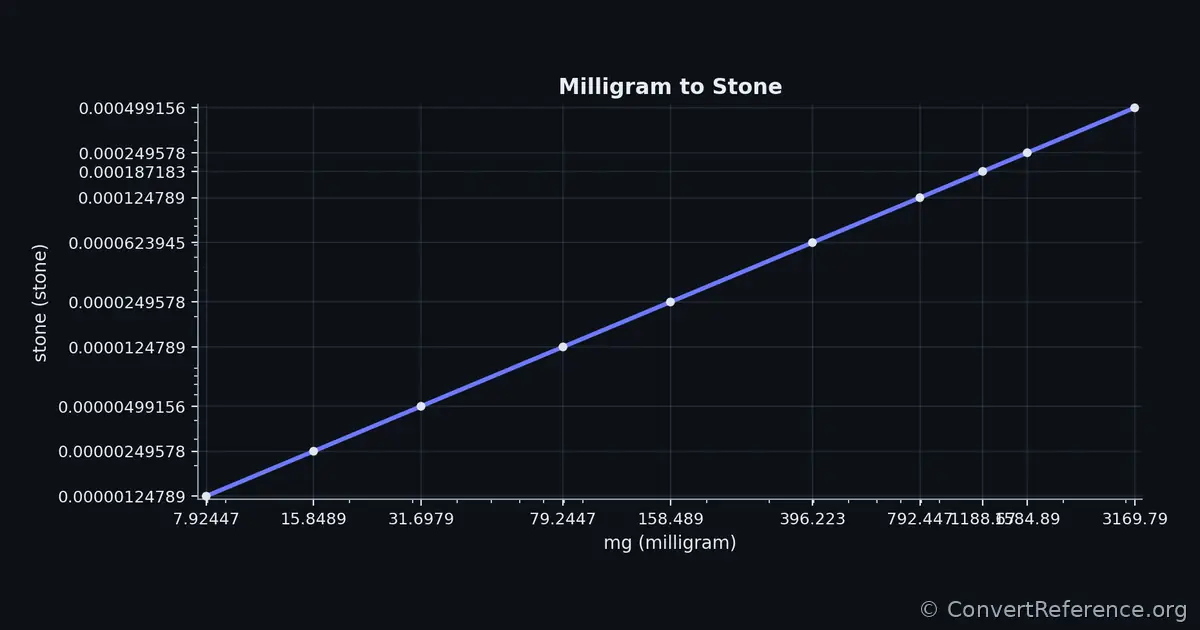
Milligrams and Stones Conversion Graph
Conversion graph showing the relationship between milligrams and stones.

Conversion Table For Milligram And Stone

Common conversion values
Milligrams Stones
7.924470.00000124789
15.84890.00000249578
31.69790.00000499156
79.24470.0000124789
158.4890.0000249578
396.2230.0000623945
792.4470.000124789
1188.670.000187183
1584.890.000249578
3169.790.000499156

Values are rounded for display; internal calculations use the exact conversion factors between milligram and stone (1.5747304441777e-7 and 6350293.18).

Dataset & API Access

Programmatic Access

Free JSON API with stable endpoints and predictable keys for automated bidirectional conversions.

Endpoint: https://convertreference.org/api/v1/convert/milligram-to-stone.json

Content Type: application/json

Documentation: View API docs

Licensing

License: CC0 1.0 Universal (Public Domain)

See all datasets

Data & Editorial Process

All numerical values and formulas are generated from the Pint scientific unit library (v0.25), using constants consistent with the BIPM SI Brochure (9th Edition) and NIST Special Publication 811. Explanatory text is drafted with AI assistance and reviewed by ConvertReference editors for clarity and accuracy. This converter is completely free to use, and all calculations are performed locally in your browser and never sent to a server.

  • 2025-12-07 – Generated: Page created using Pint v0.25 verified constants.
  • 2025-12-07 – Reviewed: Verified by ConvertReference editors; no numerical changes required.