ConvertReference.org

Metric Ton To Ounce Converter

t

Review And Reference Information

Verified by the ConvertReference Technical Standards Team

ConvertReference Technical Standards Team

All values and formulas are validated through our editorial review process and cross-checked against internationally recognized reference standards (NIST, BIPM, CODATA).

View Editorial Standards & Report Corrections

Last reviewed: December 07, 2025

Conversion Factors

1 metric ton = 35273.9619495804 ounce
1 ounce = 0.000028349523125 metric ton

(Exact factors: 35273.9619495804 and 0.000028349523125)

Sources: NIST · BIPM

About This Metric Ton And Ounce Converter

This quick, user-friendly tool helps you work with metric tons and ounces. See results clearly as metric tons are shown in ounces. A convenient swap button lets you switch between units. Use it to compare amounts at a glance and stay on the right scale.

What Are Metric Tons And Ounces?

What Is A Metric Ton?

A metric ton (symbol t) is a unit of mass equal to 1,000 kilograms. It belongs to the metric/SI system (base unit is the kilogram), with 1 t = 1,000 kg (and 1 kg = 0.001 t). Real-world: a small car weighs about one metric ton.

What Is An Ounce?

An ounce (oz) is a unit of mass in the avoirdupois system, used in the United States and other countries that use customary units. It equals 28.349523125 grams (0.028349523125 kilograms). The usual symbol is oz. Real-world example: a standard slice of bread weighs about 1 ounce (roughly 28 grams).

When To Use Metric Ton Vs Ounce

Metric Ton Usage

The metric ton (tonne) is the standard unit of mass in most countries, widely used in commerce, science, and government. It is common across Europe, Asia, Africa, and the Americas. Primary users include Germany, France, Japan, and Brazil.

Ounce Usage

The ounce is used in the United States, the United Kingdom, Canada, and Liberia as part of the customary weight system. It appears in daily life for small weights, alongside pounds, in informal measurements and mixed-use contexts with metric units.

How To Convert Between Metric Tons And Ounces

Conversion Formulas

Metric Ton to Ounce:
metric ton × 35273.9619495804 = ounce

Ounce to Metric Ton:
ounce × 0.000028349523125 = metric ton

Step-by-Step Guide

Metric Ton to Ounce

  1. Take your value in metric tons.
  2. Multiply by 35273.9619495804.
  3. The result is in ounces.

Ounce to Metric Ton

  1. Take your value in ounces.
  2. Multiply by 0.000028349523125.
  3. The result is in metric tons.

Example: Convert 2 metric tons to ounces.

  • Exact: 2 × 35273.9619495804 = 70547.9238991608 ounces.
  • Rounded: approximately 70547.9 ounces.

Example: Convert 5 ounces to metric tons.

  • Exact: 5 × 0.000028349523125 = 0.000141747615625 metric tons.
  • Rounded: approximately 0.000141748 metric tons.

History & Context

The metric ton, also called the tonne, grew with the metric system in France and spread to many countries for science and trade. It was meant to be a clear, universal large unit derived from the kilogram. The ounce has deep roots in ancient markets and medieval Europe, where many towns and kingdoms used their own small weights. Over time, rules were made to standardize the ounce in different systems, and some places adopted a common definition, helping global trade and measurement.

Practical Use

A shipping company moving steel in metric tons often needs to convert to ounces to fill a detailed label. They perform metric tons to ounces to meet customs, labeling, or invoice requirements that specify the smaller unit. In a jewelry or precious metal operation, shipments are priced per ounce, so when a bulk shipment arrives in metric tons they convert ounce to metric ton to allocate costs and inventory correctly. These directional conversions help ensure accurate costs and compliance across systems.

Common Mistakes When Converting Between Metric Tons And Ounces

  • Confusing the metric ton with a long ton or short ton and using the wrong baseline for the conversion.
  • Treating ounces as metric units and applying metric prefixes by mistake.
  • Assuming you can convert directly without regard to whether you are using mass-based or weight-based terminology.
  • Relying on memorized shortcuts instead of checking the exact unit names and standards.

Mental Shortcuts For Quick Conversions

Ton to oz: memorize 1 metric ton ≈ 35,274 ounces (about 35k); use 35,000 for quick estimates. Oz to ton: memorize 1 ounce ≈ 0.00002835 metric tons (about 1/35,274); for quick estimates, divide by 35,000. Note: this is estimation only; for precise results, use a proper converter.

Metric Tons And Ounces Conversion Graph
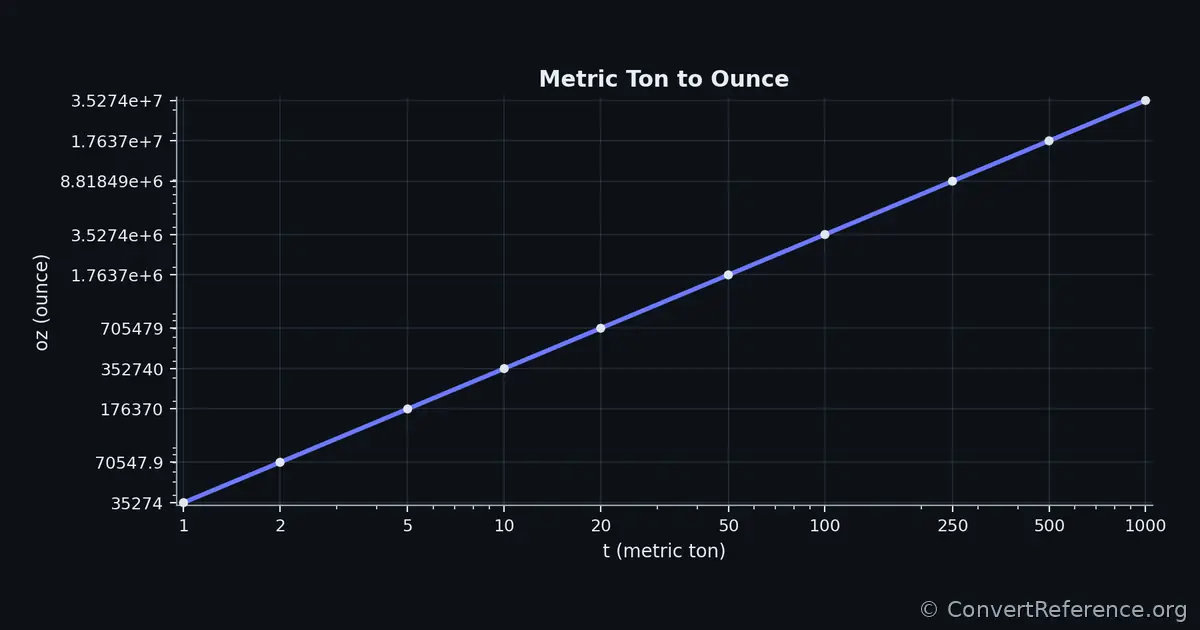
Metric tons and Ounces Conversion Graph
Conversion graph showing the relationship between metric tons and ounces.

Conversion Table For Metric Ton And Ounce

Common conversion values
Metric tons Ounces
135274
270547.9
5176370
10352740
20705479
501.7637e+6
1003.5274e+6
2508.81849e+6
5001.7637e+7
10003.5274e+7

Values are rounded for display; internal calculations use the exact conversion factors between metric ton and ounce (35273.9619495804 and 0.000028349523125).

Dataset & API Access

Programmatic Access

Free JSON API with stable endpoints and predictable keys for automated bidirectional conversions.

Endpoint: https://convertreference.org/api/v1/convert/metric-ton-to-ounce.json

Content Type: application/json

Documentation: View API docs

Licensing

License: CC0 1.0 Universal (Public Domain)

See all datasets

Data & Editorial Process

All numerical values and formulas are generated from the Pint scientific unit library (v0.25), using constants consistent with the BIPM SI Brochure (9th Edition) and NIST Special Publication 811. Explanatory text is drafted with AI assistance and reviewed by ConvertReference editors for clarity and accuracy. This converter is completely free to use, and all calculations are performed locally in your browser and never sent to a server.

  • 2025-12-07 – Generated: Page created using Pint v0.25 verified constants.
  • 2025-12-07 – Reviewed: Verified by ConvertReference editors; no numerical changes required.