Kilopascal To Millibar Converter
Review And Reference Information
About This Kilopascal And Millibar Converter
What Are Kilopascals And Millibars?
What Is A Kilopascal?
What Is A Millibar?
When To Use Kilopascal Vs Millibar
Kilopascal Usage
Millibar Usage
How To Convert Between Kilopascals And Millibars
Conversion Formulas
Kilopascal to Millibar:kilopascal × 10 = millibar
Millibar to Kilopascal:millibar × 0.1 = kilopascal
Step-by-Step Guide
Kilopascal to Millibar
- Take your value in kilopascals.
- Multiply by 10.
- The result is in millibars.
Millibar to Kilopascal
- Take your value in millibars.
- Multiply by 0.1.
- The result is in kilopascals.
Example: Convert 7 kilopascals to millibars.
- Exact: 7 × 10 = 70 millibars.
Example: Convert 5 millibars to kilopascals.
- Exact: 5 × 0.1 = 0.5 kilopascals.
History & Context
Practical Use
Common Mistakes When Converting Between Kilopascals And Millibars
- Kilopascal and millibar are treated as the same unit.
- Using the wrong direction of conversion by applying the factor in the wrong way.
- Not considering whether the pressure is gauge or absolute.
- Assuming the conversion factor changes with temperature.
Mental Shortcuts For Quick Conversions
Kilopascals And Millibars Conversion Graph
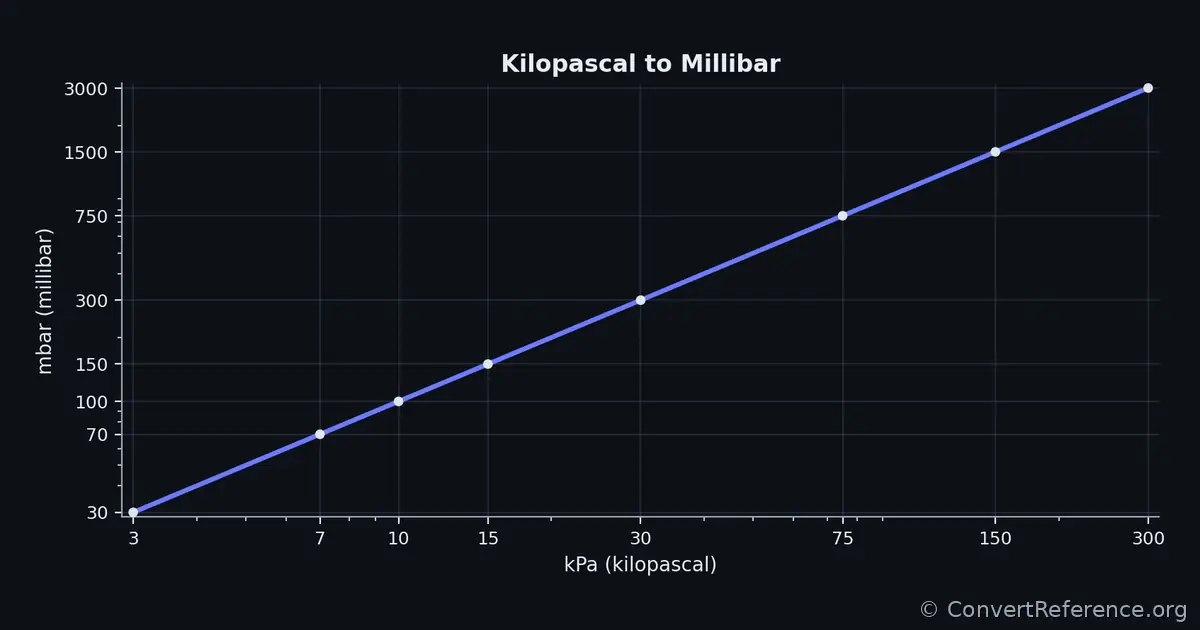
Conversion Table For Kilopascal And Millibar
| Kilopascals | Millibars |
|---|---|
| 3 | 30 |
| 7 | 70 |
| 10 | 100 |
| 15 | 150 |
| 30 | 300 |
| 75 | 750 |
| 150 | 1500 |
| 300 | 3000 |
Values are rounded for display; internal calculations use the exact conversion factors between kilopascal and millibar (10 and 0.1).
Dataset & API Access
Programmatic Access
Free JSON API with stable endpoints and predictable keys for automated bidirectional conversions.
Endpoint: https://convertreference.org/api/v1/convert/kilopascal-to-millibar.json
Content Type: application/json
Documentation: View API docs
Licensing
License: CC0 1.0 Universal (Public Domain)
Data & Editorial Process
All numerical values and formulas are generated from the Pint scientific unit library (v0.25), using constants consistent with the BIPM SI Brochure (9th Edition) and NIST Special Publication 811. Explanatory text is drafted with AI assistance and reviewed by ConvertReference editors for clarity and accuracy. This converter is completely free to use, and all calculations are performed locally in your browser and never sent to a server.
- 2025-12-08 – Generated: Page created using Pint v0.25 verified constants.
- 2025-12-08 – Reviewed: Verified by ConvertReference editors; no numerical changes required.