ConvertReference.org

Pascal To Millibar Converter

Pa

Review And Reference Information

Verified by the ConvertReference Technical Standards Team

ConvertReference Technical Standards Team

All values and formulas are validated through our editorial review process and cross-checked against internationally recognized reference standards (NIST, BIPM, CODATA).

View Editorial Standards & Report Corrections

Last reviewed: December 08, 2025

Conversion Factors

1 pascal = 0.01 millibar
1 millibar = 100 pascal

(Exact factors: 0.01 and 100)

Sources: NIST · BIPM

About This Pascal And Millibar Converter

Welcome to our quick unit converter. It supports pascal and millibar so you can compare values easily. Switch the direction anytime with the swap button. Get the result in millibar when starting from pascal.

What Are Pascals And Millibars?

What Is A Pascal?

Pascal (Pa) is the SI unit of pressure. It equals one newton per square meter (1 N/m^2). It is a derived SI unit based on base units kg, m, and s. Symbol: Pa. System: SI. Real-world example: atmospheric pressure at sea level is about 101,325 Pa (≈101 kPa).

What Is A Millibar?

Millibar is a unit of pressure equal to one thousandth of a bar. It is a metric unit (non-SI) commonly used in meteorology. The SI base unit for pressure is the pascal (Pa), and 1 mbar = 100 Pa (since 1 bar = 100,000 Pa). The usual symbol is mbar or mb. Real-world example: sea-level atmospheric pressure is about 1013 mbar (≈101,300 Pa).

When To Use Pascal Vs Millibar

Pascal Usage

Pascal (Pa) is the SI unit of pressure used globally in science, medicine, and education; pressures are commonly expressed as kPa or hPa. Primary users include the United States, United Kingdom, Germany, and France.

Millibar Usage

Millibar is a traditional unit for atmospheric pressure, still used in weather reporting in some countries. It is common in Germany, France, Japan, and Brazil, where forecasts often present values in millibars (hPa).

How To Convert Between Pascals And Millibars

Conversion Formulas

Pascal to Millibar:
pascal × 0.01 = millibar

Millibar to Pascal:
millibar × 100 = pascal

Step-by-Step Guide

Pascal to Millibar

  1. Take your value in pascals.
  2. Multiply by 0.01.
  3. The result is in millibars.

Millibar to Pascal

  1. Take your value in millibars.
  2. Multiply by 100.
  3. The result is in pascals.

Example: Convert 2 pascals to millibars.

  • Exact: 2 × 0.01 = 0.02 millibars.

Example: Convert 5 millibars to pascals.

  • Exact: 5 × 100 = 500 pascals.

History & Context

Blaise Pascal, a French scientist of the seventeenth century, did experiments that linked air pressure to the weight of air and to weather and vacuums. His findings helped scientists agree on a standard unit of pressure named after him, the pascal, which measures force per area in science and engineering. For weather work, meteorologists adopted a smaller unit called the millibar to express typical air pressure in a convenient way. The millibar reflects the idea of dividing larger pressure into easier parts, and it has been widely used in weather reports and scientific discussions. These two units show how careful measurements and clear naming helped people compare experiences of air and study weather with precision.

Practical Use

On a lab bench, a pressure sensor that outputs values in pascals is often converted to millibars to align with meteorological charts and industry references. In field reports, weather dashboards commonly display pressure in millibars, so technicians also need to convert millibars back to pascals for SI-unit calculations and data logging. An online unit converter page can handle both pascal-to-millibar and millibar-to-pascal conversions quickly and accurately.

Common Mistakes When Converting Between Pascals And Millibars

  • Assuming pascal and millibar are the same unit.
  • Believing the numeric value stays the same when converting between pascal and millibar.
  • Using Pa and mbar interchangeably in a calculation without converting.
  • Failing to apply the correct conversion direction when switching from pascal to millibar.

Mental Shortcuts For Quick Conversions

Pa to mbar: divide by 100 (move decimal two places left). mbar to Pa: multiply by 100 (move decimal two places right). For estimation only; use a precise converter for exact results.

Pascals And Millibars Conversion Graph
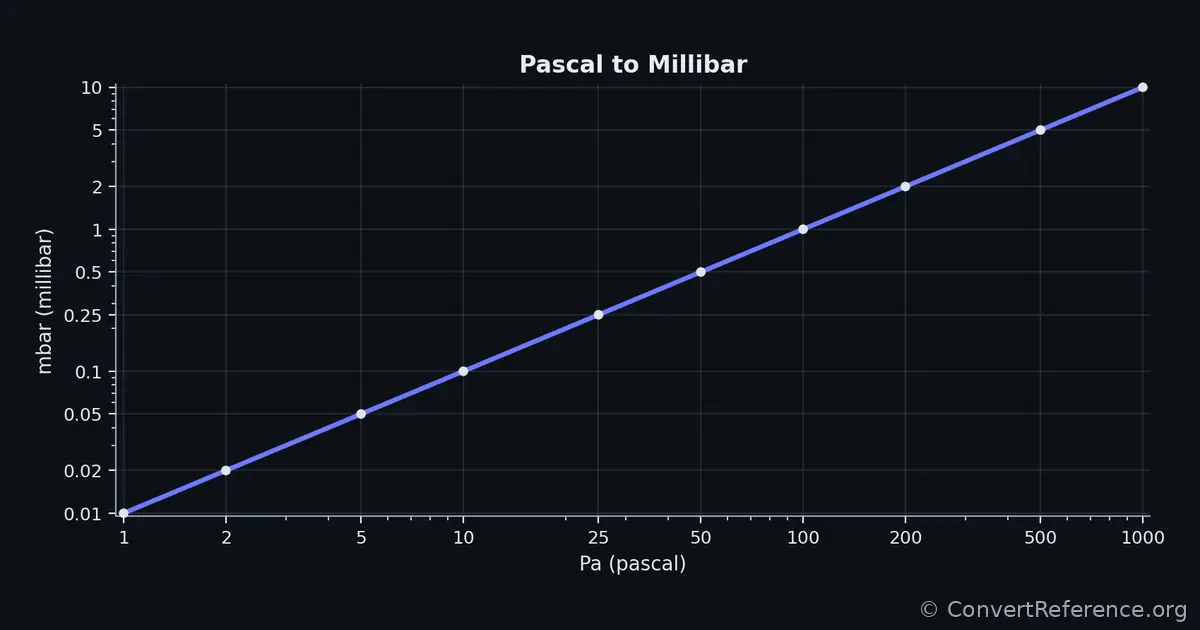
Pascals and Millibars Conversion Graph
Conversion graph showing the relationship between pascals and millibars.

Conversion Table For Pascal And Millibar

Common conversion values
Pascals Millibars
10.01
20.02
50.05
100.1
250.25
500.5
1001
2002
5005
100010

Values are rounded for display; internal calculations use the exact conversion factors between pascal and millibar (0.01 and 100).

Dataset & API Access

Programmatic Access

Free JSON API with stable endpoints and predictable keys for automated bidirectional conversions.

Endpoint: https://convertreference.org/api/v1/convert/pascal-to-millibar.json

Content Type: application/json

Documentation: View API docs

Licensing

License: CC0 1.0 Universal (Public Domain)

See all datasets

Data & Editorial Process

All numerical values and formulas are generated from the Pint scientific unit library (v0.25), using constants consistent with the BIPM SI Brochure (9th Edition) and NIST Special Publication 811. Explanatory text is drafted with AI assistance and reviewed by ConvertReference editors for clarity and accuracy. This converter is completely free to use, and all calculations are performed locally in your browser and never sent to a server.

  • 2025-12-08 – Generated: Page created using Pint v0.25 verified constants.
  • 2025-12-08 – Reviewed: Verified by ConvertReference editors; no numerical changes required.