Verified by the ConvertReference Technical Standards Team
ConvertReference Technical Standards Team
All values and formulas are validated through our editorial review process and
cross-checked against internationally recognized reference standards (NIST, BIPM, CODATA).
Welcome to the bar to millibar converter, your quick reference for pressure units. Enter a value in bar and use the swap button to switch between units. This tool keeps things simple and focused on accurate results. Get clear, instant comparisons as you explore bar and millibar.
What Are Bars And Millibars?
What Is A Bar?
Bar is a unit of pressure in the metric system. It is defined exactly as 100,000 pascals (1 bar = 10^5 Pa). It is a non-SI unit commonly used with SI; symbol: bar. Example: a car tire is typically about 2–3 bar, showing everyday pressure scales (sea-level atmospheric pressure is about 1 bar).
What Is A Millibar?
Millibar (mbar) is a unit of atmospheric pressure used in meteorology. It equals 100 pascals (Pa) exactly. In SI, the base unit is the pascal; 1 bar = 1000 mbar and 1 mbar = 100 Pa (also equal to 1 hPa). It is part of the metric system and is widely used in weather reports. Real world example: sea level pressure is about 1013 mbar (101300 Pa).
When To Use Bar Vs Millibar
Bar Usage
Bar is a common unit of pressure used in weather reporting and consumer pressure gauges in Europe and parts of Latin America. Primary users include France, Germany, Italy, and Spain.
milliBar Usage
Millibar (mb) is a traditional unit of atmospheric pressure still used in weather reporting and maps in several countries. In the United States, United Kingdom, Japan, and Brazil, pressure values can appear as mb, alongside the SI-based hectopascal (hPa).
How To Convert Between Bars And Millibars
Conversion Formulas
Bar to Millibar: bar × 1000 = millibar
Millibar to Bar: millibar × 0.001 = bar
Step-by-Step Guide
Bar to Millibar
Take your value in bars.
Multiply by 1000.
The result is in millibars.
Millibar to Bar
Take your value in millibars.
Multiply by 0.001.
The result is in bars.
Example: Convert 0.5 bars to millibars.
Exact: 0.5 × 1000 = 500 millibars.
Example: Convert 5 millibars to bars.
Exact: 5 × 0.001 = 0.005 bars.
History & Context
Bar and millibar are pressure units tied to the metric system. The bar was introduced in the early days of standardized physics and meteorology as a practical unit for atmospheric and engineering pressures, chosen for its decimal ease and convenient size compared with older cgs units. It quickly gained acceptance among scientists, meteorologists, and engineers and was widely used in instruments, charts, and industry during the modern era. The millibar, a simple subdivision of the bar, became a common term in weather maps and forecasts, helping describe air pressure without using tiny values. Over time meteorology particularly embraced the millibar, making it a familiar unit worldwide until SI compatible units took hold.
Practical Use
In automotive maintenance, tire pressures are sometimes specified in bars in service manuals, but many gauges display in millibars, so you need to convert bar to millibar to inflate correctly. This ensures the reading matches the instrument's scale and helps avoid under- or over-inflation. In meteorology or aviation, atmospheric pressure readings are usually given in millibars, and technicians may convert them to bar to align with equipment specifications. These conversions keep pressure values consistent across manuals, gauges, and charts.
Common Mistakes When Converting Between Bars And Millibars
Treating bar and millibar as the same unit.
Assuming millibar is larger than bar.
Applying the same numeric value to both units without accounting for the scale difference.
Failing to include the correct unit symbol when writing the result.
Mental Shortcuts For Quick Conversions
Bar to millibar: multiply by 1000 (bar × 1000 = mbar) — cue: 'add three zeros'. Millibar to bar: divide by 1000 (mbar ÷ 1000 = bar) — cue: 'move the decimal left three places'. Note: for estimation only; use a precise converter when exact results are needed.
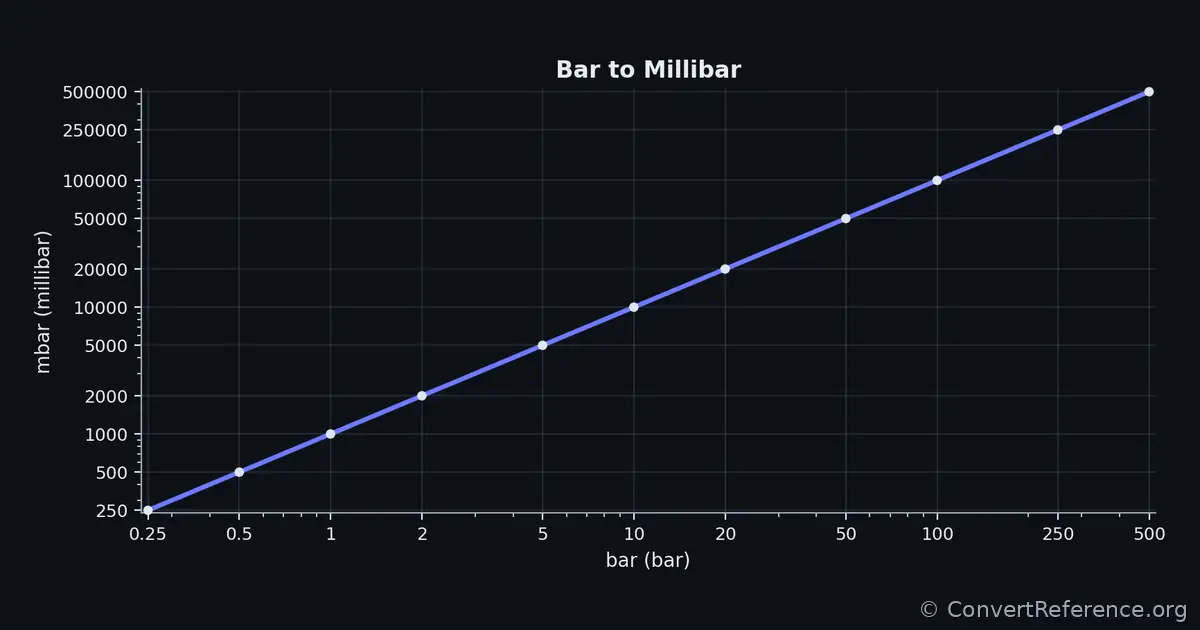
Bars And Millibars Conversion Graph
Conversion graph showing the relationship between bars and millibars.
Conversion Table For Bar And Millibar
Common conversion values
Bars
Millibars
0.25
250
0.5
500
1
1000
2
2000
5
5000
10
10000
20
20000
50
50000
100
100000
250
250000
500
500000
Values are rounded for display; internal calculations use the exact conversion factors between
bar and millibar (1000 and 0.001).
All numerical values and formulas are generated from the
Pint
scientific unit library (v0.25), using constants consistent with the
BIPM SI Brochure (9th Edition)
and
NIST Special Publication 811.
Explanatory text is drafted with AI assistance and reviewed by ConvertReference editors for clarity and accuracy.
This converter is completely free to use, and all calculations are performed locally in your browser and never sent to a server.
2025-12-08 – Generated:
Page created using Pint v0.25 verified constants.
2025-12-08 – Reviewed:
Verified by ConvertReference editors; no numerical changes required.