ConvertReference.org

Millibar To Standard Atmosphere Converter

mbar

Review And Reference Information

Verified by the ConvertReference Technical Standards Team

ConvertReference Technical Standards Team

All values and formulas are validated through our editorial review process and cross-checked against internationally recognized reference standards (NIST, BIPM, CODATA).

View Editorial Standards & Report Corrections

Last reviewed: December 08, 2025

Conversion Factors

1 millibar = 0.000986923266716013 standard atmosphere
1 standard atmosphere = 1013.25 millibar

(Exact factors: 0.000986923266716013 and 1013.25)

Sources: NIST · BIPM

About This Millibar And Standard Atmosphere Converter

This tool helps you work with millibar and standard atmosphere units. See clear results when comparing these two units. Use the swap button to switch the direction between millibar and standard atmosphere. It's fast, simple, and built for quick reference.

What Are Millibars And Standard Atmospheres?

What Is A Millibar?

Millibar (mbar) is a unit of pressure used mainly in meteorology. It is not an SI unit; it is defined as 1/1000 of a bar, equal to 100 pascals (Pa). Thus 1 mbar = 0.001 bar = 100 Pa; 1 bar = 1000 mbar. System: metric/pressure unit; common symbol: mbar (mb). Real-world example: typical sea-level air pressure is about 1013 mbar.

What Is A Standard Atmosphere?

Standard atmosphere (atm) is a unit of pressure defined exactly as 101325 pascals (Pa). It is a non-SI unit commonly used with the SI system; symbol: atm. It equals 101.325 kilopascals (kPa). Real-world example: sea-level air pressure is about 1 atm; a car tire is typically around 2 atm.

When To Use Millibar Vs Standard Atmosphere

Millibar Usage

Millibar is a traditional unit for atmospheric pressure still used in weather reporting and historical data. It is equivalent to one hectopascal (hPa). In weather broadcasts and forecasts, some countries still refer to pressure in millibars. Primary users include the United States, United Kingdom, Germany, and Australia.

Standard Atmosphere Usage

Standard atmosphere provides a common reference for atmospheric properties with altitude. It is used in meteorology, education, and scientific modeling, and serves as a baseline for instrument calibration and data interpretation. Countries that use it include the United States, United Kingdom, Germany, and Japan.

How To Convert Between Millibars And Standard Atmospheres

Conversion Formulas

Millibar to Standard Atmosphere:
millibar × 0.000986923266716013 = standard atmosphere

Standard Atmosphere to Millibar:
standard atmosphere × 1013.25 = millibar

Step-by-Step Guide

Millibar to Standard Atmosphere

  1. Take your value in millibars.
  2. Multiply by 0.000986923266716013.
  3. The result is in standard atmospheres.

Standard Atmosphere to Millibar

  1. Take your value in standard atmospheres.
  2. Multiply by 1013.25.
  3. The result is in millibars.

Example: Convert 0.05 millibars to standard atmospheres.

  • Exact: 0.05 × 0.000986923266716013 = 0.0000493461633358006 standard atmospheres.
  • Rounded: approximately 0.0000493462 standard atmospheres.

Example: Convert 5 standard atmospheres to millibars.

  • Exact: 5 × 1013.25 = 5066.25 millibars.

History & Context

Millibar arose as a practical meteorology unit in the early twentieth century, when scientists used the metric pressure scale for weather maps and balloons carried pressure sensors; it is the subunit of the bar, a unit linked to early metric physics, and it became widespread in routine weather reports for many years. The standard atmosphere, the ISA, was developed through international collaboration to provide a shared air model for aviation, design, and science; it defined a consistent set of temperature, pressure, and density profiles and was formalized by international bodies in the mid twentieth century, becoming a long standing reference for instruments, calculators, and flight planning.

Practical Use

Pilots and air traffic controllers may need to convert millibar pressure readings to standard atmosphere to compare local pressure with aviation charts that use the sea-level reference. For calibration of pressure sensors in weather balloons or aircraft altimeters, converting millibar to standard atmosphere helps align measurements with the common reference values. In a separate scenario, technicians analyzing high-altitude experiments might convert standard atmosphere to millibar to input data into equipment that expects pressure in millibars. This conversion ensures consistent interpretation of altitude-related pressure data across different systems.

Common Mistakes When Converting Between Millibars And Standard Atmospheres

  • Mistaking millibar and standard atmosphere as identical units.
  • Using the wrong direction of conversion between millibar and standard atmosphere.
  • Rounding the result too early in the calculation.
  • Ignoring standard conditions when performing the conversion.

Mental Shortcuts For Quick Conversions

Tip 1 (mb→atm): 1013 mb ≈ 1 atm; rough estimate: 1000 mb ≈ 1 atm. Tip 2 (atm→mb): 1 atm ≈ 1013 mb; rough estimate: 1000 mb. Estimation only—use a precise converter when accuracy matters.

Millibars And Standard Atmospheres Conversion Graph
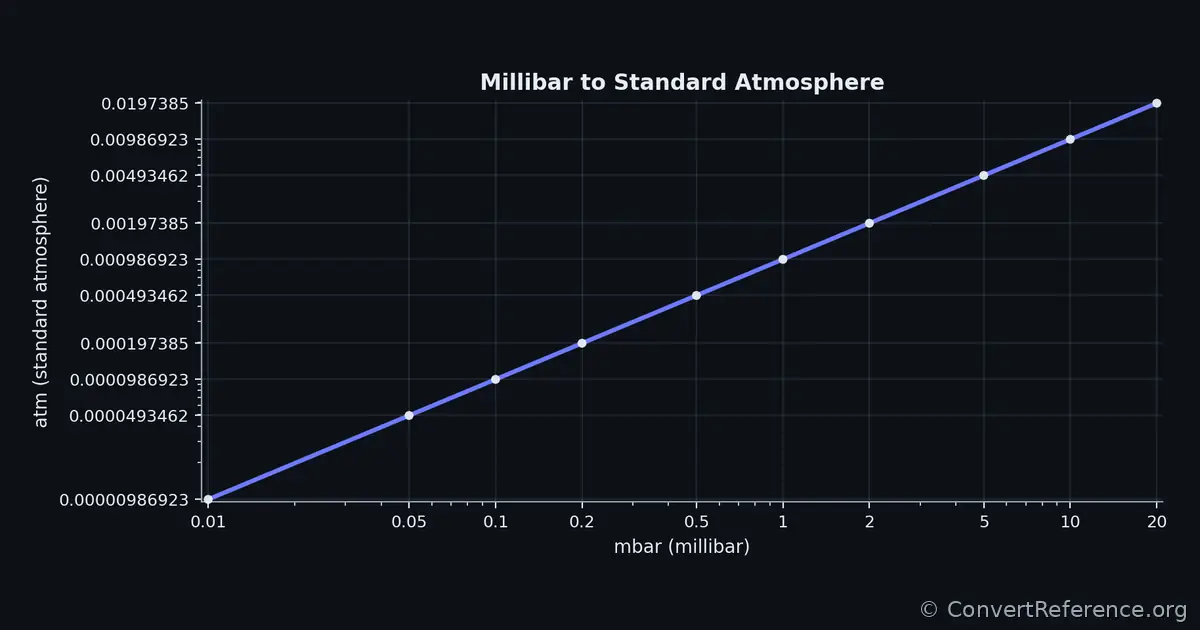
Millibars and Standard atmospheres Conversion Graph
Conversion graph showing the relationship between millibars and standard atmospheres.

Conversion Table For Millibar And Standard Atmosphere

Common conversion values
Millibars Standard atmospheres
0.010.00000986923
0.050.0000493462
0.10.0000986923
0.20.000197385
0.50.000493462
10.000986923
20.00197385
50.00493462
100.00986923
200.0197385

Values are rounded for display; internal calculations use the exact conversion factors between millibar and standard atmosphere (0.000986923266716013 and 1013.25).

Dataset & API Access

Programmatic Access

Free JSON API with stable endpoints and predictable keys for automated bidirectional conversions.

Endpoint: https://convertreference.org/api/v1/convert/millibar-to-standard-atmosphere.json

Content Type: application/json

Documentation: View API docs

Licensing

License: CC0 1.0 Universal (Public Domain)

See all datasets

Data & Editorial Process

All numerical values and formulas are generated from the Pint scientific unit library (v0.25), using constants consistent with the BIPM SI Brochure (9th Edition) and NIST Special Publication 811. Explanatory text is drafted with AI assistance and reviewed by ConvertReference editors for clarity and accuracy. This converter is completely free to use, and all calculations are performed locally in your browser and never sent to a server.

  • 2025-12-08 – Generated: Page created using Pint v0.25 verified constants.
  • 2025-12-08 – Reviewed: Verified by ConvertReference editors; no numerical changes required.