ConvertReference.org

Bar To Standard Atmosphere Converter

bar

Review And Reference Information

Verified by the ConvertReference Technical Standards Team

ConvertReference Technical Standards Team

All values and formulas are validated through our editorial review process and cross-checked against internationally recognized reference standards (NIST, BIPM, CODATA).

View Editorial Standards & Report Corrections

Last reviewed: December 08, 2025

Conversion Factors

1 bar = 0.986923266716013 standard atmosphere
1 standard atmosphere = 1.01325 bar

(Exact factors: 0.986923266716013 and 1.01325)

Sources: NIST · BIPM

About This Bar And Standard Atmosphere Converter

This tool makes it easy to compare bar values with standard atmosphere. See the corresponding pressure in the other unit at a glance. The interface is simple and fast for quick checks. Use the swap button to toggle between bar and standard atmosphere.

What Are Bars And Standard Atmospheres?

What Is A Bar?

Bar is a unit of pressure in the metric system. It is defined as exactly 100,000 pascals (Pa). It is not an SI base unit, but is widely used with pascals. Symbol: bar. System: metric/pressure units. Real-world example: sea-level atmospheric pressure is about 1 bar (roughly 100 kPa).

What Is A Standard Atmosphere?

Standard atmosphere (atm) is a unit of pressure defined exactly as 101,325 pascals (Pa). It is a non-SI unit commonly used with SI; symbol: atm. Relationship: 1 atm = 101,325 Pa = 760 torr = 14.696 psi. Real-world example: at sea level, air pressure is about 1 atm, roughly the pressure inside a typical car tire when fully inflated.

When To Use Bar Vs Standard Atmosphere

Bar Usage

Bar is a common unit of pressure used globally in weather reporting and everyday pressure measurements as an alternative to pascals. It is especially prevalent in Germany, France, Italy, and Spain.

Standard Atmosphere Usage

Standard atmosphere serves as a reference for atmospheric properties in scientific research, meteorology, education, and instrument calibration. It underpins models and calculations used nationwide in several countries, including the United States, United Kingdom, Germany, and India.

How To Convert Between Bars And Standard Atmospheres

Conversion Formulas

Bar to Standard Atmosphere:
bar × 0.986923266716013 = standard atmosphere

Standard Atmosphere to Bar:
standard atmosphere × 1.01325 = bar

Step-by-Step Guide

Bar to Standard Atmosphere

  1. Take your value in bars.
  2. Multiply by 0.986923266716013.
  3. The result is in standard atmospheres.

Standard Atmosphere to Bar

  1. Take your value in standard atmospheres.
  2. Multiply by 1.01325.
  3. The result is in bars.

Example: Convert 0.05 bars to standard atmospheres.

  • Exact: 0.05 × 0.986923266716013 = 0.0493461633358006 standard atmospheres.
  • Rounded: approximately 0.0493462 standard atmospheres.

Example: Convert 5 standard atmospheres to bars.

  • Exact: 5 × 1.01325 = 5.06625 bars.

History & Context

Pressure units evolved with the rise of the metric system. The bar was introduced as a decimal unit of pressure for science and industry and found use in meteorology, engineering, and chemistry, especially in Europe, to help people compare measurements. The standard atmosphere grew from the need for a shared reference in air studies, aviation, and experiments, and it was defined by international standards groups so researchers could discuss typical air pressure without weather surprises. Both ideas show how modern science moved toward uniform measurement, with laboratories around the world adopting them for consistent data.

Practical Use

In a high-pressure lab system, engineers often work with pressures in bar and need to convert bar to standard atmosphere to compare with sea-level references. In aviation testing or atmospheric studies at altitude, readings that are given in standard atmosphere may be converted to bar to align with the instrument's units. These conversions help ensure consistent reporting and safe design margins across different measurement standards.

Common Mistakes When Converting Between Bars And Standard Atmospheres

  • Treating bar and standard atmosphere as the same unit.
  • Using the wrong conversion factor when switching between bar and atmosphere.
  • Ignoring the difference between gauge pressure and absolute pressure in the conversion.
  • Assuming a direct mapping without checking the reference definitions.

Mental Shortcuts For Quick Conversions

Bar → atm: 1 bar ≈ 0.987 atm; for quick estimates multiply by 0.99. This is for estimation only; use a precise converter when accuracy matters. Atmosphere → bar: 1 atm ≈ 1.013 bar; for quick estimates multiply by 1.01. This is for estimation only; use a precise converter when accuracy matters.

Bars And Standard Atmospheres Conversion Graph
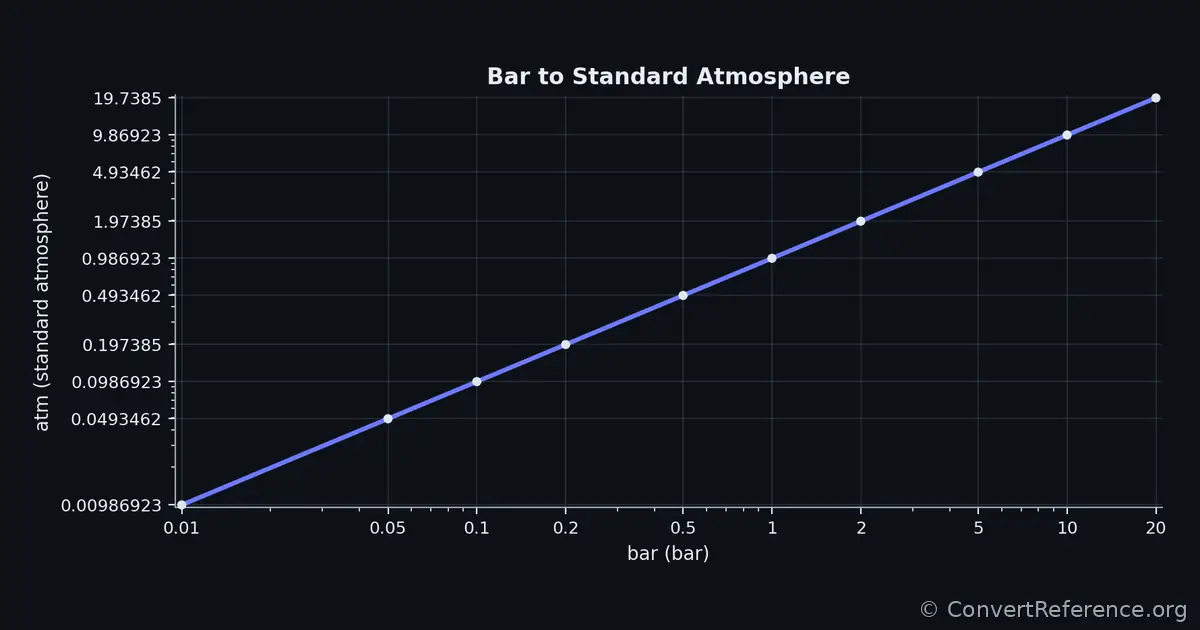
Bars and Standard atmospheres Conversion Graph
Conversion graph showing the relationship between bars and standard atmospheres.

Conversion Table For Bar And Standard Atmosphere

Common conversion values
Bars Standard atmospheres
0.010.00986923
0.050.0493462
0.10.0986923
0.20.197385
0.50.493462
10.986923
21.97385
54.93462
109.86923
2019.7385

Values are rounded for display; internal calculations use the exact conversion factors between bar and standard atmosphere (0.986923266716013 and 1.01325).

Dataset & API Access

Programmatic Access

Free JSON API with stable endpoints and predictable keys for automated bidirectional conversions.

Endpoint: https://convertreference.org/api/v1/convert/bar-to-standard-atmosphere.json

Content Type: application/json

Documentation: View API docs

Licensing

License: CC0 1.0 Universal (Public Domain)

See all datasets

Data & Editorial Process

All numerical values and formulas are generated from the Pint scientific unit library (v0.25), using constants consistent with the BIPM SI Brochure (9th Edition) and NIST Special Publication 811. Explanatory text is drafted with AI assistance and reviewed by ConvertReference editors for clarity and accuracy. This converter is completely free to use, and all calculations are performed locally in your browser and never sent to a server.

  • 2025-12-08 – Generated: Page created using Pint v0.25 verified constants.
  • 2025-12-08 – Reviewed: Verified by ConvertReference editors; no numerical changes required.