ConvertReference.org

Millibar To Technical Atmosphere Converter

mbar

Review And Reference Information

Verified by the ConvertReference Technical Standards Team

ConvertReference Technical Standards Team

All values and formulas are validated through our editorial review process and cross-checked against internationally recognized reference standards (NIST, BIPM, CODATA).

View Editorial Standards & Report Corrections

Last reviewed: December 08, 2025

Conversion Factors

1 millibar = 0.00101971621297793 technical atmosphere
1 technical atmosphere = 980.665 millibar

(Exact factors: 0.00101971621297793 and 980.665)

Sources: NIST · BIPM

About This Millibar And Technical Atmosphere Converter

This online tool helps you work with millibar and technical atmosphere. Enter a value in millibar to see the corresponding amount in technical atmosphere. A handy swap button lets you switch between units. Use it for quick reference, comparisons, and planning.

What Are Millibars And Technical Atmospheres?

What Is A Millibar?

Millibar is a unit of atmospheric pressure. It is defined as 1/1000 of a bar, so 1 mbar = 100 pascals. It belongs to the metric system and is commonly used in meteorology; symbol mbar (mb). It is not SI, but is accepted for use with SI. Example: typical sea-level pressure is about 1013 mb.

What Is A Technical Atmosphere?

Technical atmosphere (symbol: at) is a unit of pressure used in engineering. It equals 1 kgf per cm² = 98,066.5 Pa. It belongs to non-SI units for pressure (engineering/technical). Abbreviation: at. Real-world example: a bicycle tire inflated to ~6 bar is about 6 technical atmospheres.

When To Use Millibar Vs Technical Atmosphere

Millibar Usage

Millibar (mb) is a common unit for atmospheric pressure in meteorology. It is used in the United Kingdom, Canada, Australia, and New Zealand.

Technical Atmosphere Usage

Technical atmosphere is a legacy pressure unit still found in some older engineering and calibration standards and manuals. It is used in a few countries, including Russia, Germany, France, and Italy, where it appears beside other historical units in specification sheets and older documentation.

How To Convert Between Millibars And Technical Atmospheres

Conversion Formulas

Millibar to Technical Atmosphere:
millibar × 0.00101971621297793 = technical atmosphere

Technical Atmosphere to Millibar:
technical atmosphere × 980.665 = millibar

Step-by-Step Guide

Millibar to Technical Atmosphere

  1. Take your value in millibars.
  2. Multiply by 0.00101971621297793.
  3. The result is in technical atmospheres.

Technical Atmosphere to Millibar

  1. Take your value in technical atmospheres.
  2. Multiply by 980.665.
  3. The result is in millibars.

Example: Convert 0.25 millibars to technical atmospheres.

  • Exact: 0.25 × 0.00101971621297793 = 0.000254929053244482 technical atmospheres.
  • Rounded: approximately 0.000254929 technical atmospheres.

Example: Convert 5 technical atmospheres to millibars.

  • Exact: 5 × 980.665 = 4903.325 millibars.
  • Rounded: approximately 4903.33 millibars.

History & Context

Millibar is a metric unit used to measure air pressure, born to express atmospheric pressure more practically than the bar. Meteorologists adopted it in the early twentieth century to describe weather data in a familiar scale, and it became standard in many countries for weather maps and reports. The term comes from milli meaning small and bar from a traditional unit of pressure. The technical atmosphere, another historical unit, was used by engineers and scientists to describe pressure in technical work and laboratories before SI units, and it shows how weather science moved toward simpler, international standards.

Practical Use

In an aerospace testing facility, engineers might need to convert millibars to technical atmosphere to compare sensor readings that log in mbar with equipment specifications expressed in technical atmosphere. Conversely, when calibrating a pressure chamber whose control system uses technical atmosphere, technicians convert that value to millibar to set the exact target pressure. These conversions ensure that instrument readings and testing criteria stay aligned across different unit conventions. Knowing both directions helps ensure lab work remains consistent across instruments.

Common Mistakes When Converting Between Millibars And Technical Atmospheres

  • Assuming millibar and technical atmosphere are the same unit and skipping any conversion.
  • Treating technical atmosphere as if it were simply a scaled millibar, ignoring that they are different units.
  • Confusing gauge pressure with absolute pressure when converting between millibar and technical atmosphere.
  • Converting without verifying the direction of the conversion, so the wrong unit is used as the source.

Mental Shortcuts For Quick Conversions

Tip 1: mbar to at — estimate by dividing by 1033 (1033 mbar ≈ 1 at). Estimation only; use a precise converter for accuracy. Tip 2: at to mbar — estimate by multiplying by 1033 (1 at ≈ 1033 mbar). Estimation only; use a precise converter for accuracy.

Millibars And Technical Atmospheres Conversion Graph
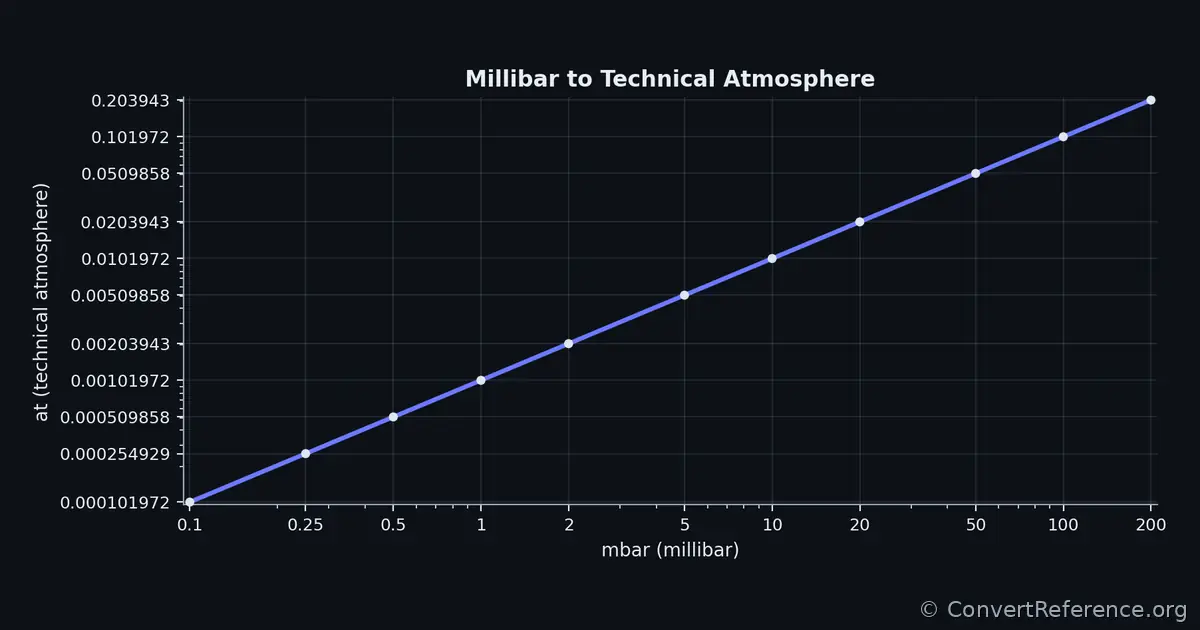
Millibars and Technical atmospheres Conversion Graph
Conversion graph showing the relationship between millibars and technical atmospheres.

Conversion Table For Millibar And Technical Atmosphere

Common conversion values
Millibars Technical atmospheres
0.10.000101972
0.250.000254929
0.50.000509858
10.00101972
20.00203943
50.00509858
100.0101972
200.0203943
500.0509858
1000.101972
2000.203943

Values are rounded for display; internal calculations use the exact conversion factors between millibar and technical atmosphere (0.00101971621297793 and 980.665).

Dataset & API Access

Programmatic Access

Free JSON API with stable endpoints and predictable keys for automated bidirectional conversions.

Endpoint: https://convertreference.org/api/v1/convert/millibar-to-technical-atmosphere.json

Content Type: application/json

Documentation: View API docs

Licensing

License: CC0 1.0 Universal (Public Domain)

See all datasets

Data & Editorial Process

All numerical values and formulas are generated from the Pint scientific unit library (v0.25), using constants consistent with the BIPM SI Brochure (9th Edition) and NIST Special Publication 811. Explanatory text is drafted with AI assistance and reviewed by ConvertReference editors for clarity and accuracy. This converter is completely free to use, and all calculations are performed locally in your browser and never sent to a server.

  • 2025-12-08 – Generated: Page created using Pint v0.25 verified constants.
  • 2025-12-08 – Reviewed: Verified by ConvertReference editors; no numerical changes required.