ConvertReference.org

Technical Atmosphere To Torr Converter

at

Review And Reference Information

Verified by the ConvertReference Technical Standards Team

ConvertReference Technical Standards Team

All values and formulas are validated through our editorial review process and cross-checked against internationally recognized reference standards (NIST, BIPM, CODATA).

View Editorial Standards & Report Corrections

Last reviewed: December 08, 2025

Conversion Factors

1 technical atmosphere = 735.559240069085 torr
1 torr = 0.00135950980631564 technical atmosphere

(Exact factors: 735.559240069085 and 0.00135950980631564)

Sources: NIST · BIPM

About This Technical Atmosphere And Torr Converter

Explore values between technical atmosphere and torr with this handy converter. View corresponding values in torr for the technical atmosphere range you choose. The interface is simple and fast, designed for quick checks and precise results. Use the swap button to switch between units.

What Are Technical Atmospheres And Torrs?

What Is A Technical Atmosphere?

Technical atmosphere (at) is a unit of pressure defined as 1 kilogram-force per square centimeter (kgf/cm2). It is a non-SI engineering unit (kgf/cm2). Exact relation: 1 at = 98,066.5 Pa = 98.0665 kPa ≈ 0.9807 bar. Symbol: at. Example: a bicycle tire at about 1 at is roughly 14.2 psi.

What Is A Torr?

Torr is a non-SI unit of pressure equal to 1/760 of an atmosphere. It is used in vacuum work. Symbol/abbrev.: Torr (often written torr). Exact relation to base units: 1 Torr = 101325 Pa / 760 ≈ 133.322 Pa. Real-world example: A typical lab vacuum is around 1 Torr.

When To Use Technical Atmosphere Vs Torr

Technical Atmosphere Usage

Technical atmosphere is used as a pressure reference in certain standards and measurements. It appears in tables and specifications across several regions. Primary users include the United States, Germany, France, and Japan.

Torr Usage

Torr is a pressure unit used in vacuum measurements and in some physics and laboratory settings. It is used in the United States, the United Kingdom, Germany, and Japan.

How To Convert Between Technical Atmospheres And Torrs

Conversion Formulas

Technical Atmosphere to Torr:
technical atmosphere × 735.559240069085 = torr

Torr to Technical Atmosphere:
torr × 0.00135950980631564 = technical atmosphere

Step-by-Step Guide

Technical Atmosphere to Torr

  1. Take your value in technical atmospheres.
  2. Multiply by 735.559240069085.
  3. The result is in torrs.

Torr to Technical Atmosphere

  1. Take your value in torrs.
  2. Multiply by 0.00135950980631564.
  3. The result is in technical atmospheres.

Example: Convert 7 technical atmospheres to torrs.

  • Exact: 7 × 735.559240069085 = 5148.91468048359 torrs.
  • Rounded: approximately 5148.91 torrs.

Example: Convert 5 torrs to technical atmospheres.

  • Exact: 5 × 0.00135950980631564 = 0.0067975490315782 technical atmospheres.
  • Rounded: approximately 0.00679755 technical atmospheres.

History & Context

Technical history shows how air pressure was learned and used. Otto von Guericke built air pumps and showed that a vacuum could be made. Evangelista Torricelli then built the mercury barometer, proving air has weight and can be measured. The unit named after him, the torr, became a common way to express small pressures in science and technology. The broader idea of an atmosphere grew as chemists and physicists used it to compare gases and their behavior. In industry, the technical atmosphere appeared as a practical pressure unit for machines and processes.

Practical Use

One common situation is a vacuum process specified in technical atmosphere (at) but readouts come from a gauge in torr, so technicians convert at to torr to verify that the chamber pressure matches the target. Conversely, when a spec or calibration data is given in torr, engineers convert to technical atmospheres to compare with equipment ratings expressed in at. This back-and-forth is routine in vacuum technology, ensuring control targets align with instrument scales in high-vacuum work. From thin-film deposition to leak testing, these two-unit conversions keep process parameters consistent across gauges and manuals.

Common Mistakes When Converting Between Technical Atmospheres And Torrs

  • Mistaking technical atmosphere for standard atmosphere and assuming they are the same.
  • Failing to specify whether the pressure is absolute or gauge before converting.
  • Assuming the same reference temperature applies to both units without verification.
  • Relying on a generic conversion without confirming the exact definitions used for technical atmosphere and torr.

Mental Shortcuts For Quick Conversions

Tip 1 (atm to torr): Multiply the value by 760 (remember 1 atm = 760 torr). Tip 2 (torr to atm): Divide the value by 760. These tips are for estimation only; use a precise converter for accurate results.

Technical Atmospheres And Torrs Conversion Graph
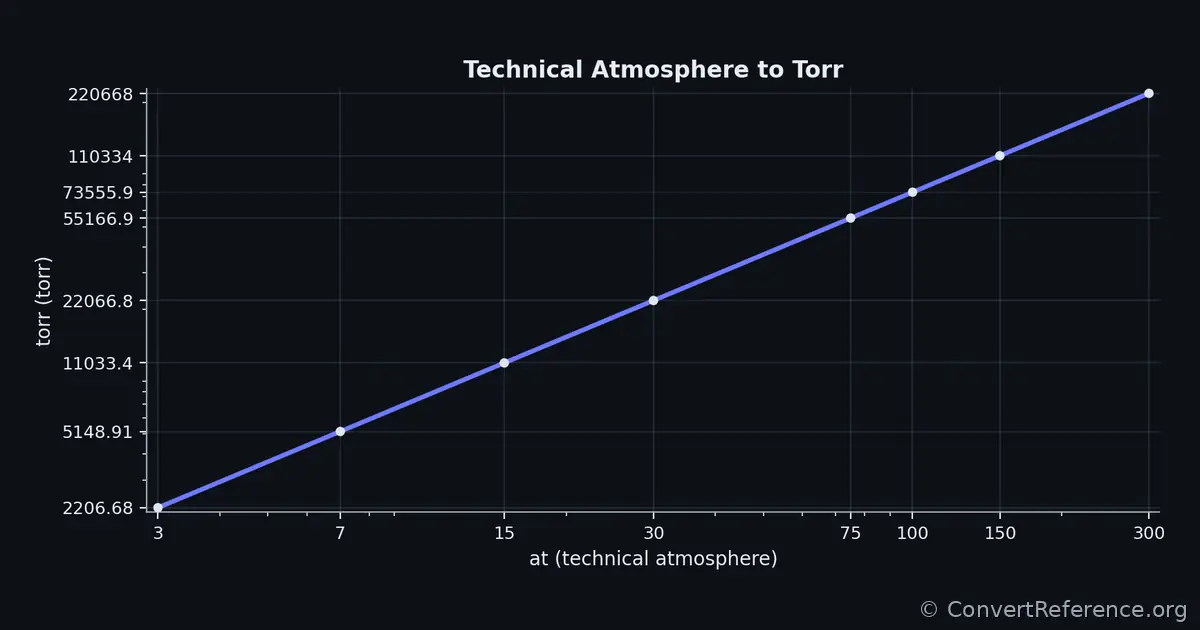
Technical atmospheres and Torrs Conversion Graph
Conversion graph showing the relationship between technical atmospheres and torrs.

Conversion Table For Technical Atmosphere And Torr

Common conversion values
Technical atmospheres Torrs
32206.68
75148.91
1511033.4
3022066.8
7555166.9
10073555.9
150110334
300220668

Values are rounded for display; internal calculations use the exact conversion factors between technical atmosphere and torr (735.559240069085 and 0.00135950980631564).

Dataset & API Access

Programmatic Access

Free JSON API with stable endpoints and predictable keys for automated bidirectional conversions.

Endpoint: https://convertreference.org/api/v1/convert/technical-atmosphere-to-torr.json

Content Type: application/json

Documentation: View API docs

Licensing

License: CC0 1.0 Universal (Public Domain)

See all datasets

Data & Editorial Process

All numerical values and formulas are generated from the Pint scientific unit library (v0.25), using constants consistent with the BIPM SI Brochure (9th Edition) and NIST Special Publication 811. Explanatory text is drafted with AI assistance and reviewed by ConvertReference editors for clarity and accuracy. This converter is completely free to use, and all calculations are performed locally in your browser and never sent to a server.

  • 2025-12-08 – Generated: Page created using Pint v0.25 verified constants.
  • 2025-12-08 – Reviewed: Verified by ConvertReference editors; no numerical changes required.