ConvertReference.org

Pascal To Technical Atmosphere Converter

Pa

Review And Reference Information

Verified by the ConvertReference Technical Standards Team

ConvertReference Technical Standards Team

All values and formulas are validated through our editorial review process and cross-checked against internationally recognized reference standards (NIST, BIPM, CODATA).

View Editorial Standards & Report Corrections

Last reviewed: December 08, 2025

Conversion Factors

1 pascal = 0.0000101971621297793 technical atmosphere
1 technical atmosphere = 98066.5 pascal

(Exact factors: 0.0000101971621297793 and 98066.5)

Sources: NIST · BIPM

About This Pascal And Technical Atmosphere Converter

This tool helps you compare pressure units quickly and clearly. Use the swap button to switch between pascal and technical atmosphere. Enter a value and view its equivalent in your chosen unit. It's simple to use and designed for quick results.

What Are Pascals And Technical Atmospheres?

What Is A Pascal?

Pascal (Pa) is the SI unit of pressure. It is defined as one newton per square meter (1 Pa = 1 N/m^2). Since N = kg·m/s^2, 1 Pa = 1 kg/(m·s^2). It belongs to the SI system; symbol: Pa. Real-world example: atmospheric pressure at sea level is about 101 kPa (about 101,000 Pa).

What Is A Technical Atmosphere?

Technical atmosphere (symbol: at) is a non-SI unit of pressure used in engineering. It is defined as 1 kgf per cm²: 1 at = 1 kgf/cm² = 98,066.5 Pa ≈ 0.968 atm. It relates to SI as 1 kgf = 9.80665 N and 1 cm² = 1e-4 m². Real-world: a car tire runs at about 2 at (≈196 kPa).

When To Use Pascal Vs Technical Atmosphere

Pascal Usage

The pascal (Pa) is the SI unit of pressure. It is used in science, education, and technical documents in countries that use SI units. Primary users include Germany, Japan, Canada, and Australia.

Technical Atmosphere Usage

Technical atmosphere is a legacy pressure unit found in older equipment manuals and standards. It appears in some regional specifications and calibration references, but modern practice uses pascal, bar, or other pressure units.

How To Convert Between Pascals And Technical Atmospheres

Conversion Formulas

Pascal to Technical Atmosphere:
pascal × 0.0000101971621297793 = technical atmosphere

Technical Atmosphere to Pascal:
technical atmosphere × 98066.5 = pascal

Step-by-Step Guide

Pascal to Technical Atmosphere

  1. Take your value in pascals.
  2. Multiply by 0.0000101971621297793.
  3. The result is in technical atmospheres.

Technical Atmosphere to Pascal

  1. Take your value in technical atmospheres.
  2. Multiply by 98066.5.
  3. The result is in pascals.

Example: Convert 7 pascals to technical atmospheres.

  • Exact: 7 × 0.0000101971621297793 = 0.000071380134908455 technical atmospheres.
  • Rounded: approximately 0.0000713801 technical atmospheres.

Example: Convert 5 technical atmospheres to pascals.

  • Exact: 5 × 98066.5 = 490332.5 pascals.
  • Rounded: approximately 490332 pascals.

History & Context

Blaise Pascal was a French thinker and scientist who studied how liquids and air press on each other. He showed that pressure in a confined fluid travels through the whole liquid, a principle that helped people understand hydraulics, engines, and weather instruments. Pascal also built an early calculating machine and wrote about chance and probability, linking math with practical tools. He explored vacuums and barometers, advancing ideas about measurement and experiment. The atmosphere became a named unit of pressure used in industry, while a technical atmosphere described machine pressure in engineering. This mix of theory, invention, and precise measurement shaped modern science and technology.

Practical Use

In engineering, you might need to convert from pascals to a technical atmosphere when checking a sensor or component spec that uses atm_t; for example, if a pressure sensor is listed as 250000 Pa but a datasheet quotes limits in atm_t, you would convert Pa to atm_t by dividing by 98066.5 to verify the safe operating range. Conversely, when reading a specification that uses a technical atmosphere, such as certain hydraulic or vacuum components rated in atm_t, you would convert to pascals by multiplying by 98066.5 to compare with the system design pressure. This ensures compatibility and appropriate safety margins when selecting parts.

Common Mistakes When Converting Between Pascals And Technical Atmospheres

  • Assuming Pascal and technical atmosphere are the same unit without performing any conversion.
  • Using the wrong direction of conversion between Pascal and technical atmosphere.
  • Confusing Pa with atm.
  • Assuming a single universal conversion factor applies in all contexts.

Mental Shortcuts For Quick Conversions

Tip 1: Pa → at: 1 at ≈ 98 kPa; estimate by Pa ÷ 98,000. Tip 2: at → Pa: 1 at ≈ 98 kPa; estimate by at × 98,000. Note: for estimation only; use a precise converter in most cases.

Pascals And Technical Atmospheres Conversion Graph
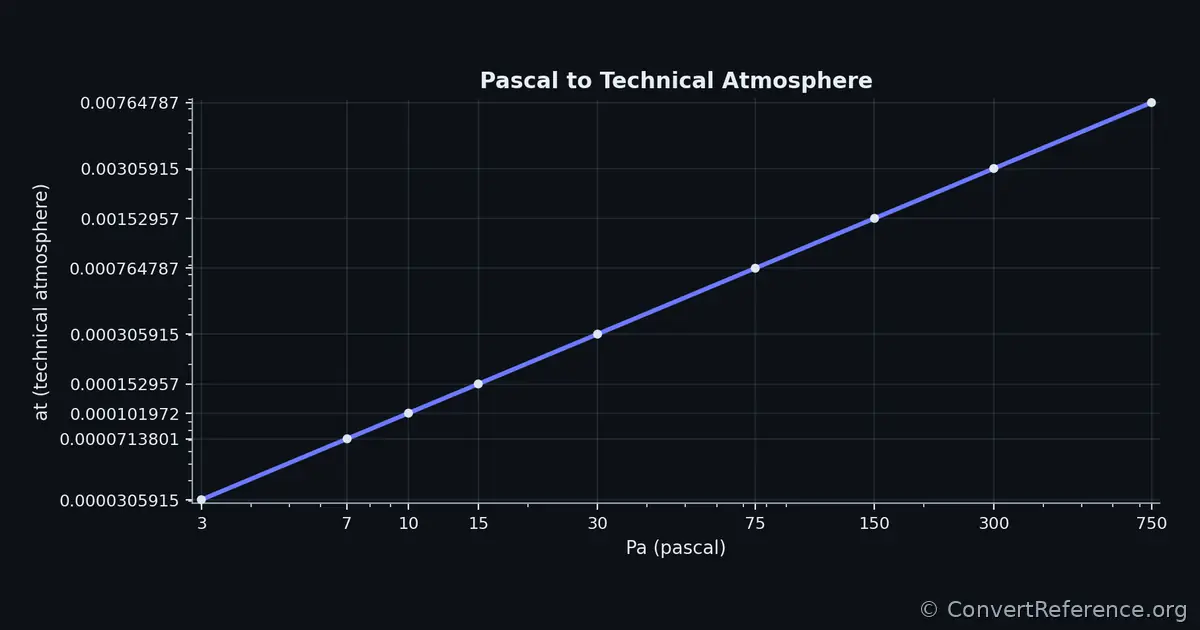
Pascals and Technical atmospheres Conversion Graph
Conversion graph showing the relationship between pascals and technical atmospheres.

Conversion Table For Pascal And Technical Atmosphere

Common conversion values
Pascals Technical atmospheres
30.0000305915
70.0000713801
100.000101972
150.000152957
300.000305915
750.000764787
1500.00152957
3000.00305915
7500.00764787

Values are rounded for display; internal calculations use the exact conversion factors between pascal and technical atmosphere (0.0000101971621297793 and 98066.5).

Dataset & API Access

Programmatic Access

Free JSON API with stable endpoints and predictable keys for automated bidirectional conversions.

Endpoint: https://convertreference.org/api/v1/convert/pascal-to-technical-atmosphere.json

Content Type: application/json

Documentation: View API docs

Licensing

License: CC0 1.0 Universal (Public Domain)

See all datasets

Data & Editorial Process

All numerical values and formulas are generated from the Pint scientific unit library (v0.25), using constants consistent with the BIPM SI Brochure (9th Edition) and NIST Special Publication 811. Explanatory text is drafted with AI assistance and reviewed by ConvertReference editors for clarity and accuracy. This converter is completely free to use, and all calculations are performed locally in your browser and never sent to a server.

  • 2025-12-08 – Generated: Page created using Pint v0.25 verified constants.
  • 2025-12-08 – Reviewed: Verified by ConvertReference editors; no numerical changes required.