ConvertReference.org

Kilopascal To Standard Atmosphere Converter

kPa

Review And Reference Information

Verified by the ConvertReference Technical Standards Team

ConvertReference Technical Standards Team

All values and formulas are validated through our editorial review process and cross-checked against internationally recognized reference standards (NIST, BIPM, CODATA).

View Editorial Standards & Report Corrections

Last reviewed: December 08, 2025

Conversion Factors

1 kilopascal = 0.00986923266716013 standard atmosphere
1 standard atmosphere = 101.325 kilopascal

(Exact factors: 0.00986923266716013 and 101.325)

Sources: NIST · BIPM

About This Kilopascal And Standard Atmosphere Converter

This handy unit converter makes it easy to compare pressure values between kilopascals and standard atmosphere. Type a value in kilopascals and view the result in standard atmosphere. If you need to compare another value, you can use the swap button to switch between units. Fast, simple, and ready when you need a quick reference for atmospheric pressures.

What Are Kilopascals And Standard Atmospheres?

What Is A Kilopascal?

Kilopascal (kPa) is the SI unit of pressure equal to 1,000 pascals. It belongs to the SI system. Symbol: kPa. Relationship: 1 kPa = 1,000 Pa. Example: A typical car tire pressure is about 200 kPa.

What Is A Standard Atmosphere?

Standard atmosphere (atm) is a unit of pressure defined as 101,325 pascals (Pa). It uses the SI base units because Pa is N/m^2 and N = kg·m/s^2, so 1 atm = 101,325 kg/(m·s^2). It belongs to the metric/SI system; symbol: atm. Example: at sea level, air pressure is about 1 atm, roughly 1013 hPa or 14.7 psi.

When To Use Kilopascal Vs Standard Atmosphere

Kilopascal Usage

Kilopascal (kPa) is the SI unit for pressure used in scientific measurements and weather reporting. It is common in many SI-using countries, including Canada, the United Kingdom, Australia, and Germany.

Standard Atmosphere Usage

Used as a reference model for scientific calculations, education, and atmospheric research, providing a baseline for studying atmospheric properties and calibrating instruments. It is adopted in curricula worldwide. Countries using it include the United States, United Kingdom, Germany, and Japan.

How To Convert Between Kilopascals And Standard Atmospheres

Conversion Formulas

Kilopascal to Standard Atmosphere:
kilopascal × 0.00986923266716013 = standard atmosphere

Standard Atmosphere to Kilopascal:
standard atmosphere × 101.325 = kilopascal

Step-by-Step Guide

Kilopascal to Standard Atmosphere

  1. Take your value in kilopascals.
  2. Multiply by 0.00986923266716013.
  3. The result is in standard atmospheres.

Standard Atmosphere to Kilopascal

  1. Take your value in standard atmospheres.
  2. Multiply by 101.325.
  3. The result is in kilopascals.

Example: Convert 2 kilopascals to standard atmospheres.

  • Exact: 2 × 0.00986923266716013 = 0.0197384653343203 standard atmospheres.
  • Rounded: approximately 0.0197385 standard atmospheres.

Example: Convert 5 standard atmospheres to kilopascals.

  • Exact: 5 × 101.325 = 506.625 kilopascals.

History & Context

Kilopascal and standard atmosphere are terms from the history of pressure measurement. The pascal, named for Blaise Pascal, became the SI unit for pressure, and the kilopascal made this measure practical for weather, science, and engineering as the metric system spread. When the International System of Units was adopted, kilopascals became common in laboratories and industry. The standard atmosphere was devised as a fixed reference pressure for experiments, aircraft design, and meteorology, so researchers could compare results without guessing conditions. It is often mentioned in historical contexts as a convenient sea level pressure reference used before more precise methods were adopted.

Practical Use

In aviation, pilots may need to convert kilopascals to standard atmosphere to interpret cabin-pressure readings that are reported in kPa against flight manuals. In meteorology and high-altitude planning, engineers may convert standard atmosphere to kilopascals to feed models and instruments that expect pressure in kilopascals. This ensures compatibility between different systems and calculations.

Common Mistakes When Converting Between Kilopascals And Standard Atmospheres

  • Treating kilopascals and standard atmospheres as interchangeable without applying a proper conversion.
  • Using an incorrect conversion factor without checking the direction of the conversion.
  • Confusing gauge pressure with absolute pressure when converting between kilopascals and standard atmospheres.
  • Assuming the standard atmosphere has the same value in all contexts without recognizing its defined reference.

Mental Shortcuts For Quick Conversions

Tip 1: 100 kPa ≈ 1 atm; divide by 100 for a quick estimate. Tip 2: 1 atm ≈ 101 kPa; multiply by 100 for a rough estimate. Note: estimation only; use a precise converter for accuracy.

Kilopascals And Standard Atmospheres Conversion Graph
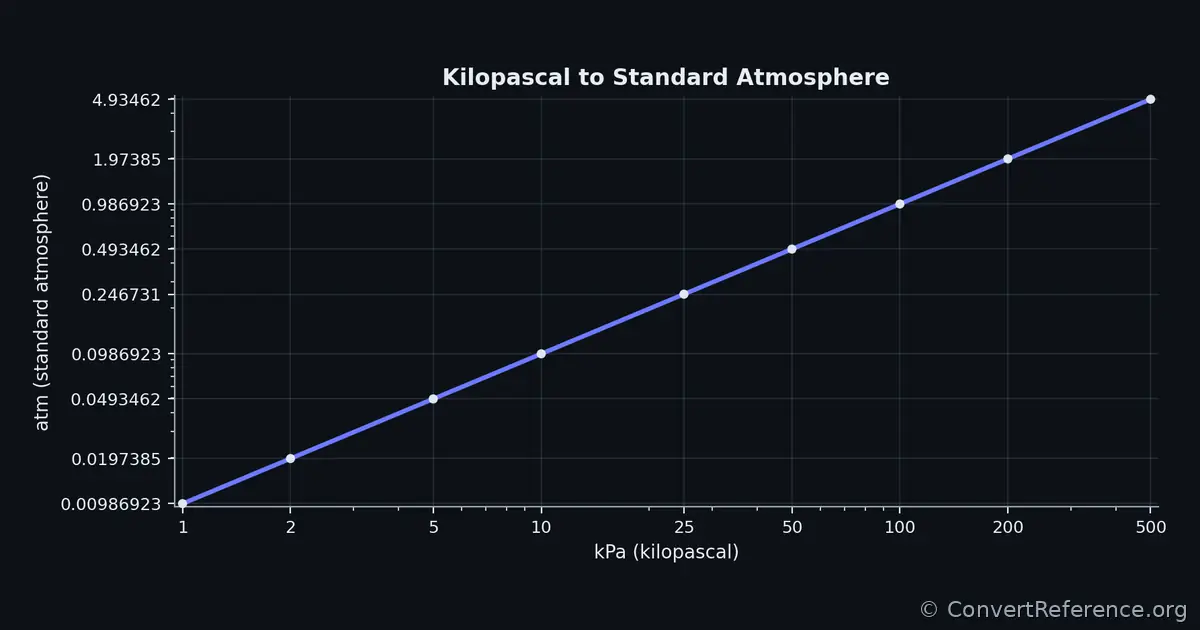
Kilopascals and Standard atmospheres Conversion Graph
Conversion graph showing the relationship between kilopascals and standard atmospheres.

Conversion Table For Kilopascal And Standard Atmosphere

Common conversion values
Kilopascals Standard atmospheres
10.00986923
20.0197385
50.0493462
100.0986923
250.246731
500.493462
1000.986923
2001.97385
5004.93462

Values are rounded for display; internal calculations use the exact conversion factors between kilopascal and standard atmosphere (0.00986923266716013 and 101.325).

Dataset & API Access

Programmatic Access

Free JSON API with stable endpoints and predictable keys for automated bidirectional conversions.

Endpoint: https://convertreference.org/api/v1/convert/kilopascal-to-standard-atmosphere.json

Content Type: application/json

Documentation: View API docs

Licensing

License: CC0 1.0 Universal (Public Domain)

See all datasets

Data & Editorial Process

All numerical values and formulas are generated from the Pint scientific unit library (v0.25), using constants consistent with the BIPM SI Brochure (9th Edition) and NIST Special Publication 811. Explanatory text is drafted with AI assistance and reviewed by ConvertReference editors for clarity and accuracy. This converter is completely free to use, and all calculations are performed locally in your browser and never sent to a server.

  • 2025-12-08 – Generated: Page created using Pint v0.25 verified constants.
  • 2025-12-08 – Reviewed: Verified by ConvertReference editors; no numerical changes required.