ConvertReference.org

Pascal To Standard Atmosphere Converter

Pa

Review And Reference Information

Verified by the ConvertReference Technical Standards Team

ConvertReference Technical Standards Team

All values and formulas are validated through our editorial review process and cross-checked against internationally recognized reference standards (NIST, BIPM, CODATA).

View Editorial Standards & Report Corrections

Last reviewed: December 08, 2025

Conversion Factors

1 pascal = 0.00000986923266716013 standard atmosphere
1 standard atmosphere = 101325 pascal

(Exact factors: 0.00000986923266716013 and 101325)

Sources: NIST · BIPM

About This Pascal And Standard Atmosphere Converter

This quick tool makes it easy to compare pressure values in pascal and standard atmosphere. Explore different numbers and observe how they relate across the units. Use the swap button to switch between pascal and standard atmosphere at any time. The interface is simple, fast, and designed for quick reference.

What Are Pascals And Standard Atmospheres?

What Is A Pascal?

Pascal (Pa) is the SI unit of pressure. It is a derived unit: 1 Pa = 1 N/m^2 = 1 kg/(m*s^2). It belongs to the International System of Units (SI). Common symbol: Pa. Real-world example: atmospheric pressure at sea level is about 101,325 Pa (about 101 kPa).

What Is A Standard Atmosphere?

Standard atmosphere (atm) is a unit of pressure used in science and aviation. It is defined as exactly 101,325 pascals (Pa). It belongs to the SI framework as a defined unit of pressure (not a base unit). 1 atm = 101.325 kPa. Symbol: atm. Example: at sea level the air pressure is about 1 atm; a car tire is typically about 2 atm.

When To Use Pascal Vs Standard Atmosphere

Pascal Usage

Pascal (Pa) is the SI unit of pressure used worldwide in science, education, and everyday measurements. It appears in weather data, lab work, and consumer devices. The United States, United Kingdom, Germany, and Japan are among the countries where it is widely used, reflecting its broad adoption across contexts.

Standard Atmosphere Usage

Standard atmosphere serves as a reference model for atmospheric properties in scientific calculations and education, providing a common basis for comparing conditions. It is used in the United States, United Kingdom, Germany, and Japan.

How To Convert Between Pascals And Standard Atmospheres

Conversion Formulas

Pascal to Standard Atmosphere:
pascal × 0.00000986923266716013 = standard atmosphere

Standard Atmosphere to Pascal:
standard atmosphere × 101325 = pascal

Step-by-Step Guide

Pascal to Standard Atmosphere

  1. Take your value in pascals.
  2. Multiply by 0.00000986923266716013.
  3. The result is in standard atmospheres.

Standard Atmosphere to Pascal

  1. Take your value in standard atmospheres.
  2. Multiply by 101325.
  3. The result is in pascals.

Example: Convert 0.05 pascals to standard atmospheres.

  • Exact: 0.05 × 0.00000986923266716013 = 4.93461633358006e-7 standard atmospheres.
  • Rounded: approximately 4.93462e-7 standard atmospheres.

Example: Convert 5 standard atmospheres to pascals.

  • Exact: 5 × 101325 = 506625 pascals.

History & Context

Blaise Pascal, a French thinker of the seventeenth century, studied how air and liquids bear pressure. He and his father did experiments at various heights and with tubes to show that pressure changes with height and is transmitted through fluids. These tests helped people understand how pumps, hydraulics, and weather instruments work, and they supported the idea that atmospheric pressure is a real property of the air. The standard atmosphere is a later effort to give science and engineering a single practical reference for air conditions. It was shaped by researchers and standard bodies who defined a common model of air around sea level and through ascent, aiding aircraft, engines, and instruments in calculations and design.

Practical Use

In some engineering tests, pressure is recorded in pascals but reference charts use standard atmosphere, so you need to convert from pascals to atm. Conversely, when calibrating equipment or reading meteorological data that express pressure in atmospheres, you must convert from standard atmosphere to pascals. A quick online unit converter lets you switch between these two units and keep data consistent.

Common Mistakes When Converting Between Pascals And Standard Atmospheres

  • Treating pascal and standard atmosphere as the same unit without converting.
  • Using the wrong direction when converting between pascal and standard atmosphere.
  • Confusing standard atmosphere with a weather pressure reading.
  • Assuming there is no fixed reference for standard atmosphere and using an arbitrary pressure as if it were the standard.

Mental Shortcuts For Quick Conversions

Pa to standard atmosphere: Divide by 101325 (Pa ÷ 101325 ≈ atm). Standard atmosphere to Pa: Multiply by 101325 (atm × 101325 ≈ Pa). Estimation only; use a precise converter when accuracy matters.

Pascals And Standard Atmospheres Conversion Graph
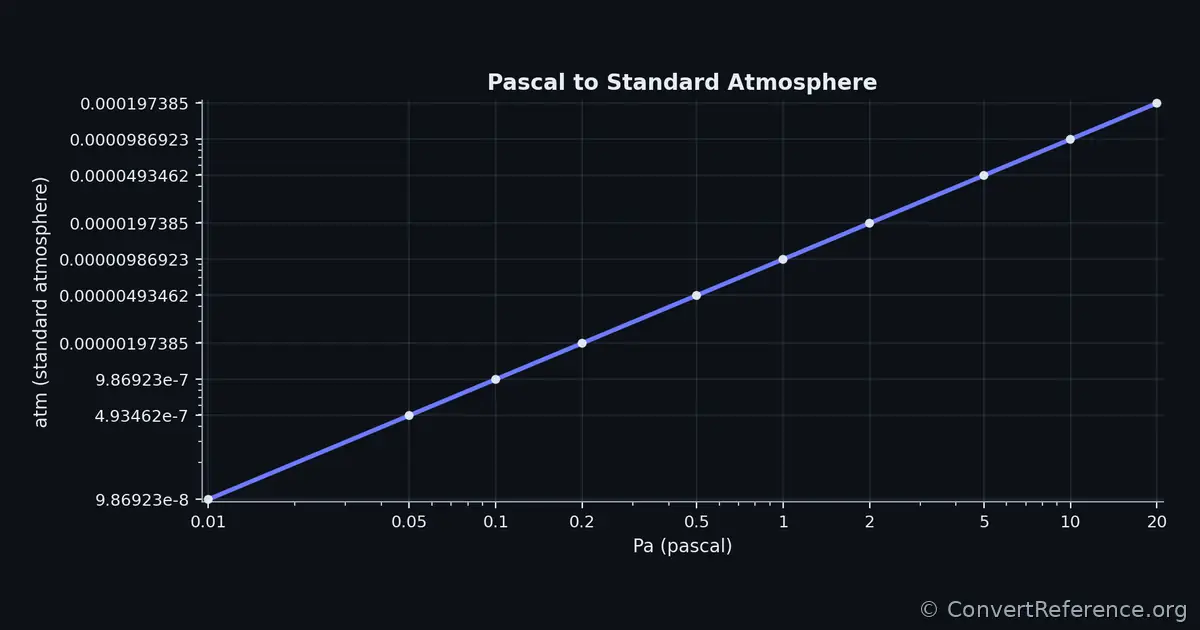
Pascals and Standard atmospheres Conversion Graph
Conversion graph showing the relationship between pascals and standard atmospheres.

Conversion Table For Pascal And Standard Atmosphere

Common conversion values
Pascals Standard atmospheres
0.019.86923e-8
0.054.93462e-7
0.19.86923e-7
0.20.00000197385
0.50.00000493462
10.00000986923
20.0000197385
50.0000493462
100.0000986923
200.000197385

Values are rounded for display; internal calculations use the exact conversion factors between pascal and standard atmosphere (0.00000986923266716013 and 101325).

Dataset & API Access

Programmatic Access

Free JSON API with stable endpoints and predictable keys for automated bidirectional conversions.

Endpoint: https://convertreference.org/api/v1/convert/pascal-to-standard-atmosphere.json

Content Type: application/json

Documentation: View API docs

Licensing

License: CC0 1.0 Universal (Public Domain)

See all datasets

Data & Editorial Process

All numerical values and formulas are generated from the Pint scientific unit library (v0.25), using constants consistent with the BIPM SI Brochure (9th Edition) and NIST Special Publication 811. Explanatory text is drafted with AI assistance and reviewed by ConvertReference editors for clarity and accuracy. This converter is completely free to use, and all calculations are performed locally in your browser and never sent to a server.

  • 2025-12-08 – Generated: Page created using Pint v0.25 verified constants.
  • 2025-12-08 – Reviewed: Verified by ConvertReference editors; no numerical changes required.