ConvertReference.org

Standard Atmosphere To Technical Atmosphere Converter

atm

Review And Reference Information

Verified by the ConvertReference Technical Standards Team

ConvertReference Technical Standards Team

All values and formulas are validated through our editorial review process and cross-checked against internationally recognized reference standards (NIST, BIPM, CODATA).

View Editorial Standards & Report Corrections

Last reviewed: December 08, 2025

Conversion Factors

1 standard atmosphere = 1.03322745279989 technical atmosphere
1 technical atmosphere = 0.967841105354059 standard atmosphere

(Exact factors: 1.03322745279989 and 0.967841105354059)

Sources: NIST · BIPM

About This Standard Atmosphere And Technical Atmosphere Converter

Welcome to our unit converter. Quickly compare standard atmosphere and technical atmosphere values with ease. This tool keeps things simple and focused on the numbers you need. Use the swap button to switch between units anytime.

What Are Standard Atmospheres And Technical Atmospheres?

What Is A Standard Atmosphere?

Standard atmosphere (atm) is a unit of pressure defined exactly as 101,325 pascals (Pa). It belongs to the SI system; symbol: atm. Relationship to base units: 1 atm = 101,325 Pa (Pa = N/m²; N=kg·m/s²). Real-world example: at sea level air pressure is about 1 atm; a typical car tire runs near 2 atm.

What Is A Technical Atmosphere?

Technical atmosphere (at) is a pressure unit defined as 1 kgf/cm² = 98,066.5 Pa (≈0.9807 bar, ≈0.968 atm). It is a non-SI engineering unit. Symbol: at. Base relation: 1 at = 98,066.5 Pa. Example: a bicycle tire inflated to about 2 at is roughly 196 kPa, giving a sense of its scale.

When To Use Standard Atmosphere Vs Technical Atmosphere

Standard Atmosphere Usage

Standard atmosphere (atm) is used as a reference pressure in physics, chemistry, and general laboratory calculations, and in educational descriptions of gas behavior and altitude-related pressure changes. It defines 101,325 Pa as a baseline. Commonly used in the United States, United Kingdom, Canada, and Germany.

Technical Atmosphere Usage

Technical atmosphere is used as a pressure reference in some national standards and older equipment specifications. It appears in technical documents and product data in several countries, including Germany, Russia, India, and Brazil.

How To Convert Between Standard Atmospheres And Technical Atmospheres

Conversion Formulas

Standard Atmosphere to Technical Atmosphere:
standard atmosphere × 1.03322745279989 = technical atmosphere

Technical Atmosphere to Standard Atmosphere:
technical atmosphere × 0.967841105354059 = standard atmosphere

Step-by-Step Guide

Standard Atmosphere to Technical Atmosphere

  1. Take your value in standard atmospheres.
  2. Multiply by 1.03322745279989.
  3. The result is in technical atmospheres.

Technical Atmosphere to Standard Atmosphere

  1. Take your value in technical atmospheres.
  2. Multiply by 0.967841105354059.
  3. The result is in standard atmospheres.

Example: Convert 7 standard atmospheres to technical atmospheres.

  • Exact: 7 × 1.03322745279989 = 7.2325921695992 technical atmospheres.
  • Rounded: approximately 7.23259 technical atmospheres.

Example: Convert 5 technical atmospheres to standard atmospheres.

  • Exact: 5 × 0.967841105354059 = 4.83920552677029 standard atmospheres.
  • Rounded: approximately 4.83921 standard atmospheres.

History & Context

Standard atmosphere began as a practical reference as aviation and engine testing grew, describing how air changes with height and giving a common basis for design. The International Standard Atmosphere, developed and adopted by international aviation and meteorology groups, was formalized in the mid twentieth century by ICAO and ISO to provide consistent sea level values and layered properties for aircraft performance, engine testing, and instrument calibration. The technical atmosphere is an older engineering idea that offered a simpler, pressure based reference for machines and experiments, influencing how engineers compared equipment when real air varied with height.

Practical Use

Design engineers may need to convert standard atmosphere to technical atmosphere when specifying pressures for valves, seals, or pneumatic actuators to align with older catalogs and component ratings. Conversely, technicians or researchers often convert technical atmosphere to standard atmosphere when comparing calibration data, experimental results, or meteorological information with modern performance charts that use standard atmosphere. This ensures consistency in pressure-based calculations, safety margins, and system behavior across different documentation and datasets.

Common Mistakes When Converting Between Standard Atmospheres And Technical Atmospheres

  • Assuming ISA values apply at altitude without adjusting for actual conditions.
  • Confusing geopotential height with geometric height when converting between standard and technical atmospheres.
  • Treating 1 atm and 1 at as the same pressure without proper unit conversion.
  • Mixing up absolute and gauge pressure when switching between the two scales.

Mental Shortcuts For Quick Conversions

ST to TA: '0.97×Standard' (tech ~3% lower). TA to ST: invert with 'divide by 0.97' (~1.03×). For estimation only; use a precise converter when accuracy matters.

Standard Atmospheres And Technical Atmospheres Conversion Graph
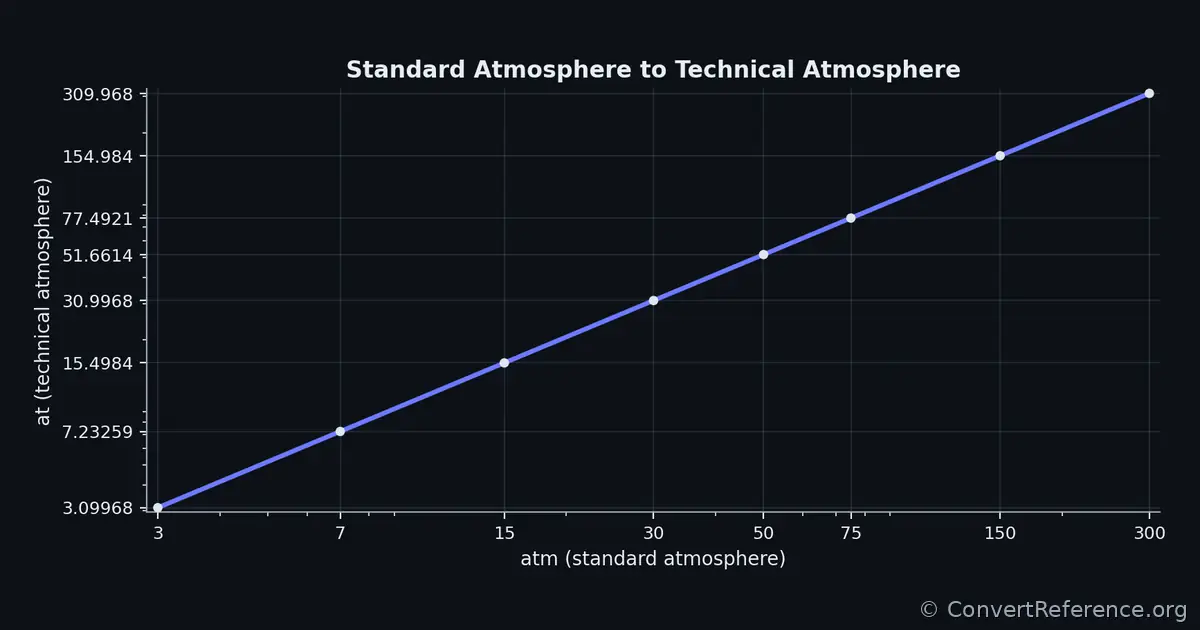
Standard atmospheres and Technical atmospheres Conversion Graph
Conversion graph showing the relationship between standard atmospheres and technical atmospheres.

Conversion Table For Standard Atmosphere And Technical Atmosphere

Common conversion values
Standard atmospheres Technical atmospheres
33.09968
77.23259
1515.4984
3030.9968
5051.6614
7577.4921
150154.984
300309.968

Values are rounded for display; internal calculations use the exact conversion factors between standard atmosphere and technical atmosphere (1.03322745279989 and 0.967841105354059).

Dataset & API Access

Programmatic Access

Free JSON API with stable endpoints and predictable keys for automated bidirectional conversions.

Endpoint: https://convertreference.org/api/v1/convert/standard-atmosphere-to-technical-atmosphere.json

Content Type: application/json

Documentation: View API docs

Licensing

License: CC0 1.0 Universal (Public Domain)

See all datasets

Data & Editorial Process

All numerical values and formulas are generated from the Pint scientific unit library (v0.25), using constants consistent with the BIPM SI Brochure (9th Edition) and NIST Special Publication 811. Explanatory text is drafted with AI assistance and reviewed by ConvertReference editors for clarity and accuracy. This converter is completely free to use, and all calculations are performed locally in your browser and never sent to a server.

  • 2025-12-08 – Generated: Page created using Pint v0.25 verified constants.
  • 2025-12-08 – Reviewed: Verified by ConvertReference editors; no numerical changes required.