ConvertReference.org

Standard Atmosphere To Torr Converter

atm

Review And Reference Information

Verified by the ConvertReference Technical Standards Team

ConvertReference Technical Standards Team

All values and formulas are validated through our editorial review process and cross-checked against internationally recognized reference standards (NIST, BIPM, CODATA).

View Editorial Standards & Report Corrections

Last reviewed: December 08, 2025

Conversion Factors

1 standard atmosphere = 760 torr
1 torr = 0.00131578947368421 standard atmosphere

(Exact factors: 760 and 0.00131578947368421)

Sources: NIST · BIPM

About This Standard Atmosphere And Torr Converter

Effortlessly view values between standard atmosphere and torr with this handy tool. See instant results as you compare different scenarios. Use the swap button to switch between units anytime. A simple, fast interface makes it easy to stay on track.

What Are Standard Atmospheres And Torrs?

What Is A Standard Atmosphere?

Standard atmosphere (atm) is a unit of pressure equal to 101,325 pascals (Pa). It is defined as 101,325 N/m^2. It belongs to the SI family as a non-SI unit accepted for use with SI. Symbol: atm. Relation: 1 atm = 101,325 Pa. Example: sea-level air pressure is about 1 atm; a sealed soda can is near 1 atm inside.

What Is A Torr?

Torr is a unit of pressure equal to 1/760 of an atmosphere. It is defined by 1 atm = 760 torr, and 1 torr ≈ 133.322 pascals. It is a non-SI unit commonly used in vacuum technology and physics. Symbol/abbreviation: Torr (often written as 'torr'). Real-world: sea-level pressure is about 760 torr; a typical lab vacuum chamber may be around 1 torr, about 0.13% of atmospheric pressure.

When To Use Standard Atmosphere Vs Torr

Standard Atmosphere Usage

Standard atmosphere provides a reference model of atmospheric properties (temperature, pressure, density) with altitude for scientific calculations. It supports consistent data in education and research and is adopted by national standards bodies and meteorological agencies. Primary users include the United States, United Kingdom, Canada, and Germany.

Torr Usage

Torr is a traditional unit of pressure used for low-pressure measurements. It remains in use in several countries, including the United States, the United Kingdom, Germany, and Japan.

How To Convert Between Standard Atmospheres And Torrs

Conversion Formulas

Standard Atmosphere to Torr:
standard atmosphere × 760 = torr

Torr to Standard Atmosphere:
torr × 0.00131578947368421 = standard atmosphere

Step-by-Step Guide

Standard Atmosphere to Torr

  1. Take your value in standard atmospheres.
  2. Multiply by 760.
  3. The result is in torrs.

Torr to Standard Atmosphere

  1. Take your value in torrs.
  2. Multiply by 0.00131578947368421.
  3. The result is in standard atmospheres.

Example: Convert 0.05 standard atmospheres to torrs.

  • Exact: 0.05 × 760 = 38 torrs.

Example: Convert 5 torrs to standard atmospheres.

  • Exact: 5 × 0.00131578947368421 = 0.00657894736842105 standard atmospheres.
  • Rounded: approximately 0.00657895 standard atmospheres.

History & Context

Torricelli showed that air has weight by using a mercury barometer, paving the way for the study of atmospheric pressure. Over time scientists learned that air pressure changes with height and weather, leading to practical systems for measuring and comparing pressure. In aviation and science a standard atmosphere was created as a common reference, defining typical conditions and how pressure behaves with altitude. The torr, a unit named for Torricelli, became a familiar term in vacuum work and meteorology, connecting barometer history to modern pressure practice.

Practical Use

In a physics lab using a vacuum chamber, a target pressure is sometimes specified in standard atmospheres, so technicians convert to torr (1 atm = 760 torr) to set the chamber. In another scenario, when a gauge reads in torr during system testing, engineers convert that value to standard atmospheres to compare with equipment ratings, for example 600 torr ≈ 0.79 atm. These conversions keep specifications and readings consistent across instruments.

Common Mistakes When Converting Between Standard Atmospheres And Torrs

  • Assuming atmosphere and torr are the same unit without converting.
  • Using standard atmosphere values directly in torr without performing any conversion.
  • Confusing torr with millimeters of mercury and treating them as completely unrelated units.
  • Relying on rough estimates or memory instead of applying the correct relationship between standard atmosphere and torr.

Mental Shortcuts For Quick Conversions

Tip 1: 1 atm = 760 torr. For quick estimates, multiply the atm value by 760. Tip 2: torr to atm = torr / 760. For estimation only; use a precise converter for accurate results.

Standard Atmospheres And Torrs Conversion Graph
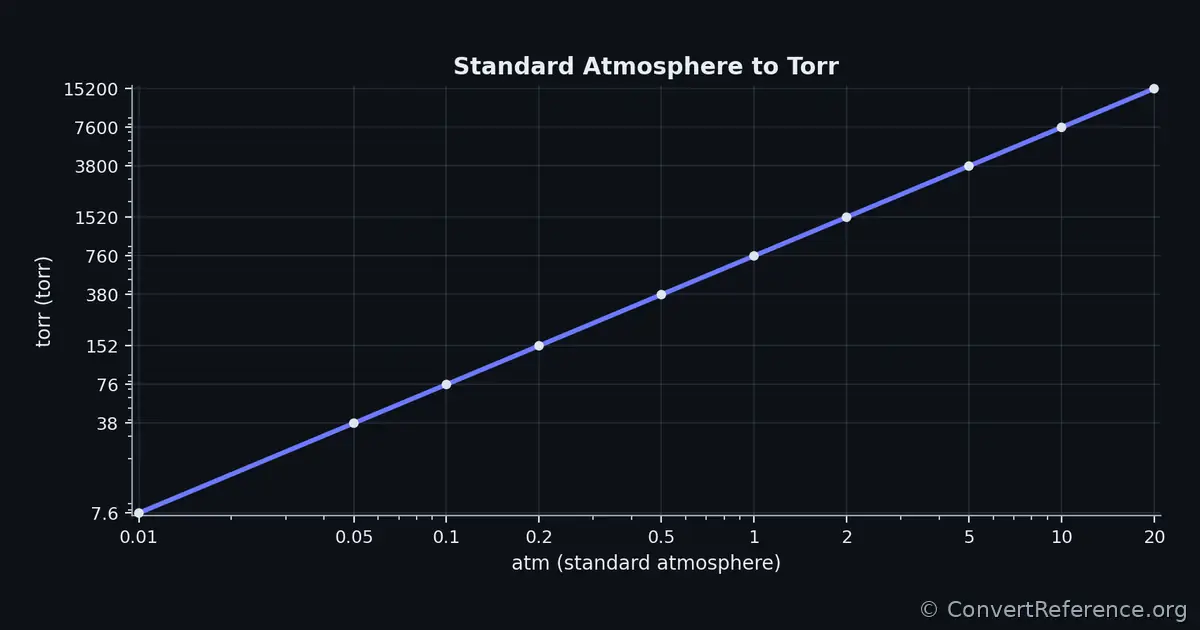
Standard atmospheres and Torrs Conversion Graph
Conversion graph showing the relationship between standard atmospheres and torrs.

Conversion Table For Standard Atmosphere And Torr

Common conversion values
Standard atmospheres Torrs
0.017.6
0.0538
0.176
0.2152
0.5380
1760
21520
53800
107600
2015200

Values are rounded for display; internal calculations use the exact conversion factors between standard atmosphere and torr (760 and 0.00131578947368421).

Dataset & API Access

Programmatic Access

Free JSON API with stable endpoints and predictable keys for automated bidirectional conversions.

Endpoint: https://convertreference.org/api/v1/convert/standard-atmosphere-to-torr.json

Content Type: application/json

Documentation: View API docs

Licensing

License: CC0 1.0 Universal (Public Domain)

See all datasets

Data & Editorial Process

All numerical values and formulas are generated from the Pint scientific unit library (v0.25), using constants consistent with the BIPM SI Brochure (9th Edition) and NIST Special Publication 811. Explanatory text is drafted with AI assistance and reviewed by ConvertReference editors for clarity and accuracy. This converter is completely free to use, and all calculations are performed locally in your browser and never sent to a server.

  • 2025-12-08 – Generated: Page created using Pint v0.25 verified constants.
  • 2025-12-08 – Reviewed: Verified by ConvertReference editors; no numerical changes required.