ConvertReference.org

Bar To Technical Atmosphere Converter

bar

Review And Reference Information

Verified by the ConvertReference Technical Standards Team

ConvertReference Technical Standards Team

All values and formulas are validated through our editorial review process and cross-checked against internationally recognized reference standards (NIST, BIPM, CODATA).

View Editorial Standards & Report Corrections

Last reviewed: December 08, 2025

Conversion Factors

1 bar = 1.01971621297793 technical atmosphere
1 technical atmosphere = 0.980665 bar

(Exact factors: 1.01971621297793 and 0.980665)

Sources: NIST · BIPM

About This Bar And Technical Atmosphere Converter

Welcome to the bar to technical atmosphere converter. This tool helps you compare pressure values quickly and easily. Enter a value in bar and view the result in technical atmosphere, with the option to switch between units using the swap button. It’s fast, simple, and designed for everyday use.

What Are Bars And Technical Atmospheres?

What Is A Bar?

Bar is a unit of pressure in the metric system. It is defined as exactly 100,000 pascals (Pa), so 1 bar = 100,000 Pa. It is a non-SI unit; symbol: bar. Real-world example: sea-level atmospheric pressure is about 1 bar (~100 kPa).

What Is A Technical Atmosphere?

Technical atmosphere (at) is a non-SI unit of pressure used in engineering and vacuum technology. It is defined as 1 at = 1 kilogram-force per square centimeter = 98,066.5 pascals. It belongs to non-SI units accepted for use with the SI. Its symbol is at (often written as at or at(tech)). Real-world example: a typical car tire at about 2 at equals roughly 28–29 psi.

When To Use Bar Vs Technical Atmosphere

Bar Usage

Bar is a practical unit of pressure used in meteorology and everyday measurements. It remains common in several regions of Europe and beyond. Primary countries that use it include Germany, France, Italy, and Spain.

Technical Atmosphere Usage

Technical atmosphere is used in some laboratory and calibration contexts where older equipment or non-SI references are maintained. It appears in historic data sheets, standard references, and educational materials in several regions. It is used in the United States, Germany, Japan, and India.

How To Convert Between Bars And Technical Atmospheres

Conversion Formulas

Bar to Technical Atmosphere:
bar × 1.01971621297793 = technical atmosphere

Technical Atmosphere to Bar:
technical atmosphere × 0.980665 = bar

Step-by-Step Guide

Bar to Technical Atmosphere

  1. Take your value in bars.
  2. Multiply by 1.01971621297793.
  3. The result is in technical atmospheres.

Technical Atmosphere to Bar

  1. Take your value in technical atmospheres.
  2. Multiply by 0.980665.
  3. The result is in bars.

Example: Convert 0.05 bars to technical atmospheres.

  • Exact: 0.05 × 1.01971621297793 = 0.0509858106488964 technical atmospheres.
  • Rounded: approximately 0.0509858 technical atmospheres.

Example: Convert 5 technical atmospheres to bars.

  • Exact: 5 × 0.980665 = 4.903325 bars.
  • Rounded: approximately 4.90333 bars.

History & Context

Pressure has long used references from everyday life, and in science engineers searched for a simple unit. The bar emerged as a practical decimal unit to measure pressure in many fields, offering a convenient alternative to older measures. It spread through European engineering and scientific work as institutions and standards bodies agreed on clear terms for pressure. The technical atmosphere developed as another practical unit used in engineering and industry, chosen for its ease in calculations and its alignment with familiar ideas of atmospheric pressure. This history shows how standardization and the desire for clear communication shaped how people compare pressures in machines, weather, and research, creating common language across nations and disciplines.

Practical Use

On a lab safety sheet, a pressure limit may be listed in bar while the testing protocol uses technical atmosphere (at), so researchers convert bar to at to ensure readings and safety checks line up. In another workflow, a regulator or test fixture labeled in at requires converting technical atmosphere to bar to dial in the correct target pressure on gauges and controls. These conversions help keep measurements consistent across equipment and procedures that use different units.

Common Mistakes When Converting Between Bars And Technical Atmospheres

  • Assuming bar and technical atmosphere are the same unit.
  • Using a conversion method from other pressure units without verifying how it applies to bar and technical atmosphere.
  • The conversion direction is applied incorrectly.
  • Relying on memory or rough rules of thumb instead of consulting the official definitions.

Mental Shortcuts For Quick Conversions

Tip 1: Bar → technical atmosphere: multiply by about 0.97 (1 bar ≈ 0.9678 at). Tip 2: Technical atmosphere → bar: multiply by about 1.03 (1 at ≈ 1.033 bar). For estimation only; use a precise converter in most cases.

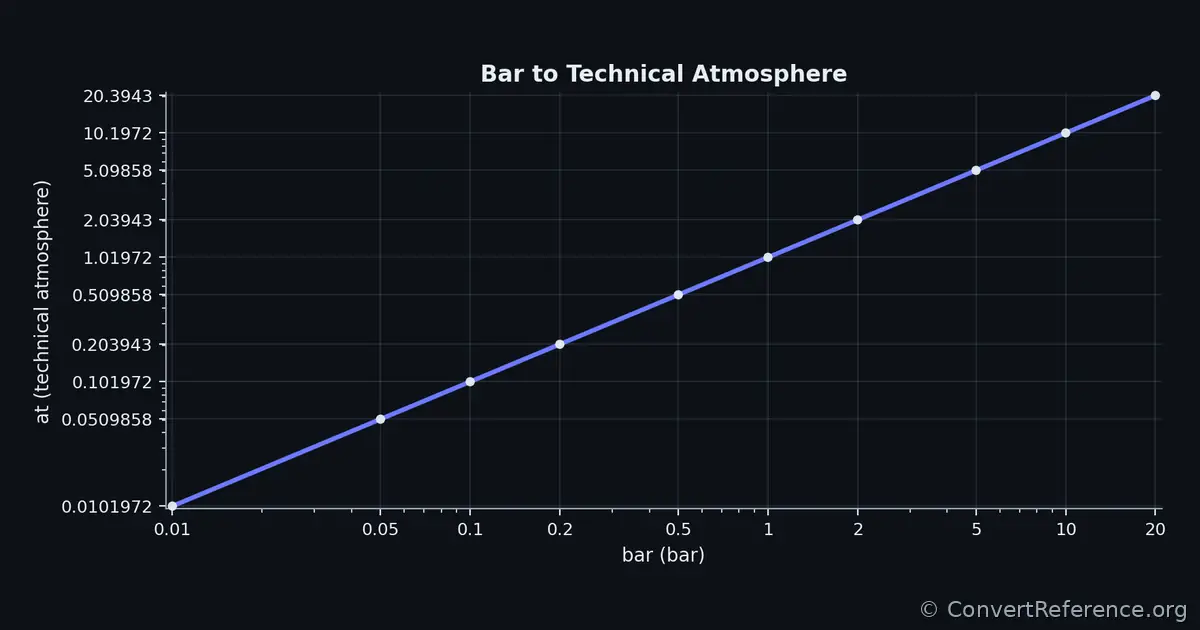
Bars And Technical Atmospheres Conversion Graph
Bars and Technical atmospheres Conversion Graph
Conversion graph showing the relationship between bars and technical atmospheres.

Conversion Table For Bar And Technical Atmosphere

Common conversion values
Bars Technical atmospheres
0.010.0101972
0.050.0509858
0.10.101972
0.20.203943
0.50.509858
11.01972
22.03943
55.09858
1010.1972
2020.3943

Values are rounded for display; internal calculations use the exact conversion factors between bar and technical atmosphere (1.01971621297793 and 0.980665).

Dataset & API Access

Programmatic Access

Free JSON API with stable endpoints and predictable keys for automated bidirectional conversions.

Endpoint: https://convertreference.org/api/v1/convert/bar-to-technical-atmosphere.json

Content Type: application/json

Documentation: View API docs

Licensing

License: CC0 1.0 Universal (Public Domain)

See all datasets

Data & Editorial Process

All numerical values and formulas are generated from the Pint scientific unit library (v0.25), using constants consistent with the BIPM SI Brochure (9th Edition) and NIST Special Publication 811. Explanatory text is drafted with AI assistance and reviewed by ConvertReference editors for clarity and accuracy. This converter is completely free to use, and all calculations are performed locally in your browser and never sent to a server.

  • 2025-12-08 – Generated: Page created using Pint v0.25 verified constants.
  • 2025-12-08 – Reviewed: Verified by ConvertReference editors; no numerical changes required.