ConvertReference.org

Day To Year Converter

d

Review And Reference Information

Verified by the ConvertReference Technical Standards Team

ConvertReference Technical Standards Team

All values and formulas are validated through our editorial review process and cross-checked against internationally recognized reference standards (NIST, BIPM, CODATA).

View Editorial Standards & Report Corrections

Last reviewed: December 08, 2025

Conversion Factors

1 day = 0.0027378507871321 year
1 year = 365.25 day

(Exact factors: 0.0027378507871321 and 365.25)

Sources: NIST · BIPM

About This Day And Year Converter

Easily compare days to years with this quick, user-friendly tool. See how a number of days translates to years at a glance. Use the swap button to switch between day and year views. Designed for fast, clear comparisons whenever you need them.

What Are Days And Years?

What Is A Day?

Day is a unit of time defined as 24 hours, equal to 1,440 minutes or 86,400 seconds. It belongs to the SI time units; the SI base unit for time is the second. Common symbol: d. In terms of a base unit: 1 day = 24 hours = 86400 seconds. Example: a typical workday lasts about 8 hours, which is one third of a day.

What Is A Year?

Year (yr) is a unit of time. In fixed use, a Julian year equals 365.25 days, exactly 31,557,600 seconds. It is not an SI base unit (the second is). Belongs to the time system and is used in calendars and astronomy. Symbol: yr (also annum a). Example: from Jan 1, 2020 to Jan 1, 2021 is one calendar year (about 365 days).

When To Use Day Vs Year

Day Usage

The day is a basic time unit used in daily life, calendars, and general scheduling. People reference durations in days (e.g., 1 day, 7 days) and plan events and timelines accordingly. Primary users include the United States, United Kingdom, Germany, and Japan.

Year Usage

Year is the basic time unit used in calendars, education, business planning, and record-keeping. It marks ages, anniversaries, fiscal years, and annual schedules. It is used in many countries, including the United States, United Kingdom, Japan, and India.

How To Convert Between Days And Years

Conversion Formulas

Day to Year:
day × 0.0027378507871321 = year

Year to Day:
year × 365.25 = day

Step-by-Step Guide

Day to Year

  1. Take your value in days.
  2. Multiply by 0.0027378507871321.
  3. The result is in years.

Year to Day

  1. Take your value in years.
  2. Multiply by 365.25.
  3. The result is in days.

Example: Convert 0.5 days to years.

  • Exact: 0.5 × 0.0027378507871321 = 0.00136892539356605 years.
  • Rounded: approximately 0.00136893 years.

Example: Convert 5 years to days.

  • Exact: 5 × 365.25 = 1826.25 days.

History & Context

People long ago observed that a day equals the cycle from sunrise to sunrise and that a year follows the course of the seasons. In ancient Egypt the day was divided by the sun into parts, and water clocks helped measure time when the sun was hidden. Mesopotamian and Greek thinkers used stars and seasons to guess how long the year would last, and over many generations communities devised calendars to keep crops and rituals in step. A major change came when rulers and scholars in later centuries reformed the system, creating calendars that better matched the cycle of the sun and the seasons, so that years and days could be planned with greater regularity.

Practical Use

A meteorologist might need to convert days to years when summarizing many years of daily temperature data to present long-term trends in annual terms. A project manager planning a multi-year project might convert years to days to estimate total workdays and schedule milestones. Using a single online unit converter, you can quickly switch between these formats to fit reports, dashboards, or forecasts.

Common Mistakes When Converting Between Days And Years

  • Assuming a year has a fixed length every time.
  • Ignoring leap years and the extra day they add.
  • Using a fixed number of days per month when converting days to years.
  • Not distinguishing between calendar year and average or solar year length.

Mental Shortcuts For Quick Conversions

Day to year (estimation): Memorize '365 days = 1 year' to estimate by dividing days by 365 and ignoring leap days. Year to day (estimation): Remember '1 year ≈ 365 days' to estimate by multiplying years by 365 and ignoring leap days. Note: for estimation only; use a precise converter for exact results.

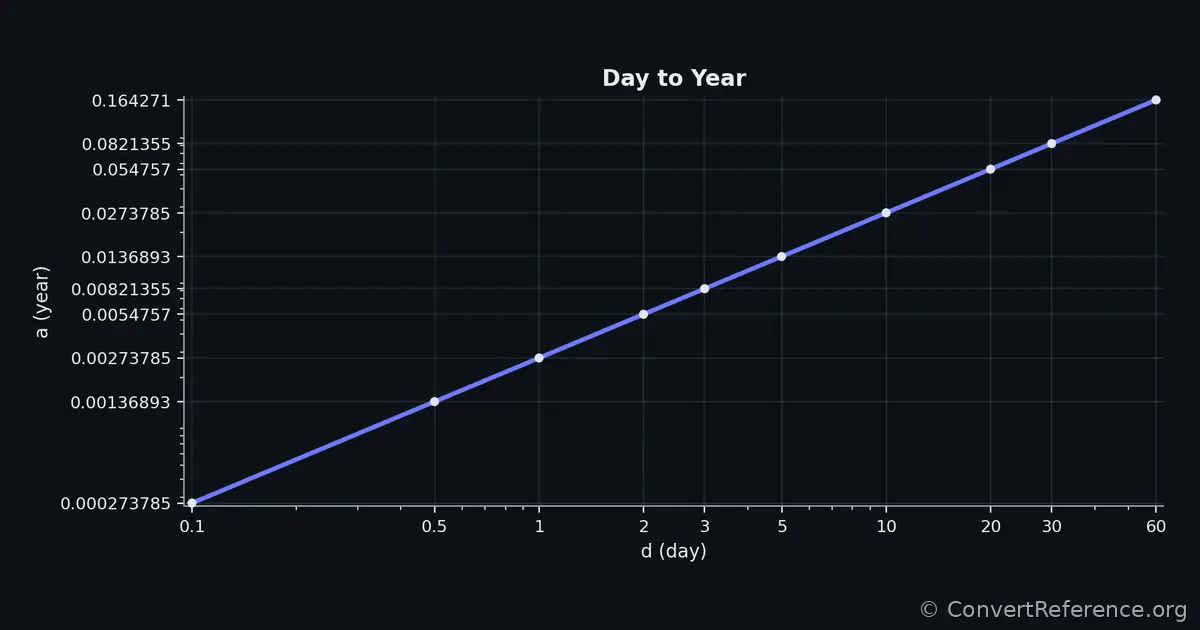
Days And Years Conversion Graph

Days and Years Conversion Graph
Conversion graph showing the relationship between days and years.

Conversion Table For Day And Year

Common conversion values
Days Years
0.10.000273785
0.50.00136893
10.00273785
20.0054757
30.00821355
50.0136893
100.0273785
200.054757
300.0821355
600.164271

Values are rounded for display; internal calculations use the exact conversion factors between day and year (0.0027378507871321 and 365.25).

Dataset & API Access

Programmatic Access

Free JSON API with stable endpoints and predictable keys for automated bidirectional conversions.

Endpoint: https://convertreference.org/api/v1/convert/day-to-year.json

Content Type: application/json

Documentation: View API docs

Licensing

License: CC0 1.0 Universal (Public Domain)

See all datasets

Data & Editorial Process

All numerical values and formulas are generated from the Pint scientific unit library (v0.25), using constants consistent with the BIPM SI Brochure (9th Edition) and NIST Special Publication 811. Explanatory text is drafted with AI assistance and reviewed by ConvertReference editors for clarity and accuracy. This converter is completely free to use, and all calculations are performed locally in your browser and never sent to a server.

  • 2025-12-08 – Generated: Page created using Pint v0.25 verified constants.
  • 2025-12-08 – Reviewed: Verified by ConvertReference editors; no numerical changes required.