ConvertReference.org

Second To Year Converter

s

Review And Reference Information

Verified by the ConvertReference Technical Standards Team

ConvertReference Technical Standards Team

All values and formulas are validated through our editorial review process and cross-checked against internationally recognized reference standards (NIST, BIPM, CODATA).

View Editorial Standards & Report Corrections

Last reviewed: December 08, 2025

Conversion Factors

1 second = 3.1688087814029e-8 year
1 year = 31557600 second

(Exact factors: 3.1688087814029e-8 and 31557600)

Sources: NIST · BIPM

About This Second And Year Converter

This quick tool helps you work with seconds and years. Type a value in seconds and see the result in years. Use the swap button to switch between units. Explore different inputs and compare outcomes in a clear, user-friendly view.

What Are Seconds And Years?

What Is A Second?

Second (s) is the SI base unit of time. It is defined as the duration of 9,192,631,770 periods of the radiation corresponding to the transition between the two hyperfine levels of cesium-133. System: International System of Units (SI). Symbol: s. Real-world example: In one second, light travels about 299,792 km in vacuum.

What Is A Year?

Year (yr) is a unit of time used to measure how long something lasts or how long until a cycle repeats. It is not an SI base unit. In astronomy, a Julian year is defined as exactly 365.25 days (31,557,600 seconds). In ordinary calendar use, a year is 365 days (common year) or 366 days (leap year). Symbol: yr. Real-world example: one year is the time it takes Earth to complete one orbit around the Sun.

When To Use Second Vs Year

Second Usage

Second is the SI base unit of time. It is used for measuring durations and intervals in science, technology, education, medicine, computing, and daily timekeeping. It is the standard time unit in many countries, including the United States, United Kingdom, Germany, and Japan.

Year Usage

Year is a calendar unit used to label dates in daily life, records, and historical timelines. It follows the Gregorian system and is used in countries such as the United States, United Kingdom, India, and Japan.

How To Convert Between Seconds And Years

Conversion Formulas

Second to Year:
second × 3.1688087814029e-8 = year

Year to Second:
year × 31557600 = second

Step-by-Step Guide

Second to Year

  1. Take your value in seconds.
  2. Multiply by 3.1688087814029e-8.
  3. The result is in years.

Year to Second

  1. Take your value in years.
  2. Multiply by 31557600.
  3. The result is in seconds.

Example: Convert 2 seconds to years.

  • Exact: 2 × 3.1688087814029e-8 = 6.33761756280579e-8 years.
  • Rounded: approximately 6.33762e-8 years.

Example: Convert 5 years to seconds.

  • Exact: 5 × 31557600 = 157788000 seconds.
  • Rounded: approximately 1.57788e+8 seconds.

History & Context

Time history began with natural cycles and the day, yet the second as a precise unit grew with clocks. In ancient and medieval times people used sundials and water clocks, and the day served as the main frame. As clocks improved, the idea of dividing the day into regular parts appeared, and the second became a small, reliable unit used by scientists and builders. A modern definition came from atomic science, where a fixed pattern of vibrations in a cesium atom defines the second. The year measures the Earth’s orbit around the Sun and calendars strive to keep seasons in line; reformers later refined the calendar to reduce drift. Today, the year and the second stay stable for science, travel, and daily life.

Practical Use

In a long-term science project, researchers might convert a total duration from seconds to years to communicate the timescale to non-specialists. For instance, if a climate model has been running for about 310 million seconds, converting to years gives roughly 9.8 years, making the duration easier to grasp. In software or planning, you might convert a forecast spanning several years into seconds to simulate real-time processing or to set precise timing in a schedule. Since one year is about 31,536,000 seconds, a three-year plan would be roughly 94,608,000 seconds, which helps systems handle timing and delays reliably.

Common Mistakes When Converting Between Seconds And Years

  • Assuming every year has the same length and ignoring leap years.
  • Treating a calendar year as a fixed duration rather than a time-based year.
  • Converting via months or days as intermediates instead of sticking to the year as a time unit.
  • Neglecting calendar quirks such as leap days when converting between seconds and years.

Mental Shortcuts For Quick Conversions

Tip 1 (sec → year): 1 year ≈ 31.5 million seconds; estimate by dividing seconds by 31.5 million. Tip 2 (year → sec): multiply years by 31.5 million to get seconds. Note: this is for estimation only; use a precise converter in most situations.

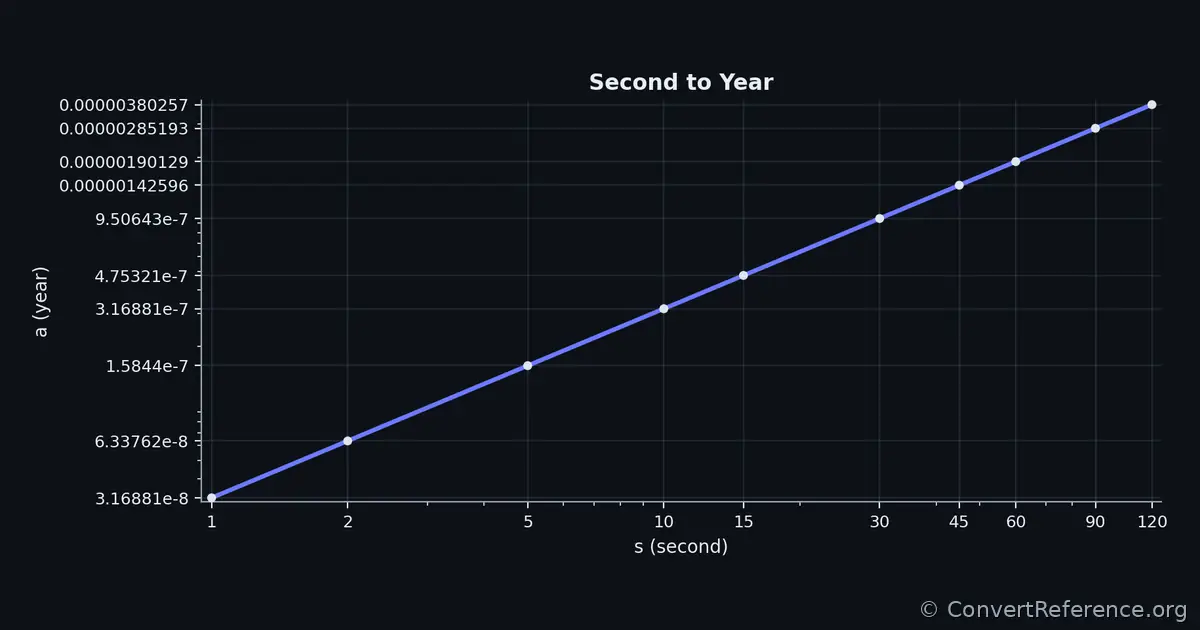
Seconds And Years Conversion Graph

Seconds and Years Conversion Graph
Conversion graph showing the relationship between seconds and years.

Conversion Table For Second And Year

Common conversion values
Seconds Years
13.16881e-8
26.33762e-8
51.5844e-7
103.16881e-7
154.75321e-7
309.50643e-7
450.00000142596
600.00000190129
900.00000285193
1200.00000380257

Values are rounded for display; internal calculations use the exact conversion factors between second and year (3.1688087814029e-8 and 31557600).

Dataset & API Access

Programmatic Access

Free JSON API with stable endpoints and predictable keys for automated bidirectional conversions.

Endpoint: https://convertreference.org/api/v1/convert/second-to-year.json

Content Type: application/json

Documentation: View API docs

Licensing

License: CC0 1.0 Universal (Public Domain)

See all datasets

Data & Editorial Process

All numerical values and formulas are generated from the Pint scientific unit library (v0.25), using constants consistent with the BIPM SI Brochure (9th Edition) and NIST Special Publication 811. Explanatory text is drafted with AI assistance and reviewed by ConvertReference editors for clarity and accuracy. This converter is completely free to use, and all calculations are performed locally in your browser and never sent to a server.

  • 2025-12-08 – Generated: Page created using Pint v0.25 verified constants.
  • 2025-12-08 – Reviewed: Verified by ConvertReference editors; no numerical changes required.