ConvertReference.org

Millimeter to Foot and Foot to Millimeter Converter (mm to ft, ft to mm)

mm

Review And Reference Information

Verified by the ConvertReference Technical Standards Team

ConvertReference Technical Standards Team

All values and formulas are validated through our editorial review process and cross-checked against internationally recognized reference standards (NIST, BIPM, CODATA).

View Editorial Standards & Report Corrections

Last reviewed: December 01, 2025

Conversion Factors

1 millimeter = 0.00328083989501312 foot
1 foot = 304.8 millimeter

(Exact factors: 0.00328083989501312 and 304.8)

Sources: NIST · BIPM

About This Millimeter And Foot Converter

This quick, user-friendly tool makes working with millimeters and feet a breeze. View results in feet from millimeters, and switch directions with the swap button. The interface is fast, clear, and free of clutter. Toggle the units anytime to compare values side by side with ease.

What Are Millimeters And Feet?

What Is A Millimeter?

Millimeter (mm) is a metric unit of length equal to 1/1000 of a meter; 1 mm = 0.001 m. It is a derived unit in the International System of Units (SI). Symbol: mm. Real-world example: a standard credit card is about 0.76 mm thick.

What Is A Foot?

Foot (ft) is a unit of length used in the US customary and British imperial systems. It is defined exactly as 0.3048 meters. Symbol: ft. 1 ft = 0.3048 m. Real-world example: a standard ruler is about 1 foot long.

When To Use Millimeter Vs Foot

Millimeter Usage

Millimeters are used globally in metric systems for measuring length in most countries, science, education, and manufacturing. Primary users include France, Germany, Japan, and Australia.

Foot Usage

Foot is a customary unit of length used in the United States, the United Kingdom, Canada, and Australia. It is common for everyday height, furniture dimensions, and home-improvement measurements, where 1 foot equals 12 inches (0.3048 meters).

How To Convert Between Millimeters And Feet

Conversion Formulas

Millimeter to Foot:
millimeter × 0.00328083989501312 = foot

Foot to Millimeter:
foot × 304.8 = millimeter

Step-by-Step Guide

Millimeter to Foot

  1. Take your value in millimeters.
  2. Multiply by 0.00328083989501312.
  3. The result is in feet.

Foot to Millimeter

  1. Take your value in feet.
  2. Multiply by 304.8.
  3. The result is in millimeters.

Example: Convert 10 millimeters to feet.

  • Exact: 10 × 0.00328083989501312 = 0.0328083989501312 feet.
  • Rounded: approximately 0.0328084 feet.

Example: Convert 5 feet to millimeters.

  • Exact: 5 × 304.8 = 1524 millimeters.

History & Context

Millimeter and foot show how people measure length through history. The millimeter grows from the metric system, devised in revolutionary France to create universal standards; it follows the meter, a basic measure to unify science and trade. The term millimeter describes a small part of that standard, used for precise work in science and industry. The foot has a long and varied past in many lands, rooted in measuring by the human foot. In medieval England and later, officials sought a common length for commerce and law, linking law, land, and trade. As ships and rails spread, the foot became a formal unit in official systems, while the metric system grew for science and business. Despite differences, both units show how people shared a common measure to organize daily life.

Practical Use

In a scale-model display, artisans measuring tiny components in millimeters may need to convert to feet so the model matches real-world proportions. They might take a length specified in millimeters and convert it to feet to ensure the model fits within a designated display footprint. On the other hand, builders working from blueprints often convert feet to millimeters when specifying wall heights, window openings, or other dimensions in precise, metric-ready drawings. Using a quick millimeter–to–foot or foot–to–millimeter conversion helps keep plans consistent and prevents mismatches during construction or display setup.

Common Mistakes When Converting Between Millimeters And Feet

  • Assuming millimeters are larger than feet.
  • Using the same operation for both directions, instead of reversing the process when converting between millimeters and feet.
  • Rounding intermediate results too early, which reduces accuracy.
  • Relying on a shortcut or guesswork instead of a proper, verified conversion.

Mental Shortcuts For Quick Conversions

MM to FT: 1 ft = 304.8 mm; estimate: ft ≈ mm/300. FT to MM: mm ≈ ft × 304.8. Note: for estimation only; use a precise converter when accuracy matters.

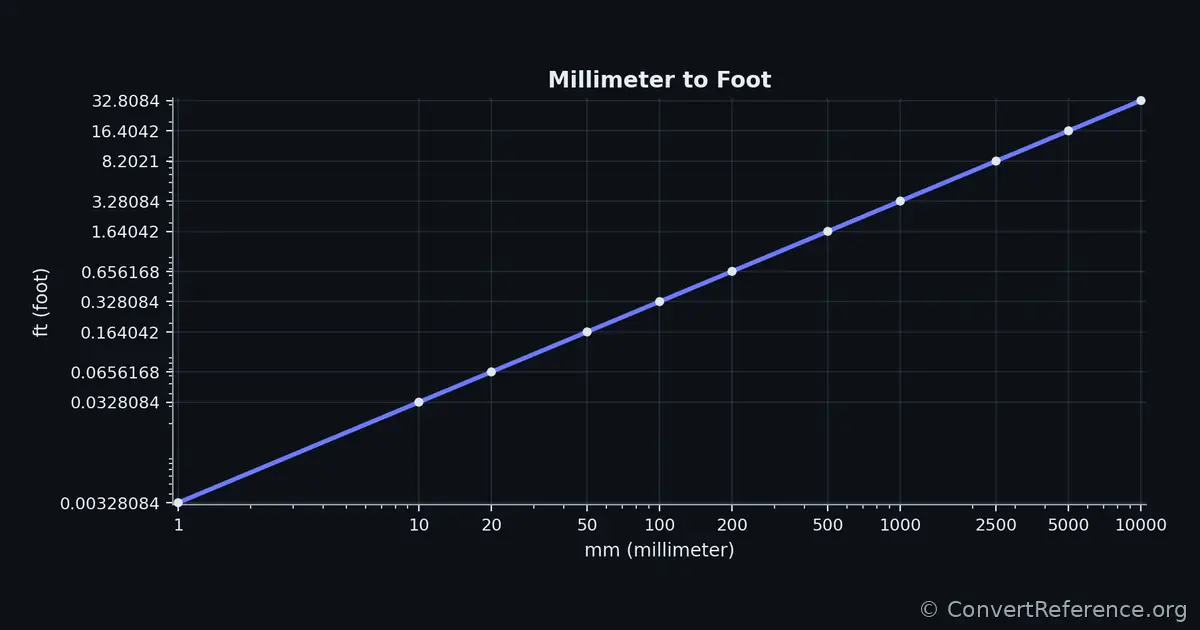
Millimeters And Feet Conversion Graph

Millimeters and Feet Conversion Graph
Conversion graph showing the relationship between millimeters and feet.

Conversion Table For Millimeters And Feet

Common conversion values
Millimeters Feet
10.00328084
100.0328084
200.0656168
500.164042
1000.328084
2000.656168
5001.64042
10003.28084
25008.2021
500016.4042
1000032.8084

Values are rounded for display; internal calculations use the exact conversion factors between millimeters and feet (0.00328083989501312 and 304.8).

Dataset & API Access

Programmatic Access

Free JSON API with stable endpoints and predictable keys for automated bidirectional conversions.

Endpoint: https://convertreference.org/api/v1/convert/millimeter-to-foot.json

Content Type: application/json

Documentation: View API docs

Licensing

License: CC0 1.0 Universal (Public Domain)

See all datasets

Data & Editorial Process

All numerical values and formulas are generated from the Pint scientific unit library (v0.25), using constants consistent with the BIPM SI Brochure (9th Edition) and NIST Special Publication 811. Explanatory text is drafted with AI assistance and reviewed by ConvertReference editors for clarity and accuracy. This converter is completely free to use, and all calculations are performed locally in your browser and never sent to a server.

  • 2025-12-01 – Generated: Page created using Pint v0.25 verified constants.
  • 2025-12-01 – Reviewed: Verified by ConvertReference editors; no numerical changes required.