ConvertReference.org

Bar To Pound Force Per Square Inch Converter

bar

Review And Reference Information

Verified by the ConvertReference Technical Standards Team

ConvertReference Technical Standards Team

All values and formulas are validated through our editorial review process and cross-checked against internationally recognized reference standards (NIST, BIPM, CODATA).

View Editorial Standards & Report Corrections

Last reviewed: December 08, 2025

Conversion Factors

1 bar = 14.5037737730209 pound force per square inch
1 pound force per square inch = 0.0689475729316836 bar

(Exact factors: 14.5037737730209 and 0.0689475729316836)

Sources: NIST · BIPM

About This Bar And Pound Force Per Square Inch Converter

Welcome to our bar and pound-force per square inch converter. Switch between units anytime with the swap button. See results instantly as you explore different values. This handy tool helps you compare pressure units with clarity and ease.

What Are Bars And Pounds Force Per Square Inch?

What Is A Bar?

bar is a unit of pressure in the metric system. It is an SI-derived unit defined exactly as 100,000 pascals (Pa). Common symbol: bar. Relationships: 1 bar = 100 kPa = 100,000 Pa; 1 bar ≈ 0.9869 atm. Real-world example: a typical car tire is about 2-3 bar. Used in meteorology and engineering, not an SI base unit.

What Is A Pound Force Per Square Inch?

Pound-force per square inch (psi) is a pressure unit in US customary units (also British gravitational units). It equals one pound-force acting on one square inch. In SI base units, 1 psi = 6894.76 pascals (N/m^2). Symbol: psi or lb_f/in^2. Example: car tires are commonly around 32 psi (≈221 kPa).

When To Use Bar Vs Pound Force Per Square Inch

Bar Usage

Bar is a unit of pressure used in many metric countries, especially in weather reporting and scientific contexts. It remains common in Europe, including Germany, France, Italy, and Spain.

Pound Force Per Square Inch Usage

Psi, or pound-force per square inch, is used in the United States and in several other English-speaking markets for expressing pressure in everyday contexts. It is also encountered in Canada, the United Kingdom, and Australia, alongside metric units.

How To Convert Between Bars And Pounds Force Per Square Inch

Conversion Formulas

Bar to Pound Force Per Square Inch:
bar × 14.5037737730209 = pound force per square inch

Pound Force Per Square Inch to Bar:
pound force per square inch × 0.0689475729316836 = bar

Step-by-Step Guide

Bar to Pound Force Per Square Inch

  1. Take your value in bars.
  2. Multiply by 14.5037737730209.
  3. The result is in pounds force per square inch.

Pound Force Per Square Inch to Bar

  1. Take your value in pounds force per square inch.
  2. Multiply by 0.0689475729316836.
  3. The result is in bars.

Example: Convert 0.05 bars to pounds force per square inch.

  • Exact: 0.05 × 14.5037737730209 = 0.725188688651046 pounds force per square inch.
  • Rounded: approximately 0.725189 pounds force per square inch.

Example: Convert 5 pounds force per square inch to bars.

  • Exact: 5 × 0.0689475729316836 = 0.344737864658418 bars.
  • Rounded: approximately 0.344738 bars.

History & Context

Bar was a metric unit of pressure that spread with the metric system in Europe and in early modern industry. It was created as a simple, practical way to measure pressure that fit with scientific work on gases and liquids. Pounds per square inch, or psi, grew from British and American engineering needs when engines and tires required a straightforward way to talk about pressure using common weights on small areas. Bar found favor in weather work, machinery, and industrial testing, while psi became standard in North America and many industry sectors tied to tires, hydraulics, and gas. Over time both units remained in use alongside the SI system, chosen by region, tradition, and task.

Practical Use

On a hydraulic system spec sheet, engineers often need to convert bar to pounds per square inch to compare a bar-rated component with a gauge that reads in psi. Converting bar to psi helps verify compatibility and safety when the control panels and safety valves are labeled in psi. Conversely, a high-pressure reactor or test rig that operates with psi readings may require converting pounds-force per square inch to bar to align with the facility's standard metric pressure limits. An online unit converter makes this psi-to-bar conversion quick so designers can stay within the allowable bar range and keep equipment within spec.

Common Mistakes When Converting Between Bars And Pounds Force Per Square Inch

  • Confusing bar with psi and assuming the numerical value is the same.
  • Treating gauge pressure and absolute pressure as the same during conversion.
  • Using the wrong starting unit for the conversion, such as treating bar values as psi.
  • Ignoring that a conversion factor exists between bar and psi and applying the value without adjusting.

Mental Shortcuts For Quick Conversions

Tip 1 (bar to psi): 1 bar ≈ 14.7 psi. Mnemonic: bar roughly 14 psi. Tip 2 (psi to bar): 1 psi ≈ 0.069 bar. Mnemonic: psi to bar ≈ 1/14.5. For estimation only; use a precise converter for exact results.

Bars And Pounds Force Per Square Inch Conversion Graph
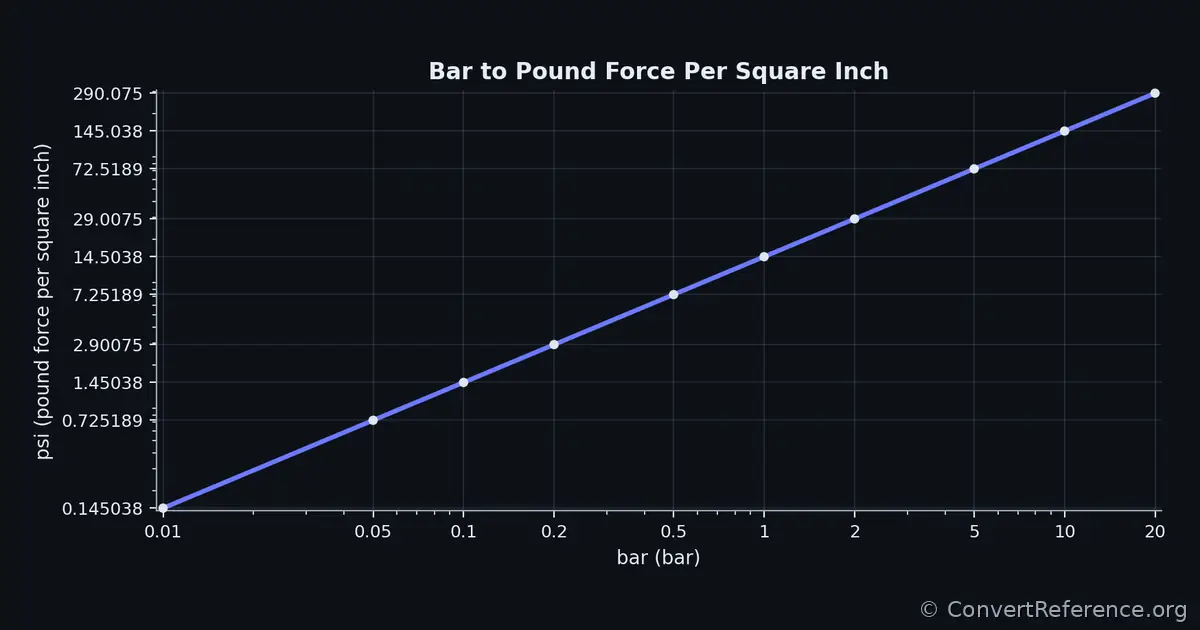
Bars and Pounds force per square inch Conversion Graph
Conversion graph showing the relationship between bars and pounds force per square inch.

Conversion Table For Bar And Pound Force Per Square Inch

Common conversion values
Bars Pounds force per square inch
0.010.145038
0.050.725189
0.11.45038
0.22.90075
0.57.25189
114.5038
229.0075
572.5189
10145.038
20290.075

Values are rounded for display; internal calculations use the exact conversion factors between bar and pound force per square inch (14.5037737730209 and 0.0689475729316836).

Dataset & API Access

Programmatic Access

Free JSON API with stable endpoints and predictable keys for automated bidirectional conversions.

Endpoint: https://convertreference.org/api/v1/convert/bar-to-pound-force-per-square-inch.json

Content Type: application/json

Documentation: View API docs

Licensing

License: CC0 1.0 Universal (Public Domain)

See all datasets

Data & Editorial Process

All numerical values and formulas are generated from the Pint scientific unit library (v0.25), using constants consistent with the BIPM SI Brochure (9th Edition) and NIST Special Publication 811. Explanatory text is drafted with AI assistance and reviewed by ConvertReference editors for clarity and accuracy. This converter is completely free to use, and all calculations are performed locally in your browser and never sent to a server.

  • 2025-12-08 – Generated: Page created using Pint v0.25 verified constants.
  • 2025-12-08 – Reviewed: Verified by ConvertReference editors; no numerical changes required.