ConvertReference.org

Pound Force Per Square Inch To Torr Converter

psi

Review And Reference Information

Verified by the ConvertReference Technical Standards Team

ConvertReference Technical Standards Team

All values and formulas are validated through our editorial review process and cross-checked against internationally recognized reference standards (NIST, BIPM, CODATA).

View Editorial Standards & Report Corrections

Last reviewed: December 08, 2025

Conversion Factors

1 pound force per square inch = 51.7149325715071 torr
1 torr = 0.019336774704623 pound force per square inch

(Exact factors: 51.7149325715071 and 0.019336774704623)

Sources: NIST · BIPM

About This Pound Force Per Square Inch And Torr Converter

This quick tool lets you compare pressure values between psi and torr. You can click the swap button to switch between units. Your results appear clearly as you work. Use it to compare, verify, and simplify pressure unit checks.

What Are Pounds Force Per Square Inch And Torrs?

What Is A Pound Force Per Square Inch?

psi (pound-force per square inch) is a unit of pressure. It means one pound-force applied to one square inch. In SI, 1 psi ≈ 6894.76 Pa (since 1 lbf = 4.44822 N and 1 in^2 = 0.00064516 m^2). System: Imperial/US customary. Symbol: psi. Real-world: car tires run about 32 psi.

What Is A Torr?

Definition: The torr is a unit of pressure equal to 1/760 of standard atmospheric pressure. It equals about 133.3 pascals (exactly 101325/760 Pa). System: a non-SI unit defined via the SI pascal; abbreviation: torr. Relationship: 1 atm = 760 Torr; 1 Torr = 1 mmHg at 0 C. Real-world example: standard sea level pressure is about 760 Torr.

When To Use Pound Force Per Square Inch Vs Torr

Pound Force Per Square Inch Usage

Psi (pound-force per square inch) is a customary pressure unit used primarily in the United States, with sustained use in the United Kingdom, Canada, and Ireland. It remains common where Imperial-based pressure units are preferred.

Torr Usage

Torr is a unit of pressure still used in several countries for describing relatively low pressures in scientific and technical contexts. It is used in the United States, United Kingdom, Germany, and Japan.

How To Convert Between Pounds Force Per Square Inch And Torrs

Conversion Formulas

Pound Force Per Square Inch to Torr:
pound force per square inch × 51.7149325715071 = torr

Torr to Pound Force Per Square Inch:
torr × 0.019336774704623 = pound force per square inch

Step-by-Step Guide

Pound Force Per Square Inch to Torr

  1. Take your value in pounds force per square inch.
  2. Multiply by 51.7149325715071.
  3. The result is in torrs.

Torr to Pound Force Per Square Inch

  1. Take your value in torrs.
  2. Multiply by 0.019336774704623.
  3. The result is in pounds force per square inch.

Example: Convert 0.05 pounds force per square inch to torrs.

  • Exact: 0.05 × 51.7149325715071 = 2.58574662857535 torrs.
  • Rounded: approximately 2.58575 torrs.

Example: Convert 5 torrs to pounds force per square inch.

  • Exact: 5 × 0.019336774704623 = 0.0966838735231148 pounds force per square inch.
  • Rounded: approximately 0.0966839 pounds force per square inch.

History & Context

Pound-force per square inch, a practical pressure unit in American engineering, grew with steam engines, cars, and machines that needed a simple way to compare forces and air or fluid pressure. It helped designers and mechanics judge performance, guide tire inflation, and standardize gauges in factories using the inch-pound system. The torr, named for Evangelista Torricelli, arose from early experiments with the mercury barometer and the idea of a near-vacuum. It became a common scale for very low pressures in scientific work and vacuum techniques, long before broader metric standards were adopted.

Practical Use

In a lab, technicians calibrate a high-pressure gas regulator and need to convert pound-force per square inch to torr to compare their readings with a standard specified in torr. This helps ensure safe operation since equipment data sheets often quote pressures in torr, while gauges provide psi. Conversely, in vacuum system troubleshooting, engineers measure pressure in torr and convert to psi to set up components and alarms that are labeled in psi.

Common Mistakes When Converting Between Pounds Force Per Square Inch And Torrs

  • Treating psi and torr as the same unit and substituting them directly.
  • Using the same conversion step in both directions without applying the reciprocal relation.
  • Confusing gauge pressure with absolute pressure when performing the conversion.
  • Ignoring that torr is defined in relation to mmHg and treating it as unrelated to other pressure units.

Mental Shortcuts For Quick Conversions

Psi → Torr (estimation): 1 psi ≈ 52 torr; multiply by 52 for a quick estimate. Torr → Psi (estimation): 1 torr ≈ 0.0193 psi; multiply by 0.0193 for a quick estimate. This is for estimation only; use a precise converter when accuracy matters.

Pounds Force Per Square Inch And Torrs Conversion Graph
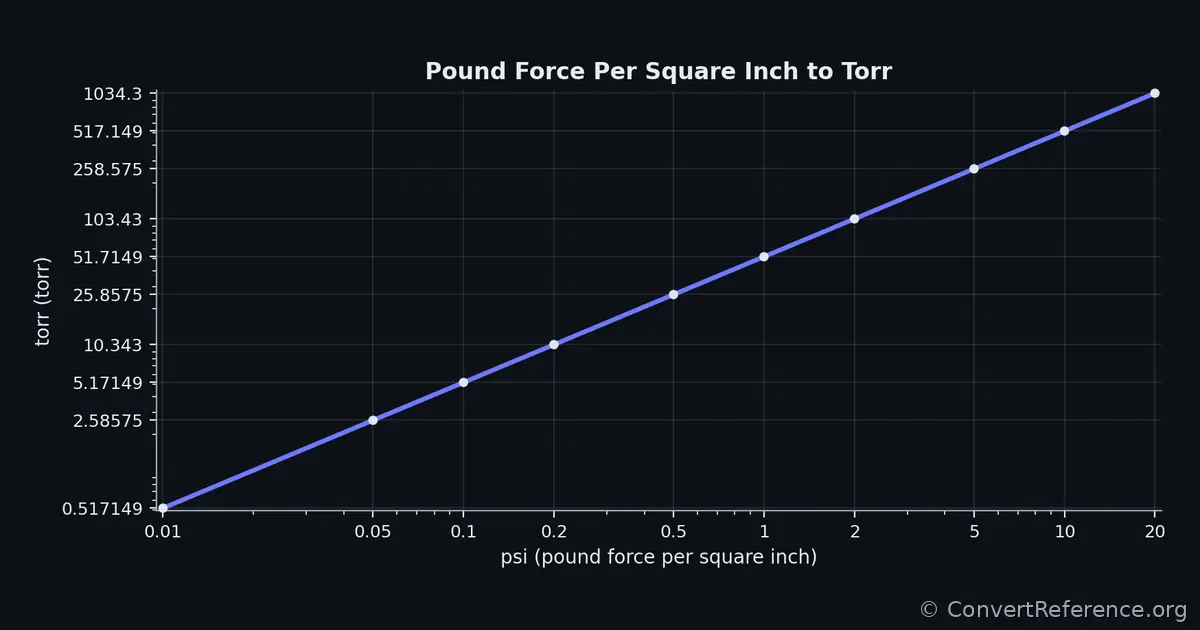
Pounds force per square inch and Torrs Conversion Graph
Conversion graph showing the relationship between pounds force per square inch and torrs.

Conversion Table For Pound Force Per Square Inch And Torr

Common conversion values
Pounds force per square inch Torrs
0.010.517149
0.052.58575
0.15.17149
0.210.343
0.525.8575
151.7149
2103.43
5258.575
10517.149
201034.3

Values are rounded for display; internal calculations use the exact conversion factors between pound force per square inch and torr (51.7149325715071 and 0.019336774704623).

Dataset & API Access

Programmatic Access

Free JSON API with stable endpoints and predictable keys for automated bidirectional conversions.

Endpoint: https://convertreference.org/api/v1/convert/pound-force-per-square-inch-to-torr.json

Content Type: application/json

Documentation: View API docs

Licensing

License: CC0 1.0 Universal (Public Domain)

See all datasets

Data & Editorial Process

All numerical values and formulas are generated from the Pint scientific unit library (v0.25), using constants consistent with the BIPM SI Brochure (9th Edition) and NIST Special Publication 811. Explanatory text is drafted with AI assistance and reviewed by ConvertReference editors for clarity and accuracy. This converter is completely free to use, and all calculations are performed locally in your browser and never sent to a server.

  • 2025-12-08 – Generated: Page created using Pint v0.25 verified constants.
  • 2025-12-08 – Reviewed: Verified by ConvertReference editors; no numerical changes required.