ConvertReference.org

Pascal To Pound Force Per Square Inch Converter

Pa

Review And Reference Information

Verified by the ConvertReference Technical Standards Team

ConvertReference Technical Standards Team

All values and formulas are validated through our editorial review process and cross-checked against internationally recognized reference standards (NIST, BIPM, CODATA).

View Editorial Standards & Report Corrections

Last reviewed: December 08, 2025

Conversion Factors

1 pascal = 0.000145037737730209 pound force per square inch
1 pound force per square inch = 6894.75729316836 pascal

(Exact factors: 0.000145037737730209 and 6894.75729316836)

Sources: NIST · BIPM

About This Pascal And Pound Force Per Square Inch Converter

This fast, user-friendly tool helps you work with pressure values in pascal and pound-force per square inch. See how a value in pascal translates to its pound-force per square inch result at a glance. A swap button lets you switch between units in an instant. Use it to compare readings clearly and confidently.

What Are Pascals And Pounds Force Per Square Inch?

What Is A Pascal?

Pascal (Pa) is the SI unit of pressure. It equals one newton per square meter (1 Pa = 1 N/m^2). Since 1 N = 1 kg*m/s^2, 1 Pa = 1 kg/(m*s^2). It belongs to the SI system; symbol: Pa. Example: sea-level atmospheric pressure is about 101,325 Pa (about 101 kPa).

What Is A Pound Force Per Square Inch?

Pound-force per square inch (psi) is a unit of pressure equal to the force of one pound-force on one square inch of area. In base terms: 1 psi = 1 lbf / in^2; 1 psi ≈ 6894.76 Pa. System: English engineering (Imperial/US customary). Symbol/abbrev: psi or lb/in^2. Example: a typical car tire is about 32 psi.

When To Use Pascal Vs Pound Force Per Square Inch

Pascal Usage

Pascal is the SI unit of pressure used globally in science, education, and regulatory measurements. It underpins official pressure values in many countries' standards. Primary users include United States, United Kingdom, Germany, and Japan.

Pound Force Per Square Inch Usage

Psi (pound-force per square inch) is used to measure pressure in several English-speaking countries. It is common in the United States and Canada, and is also encountered in the United Kingdom and Australia on consumer gauges and related readings.

How To Convert Between Pascals And Pounds Force Per Square Inch

Conversion Formulas

Pascal to Pound Force Per Square Inch:
pascal × 0.000145037737730209 = pound force per square inch

Pound Force Per Square Inch to Pascal:
pound force per square inch × 6894.75729316836 = pascal

Step-by-Step Guide

Pascal to Pound Force Per Square Inch

  1. Take your value in pascals.
  2. Multiply by 0.000145037737730209.
  3. The result is in pounds force per square inch.

Pound Force Per Square Inch to Pascal

  1. Take your value in pounds force per square inch.
  2. Multiply by 6894.75729316836.
  3. The result is in pascals.

Example: Convert 7 pascals to pounds force per square inch.

  • Exact: 7 × 0.000145037737730209 = 0.00101526416411146 pounds force per square inch.
  • Rounded: approximately 0.00101526 pounds force per square inch.

Example: Convert 5 pounds force per square inch to pascals.

  • Exact: 5 × 6894.75729316836 = 34473.7864658418 pascals.
  • Rounded: approximately 34473.8 pascals.

History & Context

Blaise Pascal was a French scientist whose work showed how pressure spreads through liquids and air, helping people understand how a hydraulic press can lift heavy loads. His experiments helped form the idea of a standard pressure measure that bears his name, the pascal, and his insights influenced how scientists think about force and fluid height. In English and American engineering, pound force per square inch became a practical way to express pressure for engines, tires, and machines. This practical measure grew with industry, giving engineers clear ideas about pressure in many tools, while the pascal gained status as a global scientific standard.

Practical Use

In a hydraulic system, technicians often convert pressure from pascals to pounds per square inch to match gauges and manufacturer specs that are labeled in psi. When setting up pressure tests with an SI-based workflow, they may still need to express the result in psi for compatibility with common equipment readings. Conversely, in tire or laboratory scenarios, engineers might convert from psi to pascals to perform SI calculations and ensure consistent data logging. These conversions help bridge common imperial units and SI units on an online unit converter page.

Common Mistakes When Converting Between Pascals And Pounds Force Per Square Inch

  • Treating pascal and psi as if they were the same unit.
  • Using the wrong direction of the conversion factor when starting from pascals.
  • Thinking psi measures a unit of force rather than a unit of pressure.
  • Confusing pounds-force with pounds-mass when dealing with psi.

Mental Shortcuts For Quick Conversions

Pa→psi (est.): divide by ~6,900 (1 psi ≈ 6,894.76 Pa). Psi→Pa (est.): multiply by ~6,900 (1 psi ≈ 6,894.76 Pa). Estimation only; use a precise converter for accuracy.

Pascals And Pounds Force Per Square Inch Conversion Graph
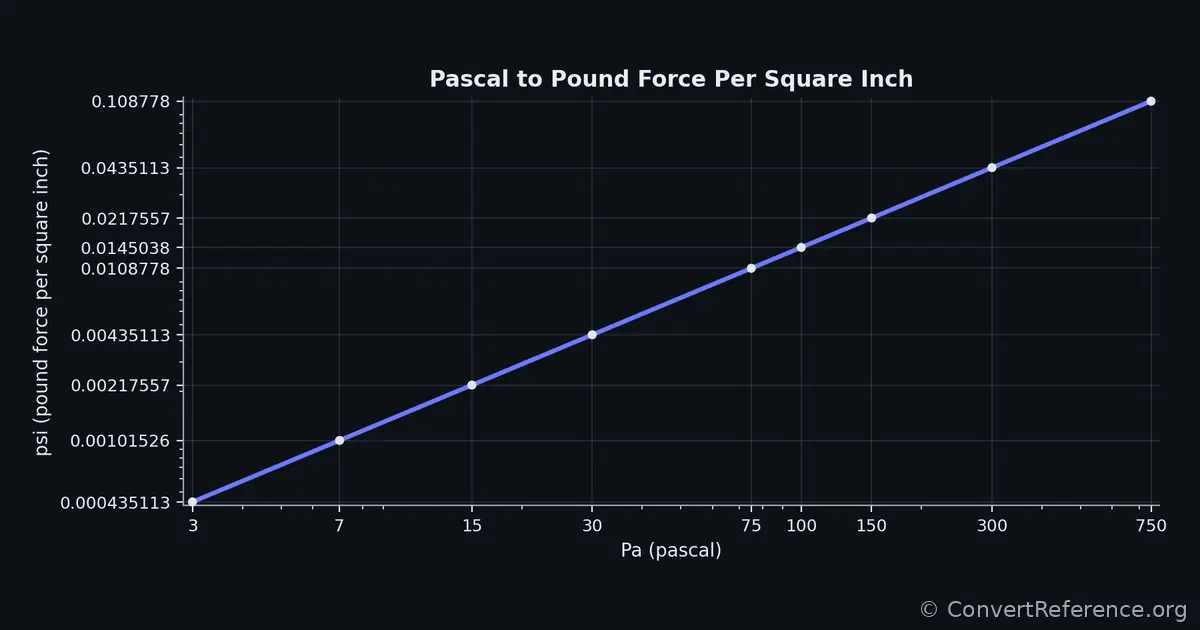
Pascals and Pounds force per square inch Conversion Graph
Conversion graph showing the relationship between pascals and pounds force per square inch.

Conversion Table For Pascal And Pound Force Per Square Inch

Common conversion values
Pascals Pounds force per square inch
30.000435113
70.00101526
150.00217557
300.00435113
750.0108778
1000.0145038
1500.0217557
3000.0435113
7500.108778

Values are rounded for display; internal calculations use the exact conversion factors between pascal and pound force per square inch (0.000145037737730209 and 6894.75729316836).

Dataset & API Access

Programmatic Access

Free JSON API with stable endpoints and predictable keys for automated bidirectional conversions.

Endpoint: https://convertreference.org/api/v1/convert/pascal-to-pound-force-per-square-inch.json

Content Type: application/json

Documentation: View API docs

Licensing

License: CC0 1.0 Universal (Public Domain)

See all datasets

Data & Editorial Process

All numerical values and formulas are generated from the Pint scientific unit library (v0.25), using constants consistent with the BIPM SI Brochure (9th Edition) and NIST Special Publication 811. Explanatory text is drafted with AI assistance and reviewed by ConvertReference editors for clarity and accuracy. This converter is completely free to use, and all calculations are performed locally in your browser and never sent to a server.

  • 2025-12-08 – Generated: Page created using Pint v0.25 verified constants.
  • 2025-12-08 – Reviewed: Verified by ConvertReference editors; no numerical changes required.