ConvertReference.org

Mile Per Hour To Speed Of Light Converter

mph

Review And Reference Information

Verified by the ConvertReference Technical Standards Team

ConvertReference Technical Standards Team

All values and formulas are validated through our editorial review process and cross-checked against internationally recognized reference standards (NIST, BIPM, CODATA).

View Editorial Standards & Report Corrections

Last reviewed: December 08, 2025

Conversion Factors

1 mile per hour = 1.49116493117382e-9 speed of light
1 speed of light = 670616629.384395 mile per hour

(Exact factors: 1.49116493117382e-9 and 670616629.384395)

Sources: NIST · BIPM

About This Mile Per Hour And Speed Of Light Converter

This quick tool shows how miles per hour relate to the speed of light. See the result in the other unit with a clear, on-screen display. If you need a different direction, use the swap button to switch between mph and the speed of light. It's simple to use and designed for fast, hassle-free results.

What Are Miles Per Hour And Speeds Of Light?

What Is A Mile Per Hour?

mph, or miles per hour, is a unit of speed in the Imperial/US customary system. It tells how many miles are covered in one hour. Exact relation: 1 mph = 1609.344 meters / 3600 seconds ≈ 0.44704 m/s. Common symbol: mph (or mi/h). Real-world: at 60 mph a car travels about 1 mile per minute (≈97 km/h).

What Is A Speed Of Light?

Speed of light in vacuum (c) is an exact SI constant: 299,792,458 meters per second. The meter is defined as the distance light travels in vacuum in 1/299,792,458 of a second, so c is exact. System: SI (metric). Symbol: c. Example: light travels about 300,000 km per second; sunlight takes ~8 minutes 20 seconds to reach Earth from the Sun.

When To Use Mile Per Hour Vs Speed Of Light

Mile Per Hour Usage

MPH is the standard unit for road speeds in the United States and the United Kingdom, and is also used in the Bahamas and Liberia. It appears on speed-limit signs and in everyday driving speeds in these countries.

Speed Of Light Usage

The speed of light is a fundamental constant used in physics, metrology, and timekeeping to define units and calibrate instruments. It underpins the definition of the metre and the realization of time standards in countries such as the United States, Germany, Japan, and France.

How To Convert Between Miles Per Hour And Speeds Of Light

Conversion Formulas

Mile Per Hour to Speed Of Light:
mile per hour × 1.49116493117382e-9 = speed of light

Speed Of Light to Mile Per Hour:
speed of light × 670616629.384395 = mile per hour

Step-by-Step Guide

Mile Per Hour to Speed Of Light

  1. Take your value in miles per hour.
  2. Multiply by 1.49116493117382e-9.
  3. The result is in speeds of light.

Speed Of Light to Mile Per Hour

  1. Take your value in speeds of light.
  2. Multiply by 670616629.384395.
  3. The result is in miles per hour.

Example: Convert 0.05 miles per hour to speeds of light.

  • Exact: 0.05 × 1.49116493117382e-9 = 7.4558246558691e-11 speeds of light.
  • Rounded: approximately 7.45582e-11 speeds of light.

Example: Convert 5 speeds of light to miles per hour.

  • Exact: 5 × 670616629.384395 = 3353083146.92198 miles per hour.
  • Rounded: approximately 3.35308e+9 miles per hour.

History & Context

Long before machines, people debated how fast light travels. In the seventeenth century, Ole Roemer showed that light takes time to reach Earth by watching the motions of Jupiter's moons, proving it is not instantaneous. Later experiments by Fizeau and then Foucault in the nineteenth century used moving parts and mirrors to compare light with a reference beam, giving strong evidence that light moves at a finite speed. In the same era, light was understood as an electromagnetic wave described by Maxwell, linking optics and electricity. The mile per hour grew with road transport as people measured speed in miles over time, and as carriages, trains, and cars appeared, authorities used miles per hour to set speeds and improve traffic safety.

Practical Use

In a theoretical propulsion or science-fiction scenario, engineers might convert speeds from miles per hour to a fraction of the speed of light to gauge whether relativistic effects would need accounting. In a physics classroom or astronomy outreach, educators might convert the speed of light into miles per hour to help students grasp how enormous c is compared with everyday speeds. These conversions on the online unit converter page provide concrete, relatable context for both directions.

Common Mistakes When Converting Between Miles Per Hour And Speeds Of Light

  • Assuming miles per hour can be read as a direct fraction of the speed of light without converting units.
  • Treating the speed of light as an everyday speed and ignoring its status as a universal constant.
  • Failing to apply proper dimensional analysis and thus misinterpreting the relationship between mph and c.
  • Assuming mph can replace c in equations due to a misunderstanding of units.

Mental Shortcuts For Quick Conversions

Tip 1 (mph → c): c ≈ 670,616,629 mph; for quick estimates use about 670 million mph. Tip 2 (c → mph): c ≈ 670,616,629 mph (about 670 million mph). Note: For estimation only; use a precise converter for accurate results.

Miles Per Hour And Speeds Of Light Conversion Graph
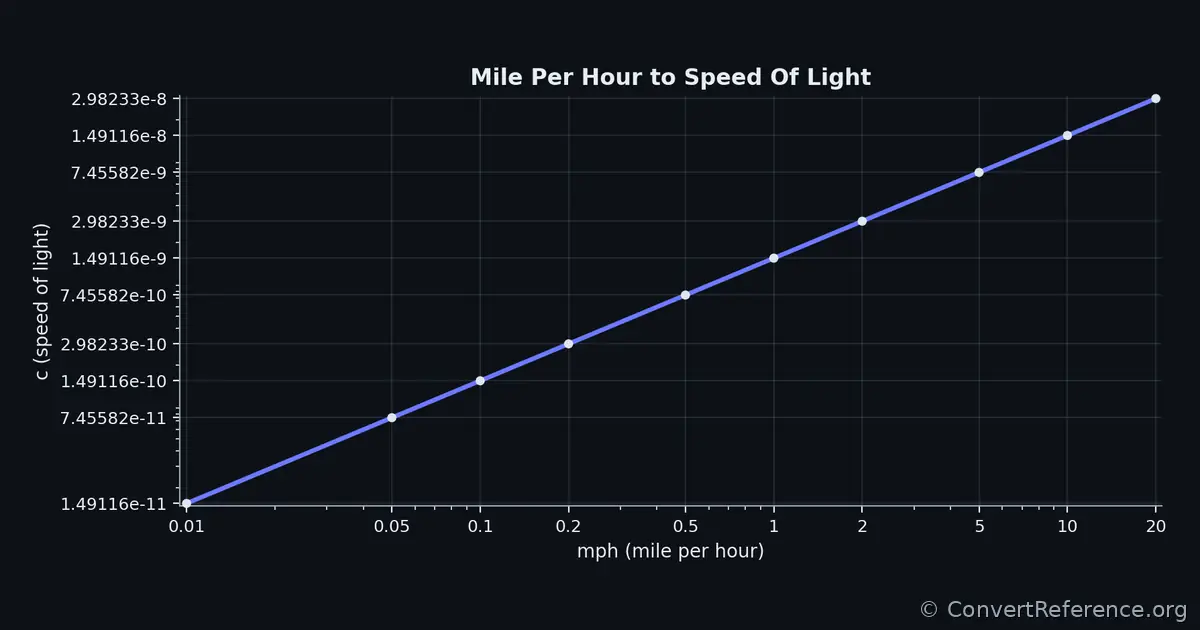
Miles per hour and Speeds of light Conversion Graph
Conversion graph showing the relationship between miles per hour and speeds of light.

Conversion Table For Mile Per Hour And Speed Of Light

Common conversion values
Miles per hour Speeds of light
0.011.49116e-11
0.057.45582e-11
0.11.49116e-10
0.22.98233e-10
0.57.45582e-10
11.49116e-9
22.98233e-9
57.45582e-9
101.49116e-8
202.98233e-8

Values are rounded for display; internal calculations use the exact conversion factors between mile per hour and speed of light (1.49116493117382e-9 and 670616629.384395).

Dataset & API Access

Programmatic Access

Free JSON API with stable endpoints and predictable keys for automated bidirectional conversions.

Endpoint: https://convertreference.org/api/v1/convert/mile-per-hour-to-speed-of-light.json

Content Type: application/json

Documentation: View API docs

Licensing

License: CC0 1.0 Universal (Public Domain)

See all datasets

Data & Editorial Process

All numerical values and formulas are generated from the Pint scientific unit library (v0.25), using constants consistent with the BIPM SI Brochure (9th Edition) and NIST Special Publication 811. Explanatory text is drafted with AI assistance and reviewed by ConvertReference editors for clarity and accuracy. This converter is completely free to use, and all calculations are performed locally in your browser and never sent to a server.

  • 2025-12-08 – Generated: Page created using Pint v0.25 verified constants.
  • 2025-12-08 – Reviewed: Verified by ConvertReference editors; no numerical changes required.