ConvertReference.org

Mile Per Hour To Foot Per Second Converter

mph

Review And Reference Information

Verified by the ConvertReference Technical Standards Team

ConvertReference Technical Standards Team

All values and formulas are validated through our editorial review process and cross-checked against internationally recognized reference standards (NIST, BIPM, CODATA).

View Editorial Standards & Report Corrections

Last reviewed: December 08, 2025

Conversion Factors

1 mile per hour = 1.46666666666667 foot per second
1 foot per second = 0.681818181818182 mile per hour

(Exact factors: 1.46666666666667 and 0.681818181818182)

Sources: NIST · BIPM

About This Mile Per Hour And Foot Per Second Converter

Welcome to a fast, friendly speed converter. Switch between miles per hour and feet per second with ease to compare values. The swap button makes it simple to explore both unit directions. Get quick, clear results that help you understand speed measurements at a glance.

What Are Miles Per Hour And Feet Per Second?

What Is A Mile Per Hour?

Mile per hour (mph) is a speed unit in the Imperial/US customary system. It measures how many miles are traveled in one hour. Exact relationship: 1 mph = 1609.344 meters per hour = 0.44704 meters per second. Symbol: mph. Real-world example: at 60 mph a car travels about 1 mile per minute.

What Is A Foot Per Second?

Foot per second (ft/s) is a speed unit used in the Imperial/US customary system. It equals one foot (0.3048 meters) per second; 1 ft/s = 0.3048 m/s. Symbol: ft/s. It's defined from the foot and the second. Real-world example: a person walking at about 3 ft/s (~2 mph).

When To Use Mile Per Hour Vs Foot Per Second

Mile Per Hour Usage

Mile per hour is used for road speeds and speed limits in several English-speaking countries. It appears on vehicle speedometers and road signs for everyday driving. The primary countries using mph are the United States, the United Kingdom, Canada, and Australia.

Foot Per Second Usage

Foot per second is a velocity unit primarily used in the United States as part of the U.S. customary system. It also appears in Liberia and Myanmar in legacy or mixed-measurement contexts, where older imperial units persist in some measurements.

How To Convert Between Miles Per Hour And Feet Per Second

Conversion Formulas

Mile Per Hour to Foot Per Second:
mile per hour × 1.46666666666667 = foot per second

Foot Per Second to Mile Per Hour:
foot per second × 0.681818181818182 = mile per hour

Step-by-Step Guide

Mile Per Hour to Foot Per Second

  1. Take your value in miles per hour.
  2. Multiply by 1.46666666666667.
  3. The result is in feet per second.

Foot Per Second to Mile Per Hour

  1. Take your value in feet per second.
  2. Multiply by 0.681818181818182.
  3. The result is in miles per hour.

Example: Convert 0.5 miles per hour to feet per second.

  • Exact: 0.5 × 1.46666666666667 = 0.733333333333333 feet per second.
  • Rounded: approximately 0.733333 feet per second.

Example: Convert 5 feet per second to miles per hour.

  • Exact: 5 × 0.681818181818182 = 3.40909090909091 miles per hour.
  • Rounded: approximately 3.40909 miles per hour.

History & Context

Mile per hour and foot per second are old ways people used to describe how fast things move. In ancient and medieval times local miles and feet varied a lot, so speed could be hard to compare. The mile grew as routes and markets spread and rulers wanted a consistent length, while the foot started as the size of a human foot and was fixed by standards set by rulers and craftspeople. As boats, carts, and trains came into daily use, these terms helped engineers and travelers talk about pace clearly. Governments and trade later made mph and fps familiar everywhere in science, transport, and daily life.

Practical Use

Engineers may need to convert miles per hour to feet per second when analyzing a vehicle's braking distance or acceleration, since those calculations use feet and seconds. In sports science or physics problems, speeds measured in feet per second are often converted to miles per hour to communicate results in a familiar unit. These conversions help ensure the math aligns with real-world measurements while making it easier to compare results. Using the right unit in each step prevents mistakes in timing, distance and energy calculations.

Common Mistakes When Converting Between Miles Per Hour And Feet Per Second

  • Assuming mph and ft/s have the same numeric value.
  • Forgetting to convert hours to seconds when converting from mph to ft/s.
  • Treating miles and feet as interchangeable units.
  • Applying the conversion factor in the wrong direction.

Mental Shortcuts For Quick Conversions

Tip 1: mph to ft/s — use the 1.5 rule: multiply by 1.5 (1 mph ≈ 1.47 ft/s). Tip 2: ft/s to mph — divide by 1.5 (≈ 0.67). For estimation only; use a precise converter when accuracy matters.

Miles Per Hour And Feet Per Second Conversion Graph
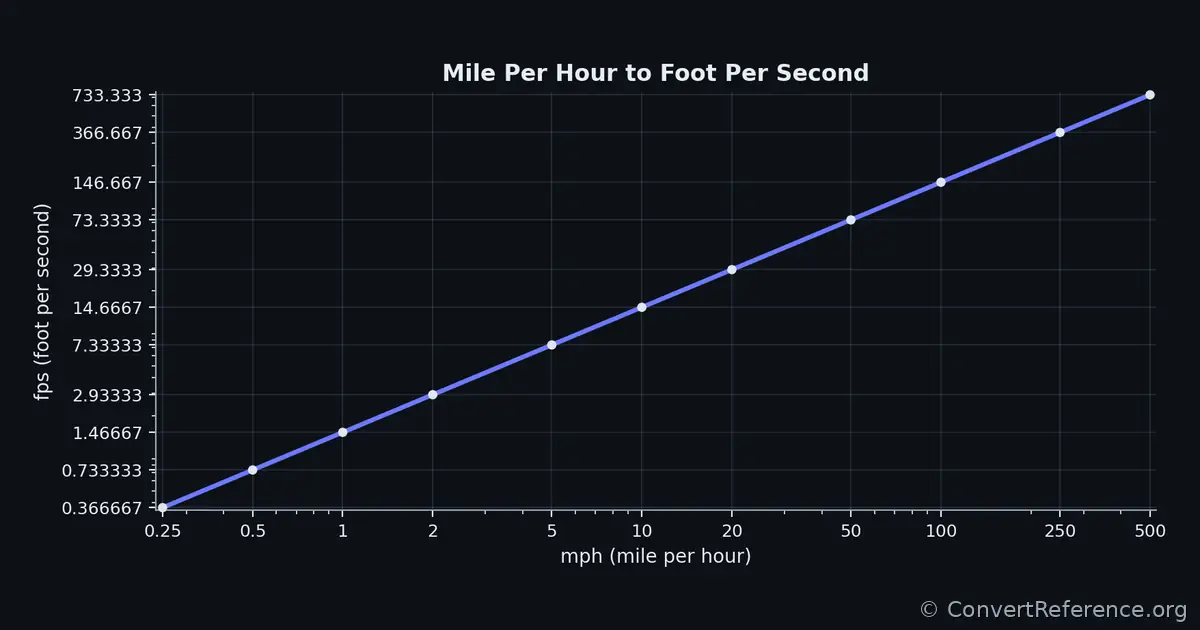
Miles per hour and Feet per second Conversion Graph
Conversion graph showing the relationship between miles per hour and feet per second.

Conversion Table For Mile Per Hour And Foot Per Second

Common conversion values
Miles per hour Feet per second
0.250.366667
0.50.733333
11.46667
22.93333
57.33333
1014.6667
2029.3333
5073.3333
100146.667
250366.667
500733.333

Values are rounded for display; internal calculations use the exact conversion factors between mile per hour and foot per second (1.46666666666667 and 0.681818181818182).

Dataset & API Access

Programmatic Access

Free JSON API with stable endpoints and predictable keys for automated bidirectional conversions.

Endpoint: https://convertreference.org/api/v1/convert/mile-per-hour-to-foot-per-second.json

Content Type: application/json

Documentation: View API docs

Licensing

License: CC0 1.0 Universal (Public Domain)

See all datasets

Data & Editorial Process

All numerical values and formulas are generated from the Pint scientific unit library (v0.25), using constants consistent with the BIPM SI Brochure (9th Edition) and NIST Special Publication 811. Explanatory text is drafted with AI assistance and reviewed by ConvertReference editors for clarity and accuracy. This converter is completely free to use, and all calculations are performed locally in your browser and never sent to a server.

  • 2025-12-08 – Generated: Page created using Pint v0.25 verified constants.
  • 2025-12-08 – Reviewed: Verified by ConvertReference editors; no numerical changes required.