ConvertReference.org

Kilometer Per Hour To Foot Per Second Converter

kph

Review And Reference Information

Verified by the ConvertReference Technical Standards Team

ConvertReference Technical Standards Team

All values and formulas are validated through our editorial review process and cross-checked against internationally recognized reference standards (NIST, BIPM, CODATA).

View Editorial Standards & Report Corrections

Last reviewed: December 08, 2025

Conversion Factors

1 kilometer per hour = 0.911344415281423 foot per second
1 foot per second = 1.09728 kilometer per hour

(Exact factors: 0.911344415281423 and 1.09728)

Sources: NIST · BIPM

About This Kilometer Per Hour And Foot Per Second Converter

This tool helps you compare speeds between kilometers per hour and feet per second. See the equivalent value in feet per second while you work between the two units. Use the swap button to switch between km/h and ft/s. Experience quick, clear results for your speed in both units.

What Are Kilometers Per Hour And Feet Per Second?

What Is A Kilometer Per Hour?

Kilometer per hour (km/h) is a speed unit in the SI system, derived from the meter and second. It equals 1000 meters per hour, which is 1000/3600 = 5/18 meters per second (≈0.2778 m/s). Symbol: km/h. Example: at 60 km/h a car travels about 1 kilometer per minute.

What Is A Foot Per Second?

Foot per second (ft/s) is a unit of speed used in the US customary and British imperial systems. It means one foot traveled each second. In SI terms, 1 ft = 0.3048 m, so 1 ft/s = 0.3048 m/s. Symbol: ft/s (also ft s^-1). Example: walking at about 3 mph is roughly 4.4 ft/s.

When To Use Kilometer Per Hour Vs Foot Per Second

Kilometer Per Hour Usage

Kilometres per hour is the standard unit for road speeds in many metric-using countries. It appears on speed limits and road signs in France, Germany, Spain, and Japan.

Foot Per Second Usage

Foot per second is used where imperial measurements persist, most notably in the United States. It also appears in Canada, the United Kingdom, and Australia in legacy materials and in some specialized references.

How To Convert Between Kilometers Per Hour And Feet Per Second

Conversion Formulas

Kilometer Per Hour to Foot Per Second:
kilometer per hour × 0.911344415281423 = foot per second

Foot Per Second to Kilometer Per Hour:
foot per second × 1.09728 = kilometer per hour

Step-by-Step Guide

Kilometer Per Hour to Foot Per Second

  1. Take your value in kilometers per hour.
  2. Multiply by 0.911344415281423.
  3. The result is in feet per second.

Foot Per Second to Kilometer Per Hour

  1. Take your value in feet per second.
  2. Multiply by 1.09728.
  3. The result is in kilometers per hour.

Example: Convert 0.05 kilometers per hour to feet per second.

  • Exact: 0.05 × 0.911344415281423 = 0.0455672207640712 feet per second.
  • Rounded: approximately 0.0455672 feet per second.

Example: Convert 5 feet per second to kilometers per hour.

  • Exact: 5 × 1.09728 = 5.4864 kilometers per hour.

History & Context

Kilometer per hour arose with the spread of the metric system, which many European countries adopted to replace older local units. It made it easy to describe how fast cars and trains move on land, and it became common in road rules and vehicle manuals as traffic grew. Foot per second comes from the old imperial and customary systems that used the length of a foot and seconds for motion. It appeared in early physics, engineering, and ship and railroad work when people measured speeds with familiar units. Over time, different regions kept their own choices, with kilometer per hour preferred in road use and foot per second kept for historical and technical contexts.

Practical Use

When driving in a country that uses kilometers per hour, you might need to convert to feet per second to compare your speed with safety manuals or training videos that show imperial units. For example, a speed limit of 100 km/h can be expressed as about 91 ft/s to help assess stopping distances in certain driving courses. Conversely, you might measure a sprinter's pace in feet per second and need to convert to kilometers per hour to compare with international race times. That conversion lets you translate track data into speeds familiar to road rules or vehicle performance guidelines.

Common Mistakes When Converting Between Kilometers Per Hour And Feet Per Second

  • Assuming the numerical value is the same in km/h and ft/s.
  • Failing to convert hours to seconds when switching between km/h and ft/s.
  • Applying the conversion in the wrong direction and using the incorrect factor.
  • Rounding intermediate results too early distorts the final value.

Mental Shortcuts For Quick Conversions

Tip 1: 1 km/h ≈ 0.911 ft/s — estimate by ~0.9 (e.g., 60 km/h ≈ 54 ft/s). Tip 2: 1 ft/s ≈ 1.098 km/h — estimate by ~1.1 (e.g., 30 ft/s ≈ 33 km/h). Note: for estimation only; use a precise converter for important calculations.

Kilometers Per Hour And Feet Per Second Conversion Graph
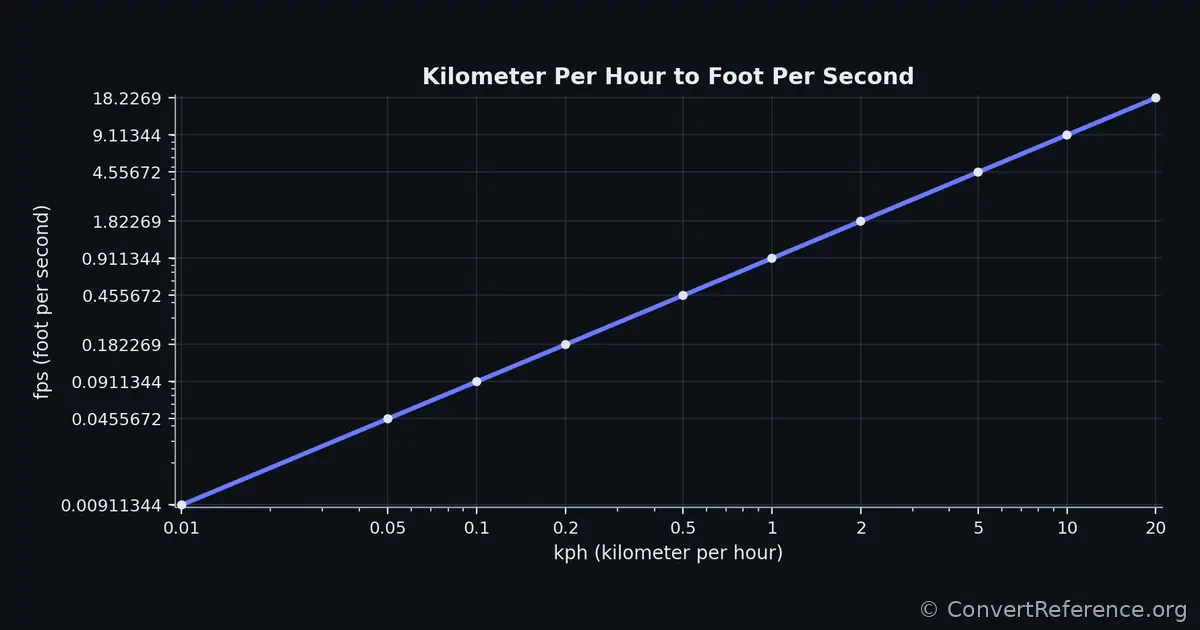
Kilometers per hour and Feet per second Conversion Graph
Conversion graph showing the relationship between kilometers per hour and feet per second.

Conversion Table For Kilometer Per Hour And Foot Per Second

Common conversion values
Kilometers per hour Feet per second
0.010.00911344
0.050.0455672
0.10.0911344
0.20.182269
0.50.455672
10.911344
21.82269
54.55672
109.11344
2018.2269

Values are rounded for display; internal calculations use the exact conversion factors between kilometer per hour and foot per second (0.911344415281423 and 1.09728).

Dataset & API Access

Programmatic Access

Free JSON API with stable endpoints and predictable keys for automated bidirectional conversions.

Endpoint: https://convertreference.org/api/v1/convert/kilometer-per-hour-to-foot-per-second.json

Content Type: application/json

Documentation: View API docs

Licensing

License: CC0 1.0 Universal (Public Domain)

See all datasets

Data & Editorial Process

All numerical values and formulas are generated from the Pint scientific unit library (v0.25), using constants consistent with the BIPM SI Brochure (9th Edition) and NIST Special Publication 811. Explanatory text is drafted with AI assistance and reviewed by ConvertReference editors for clarity and accuracy. This converter is completely free to use, and all calculations are performed locally in your browser and never sent to a server.

  • 2025-12-08 – Generated: Page created using Pint v0.25 verified constants.
  • 2025-12-08 – Reviewed: Verified by ConvertReference editors; no numerical changes required.