ConvertReference.org

Meter Per Second To Foot Per Second Converter

mps

Review And Reference Information

Verified by the ConvertReference Technical Standards Team

ConvertReference Technical Standards Team

All values and formulas are validated through our editorial review process and cross-checked against internationally recognized reference standards (NIST, BIPM, CODATA).

View Editorial Standards & Report Corrections

Last reviewed: December 08, 2025

Conversion Factors

1 meter per second = 3.28083989501312 foot per second
1 foot per second = 0.3048 meter per second

(Exact factors: 3.28083989501312 and 0.3048)

Sources: NIST · BIPM

About This Meter Per Second And Foot Per Second Converter

This online tool helps you work with meters per second and feet per second. Easily compare these two speed units in one place. Use the swap button to switch between meters per second and feet per second. The interface stays clean and simple so you can focus on your task.

What Are Meters Per Second And Feet Per Second?

What Is A Meter Per Second?

Meter per second (m/s) is the SI unit of velocity. It means distance of 1 meter traveled in 1 second. It is a derived unit from base units meter (m) and second (s) in the International System of Units (SI). Symbol: m/s. Real-world example: a person walking at about 1.4 m/s would cover roughly 84 meters in a minute.

What Is A Foot Per Second?

Foot per second (ft/s) is a speed unit used in the US customary/imperial system. It means moving one foot each second. In SI units, 1 ft/s equals 0.3048 m/s (1 ft = 0.3048 m). The common symbol is ft/s (also fps). Real-world example: a person walking slowly travels about 3 ft/s, roughly 2 mph.

When To Use Meter Per Second Vs Foot Per Second

Meter Per Second Usage

Meter per second is the SI unit for speed, used in science, education, and official measurements in metric-using countries. It appears in equations and data across many contexts. Primary countries that use it include United Kingdom, Germany, Japan, and Canada.

Foot Per Second Usage

Foot per second (ft/s) is used mainly in the United States as part of US customary units to express velocity. It may appear in education or historical contexts there, and is less common elsewhere in everyday usage.

How To Convert Between Meters Per Second And Feet Per Second

Conversion Formulas

Meter Per Second to Foot Per Second:
meter per second × 3.28083989501312 = foot per second

Foot Per Second to Meter Per Second:
foot per second × 0.3048 = meter per second

Step-by-Step Guide

Meter Per Second to Foot Per Second

  1. Take your value in meters per second.
  2. Multiply by 3.28083989501312.
  3. The result is in feet per second.

Foot Per Second to Meter Per Second

  1. Take your value in feet per second.
  2. Multiply by 0.3048.
  3. The result is in meters per second.

Example: Convert 0.05 meters per second to feet per second.

  • Exact: 0.05 × 3.28083989501312 = 0.164041994750656 feet per second.
  • Rounded: approximately 0.164042 feet per second.

Example: Convert 5 feet per second to meters per second.

  • Exact: 5 × 0.3048 = 1.524 meters per second.

History & Context

Meter per second emerged with the rise of the metric system when a standard unit of length was created to be universal and its link to time was kept simple for scientists and engineers; the idea of speed as distance traveled per unit time helped establish meter per second as a natural way to express how fast things move in physics, navigation, and industry. Foot per second developed in the English and imperial systems, where the foot served as a practical length unit and speed was described in those terms in trials, rail work, and aviation. These units show a move from local measures to international standards, with the metric path tied to a scientific and industrial world, and the imperial path rooted in everyday engineering practice.

Practical Use

A wind engineer measuring wind speed for a project may need to convert meters per second to feet per second to satisfy a client’s preferred units. This helps ensure the design calculations and specifications align with US engineering practice when presenting results. On a running track or in a sports science study, coaches might convert feet per second to meters per second to compare sprint data with metric benchmarks. Such bidirectional conversions facilitate clear communication with international teams and researchers.

Common Mistakes When Converting Between Meters Per Second And Feet Per Second

  • Treating meters per second and feet per second as the same unit.
  • Using the wrong conversion direction, such as multiplying when you should divide when converting between m/s and ft/s.
  • Assuming the numeric value stays the same when converting between meters per second and feet per second.
  • Not tracking the starting and target units, leading to mixed or incorrect results.

Mental Shortcuts For Quick Conversions

m/s to ft/s: multiply by 3.28 (1 m ≈ 3.28 ft). Estimation only; use a precise converter when accuracy matters. ft/s to m/s: divide by 3.28 (1 ft ≈ 0.3048 m). Estimation only; use a precise converter when accuracy matters.

Meters Per Second And Feet Per Second Conversion Graph
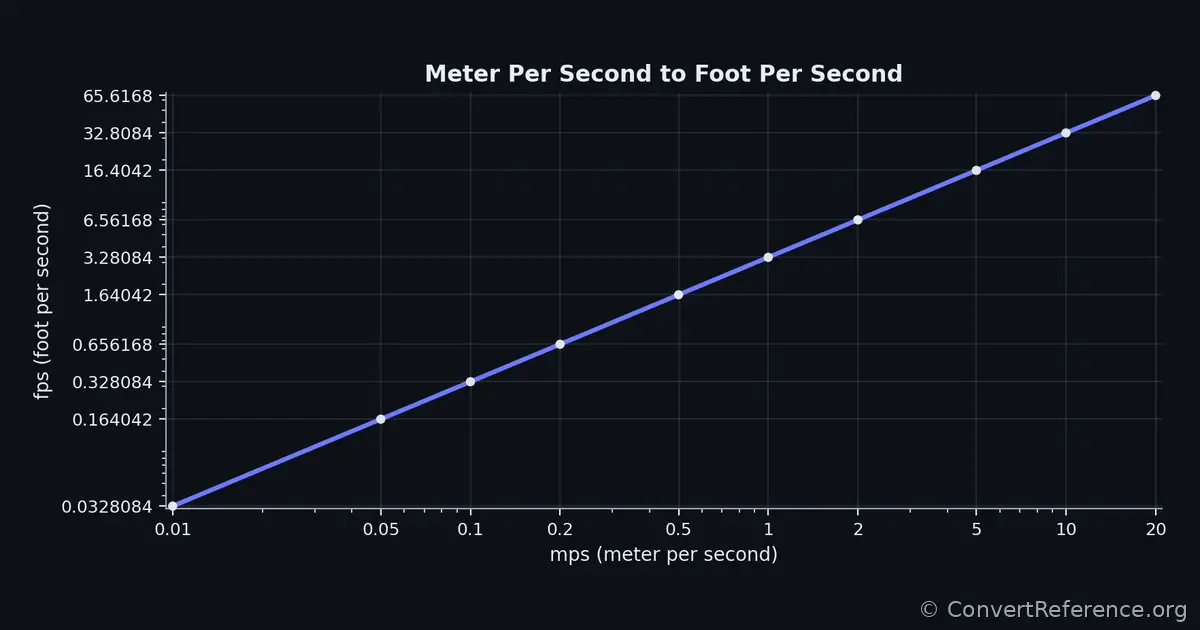
Meters per second and Feet per second Conversion Graph
Conversion graph showing the relationship between meters per second and feet per second.

Conversion Table For Meter Per Second And Foot Per Second

Common conversion values
Meters per second Feet per second
0.010.0328084
0.050.164042
0.10.328084
0.20.656168
0.51.64042
13.28084
26.56168
516.4042
1032.8084
2065.6168

Values are rounded for display; internal calculations use the exact conversion factors between meter per second and foot per second (3.28083989501312 and 0.3048).

Dataset & API Access

Programmatic Access

Free JSON API with stable endpoints and predictable keys for automated bidirectional conversions.

Endpoint: https://convertreference.org/api/v1/convert/meter-per-second-to-foot-per-second.json

Content Type: application/json

Documentation: View API docs

Licensing

License: CC0 1.0 Universal (Public Domain)

See all datasets

Data & Editorial Process

All numerical values and formulas are generated from the Pint scientific unit library (v0.25), using constants consistent with the BIPM SI Brochure (9th Edition) and NIST Special Publication 811. Explanatory text is drafted with AI assistance and reviewed by ConvertReference editors for clarity and accuracy. This converter is completely free to use, and all calculations are performed locally in your browser and never sent to a server.

  • 2025-12-08 – Generated: Page created using Pint v0.25 verified constants.
  • 2025-12-08 – Reviewed: Verified by ConvertReference editors; no numerical changes required.