ConvertReference.org

Kilometer Per Second To Meter Per Second Converter

kps

Review And Reference Information

Verified by the ConvertReference Technical Standards Team

ConvertReference Technical Standards Team

All values and formulas are validated through our editorial review process and cross-checked against internationally recognized reference standards (NIST, BIPM, CODATA).

View Editorial Standards & Report Corrections

Last reviewed: December 08, 2025

Conversion Factors

1 kilometer per second = 1000 meter per second
1 meter per second = 0.001 kilometer per second

(Exact factors: 1000 and 0.001)

Sources: NIST · BIPM

About This Kilometer Per Second And Meter Per Second Converter

Easily compare speeds between kilometers per second and meters per second. See results instantly in your selected unit. Use the swap button to switch between units. Fast, simple, and designed for quick checks.

What Are Kilometers Per Second And Meters Per Second?

What Is A Kilometer Per Second?

Kilometer per second (km/s) is a unit of velocity equal to one kilometer traveled each second. It is derived from the base SI unit meter per second (1 km/s = 1000 m/s). It belongs to the SI (metric) system. Symbol: km/s. Example: The International Space Station orbits Earth at about 7.66 km/s.

What Is A Meter Per Second?

Meter per second (m/s) is a unit of velocity in the International System of Units (SI). It shows how many meters are traveled each second. It is derived from base units: 1 m/s = 1 meter per 1 second. Symbol: m/s (also written m s^-1). Example: a person walking at about 1.4 m/s.

When To Use Kilometer Per Second Vs Meter Per Second

Kilometer Per Second Usage

Kilometer per second is used in science to express very high speeds and large-scale motion where meters per second would be too small. It is used by researchers in many countries, notably United States, United Kingdom, Germany, and Japan.

Meter Per Second Usage

Meter per second is the SI unit for speed used in science, education, and public weather forecasts in many countries. It appears in measurements and discussions of motion in daily life. Countries where it is commonly used include Canada, the United Kingdom, Germany, and Australia.

How To Convert Between Kilometers Per Second And Meters Per Second

Conversion Formulas

Kilometer Per Second to Meter Per Second:
kilometer per second × 1000 = meter per second

Meter Per Second to Kilometer Per Second:
meter per second × 0.001 = kilometer per second

Step-by-Step Guide

Kilometer Per Second to Meter Per Second

  1. Take your value in kilometers per second.
  2. Multiply by 1000.
  3. The result is in meters per second.

Meter Per Second to Kilometer Per Second

  1. Take your value in meters per second.
  2. Multiply by 0.001.
  3. The result is in kilometers per second.

Example: Convert 7 kilometers per second to meters per second.

  • Exact: 7 × 1000 = 7000 meters per second.

Example: Convert 5 meters per second to kilometers per second.

  • Exact: 5 × 0.001 = 0.005 kilometers per second.

History & Context

Kilometer per second and meter per second grew from the metric system, a rational plan for measuring length and speed. The meter began as a practical standard created in France, defined by a precise distance kept by authorities and tied to a natural reference rather than local tools. It became part of a global effort to unify measurements, and the kilometer was adopted as a larger unit for longer distances in science and daily life, sharing the same base unit for speed. These units helped describe motion from roads to aircraft to space, and international bodies later unified symbols and timing to keep measurements stable and comparable.

Practical Use

Researchers tracking a meteor entering the atmosphere at about 30 km/s convert the speed to meters per second to feed into physics models that require SI units. This conversion ensures the equations for momentum and energy use a consistent basis without dealing with large prefixes. In a separate context, aerospace engineers may present results to decision makers by converting from meters per second to kilometers per second, for example turning 6,500 m/s into 6.5 km/s to compare with orbital velocity targets. This helps bridge technical calculations and strategic planning.

Common Mistakes When Converting Between Kilometers Per Second And Meters Per Second

  • Treating kilometer per second and meter per second as the same unit.
  • Assuming the prefix does not change the magnitude of the unit.
  • Using the wrong direction in the conversion, effectively multiplying when dividing would be correct.
  • Conflating speed with distance or time and attempting to convert those instead.

Mental Shortcuts For Quick Conversions

km/s to m/s: Move the decimal three places to the right (multiply by 1000). m/s to km/s: Move the decimal three places to the left (divide by 1000). Note: This is for estimation only; use a precise converter in most cases.

Kilometers Per Second And Meters Per Second Conversion Graph
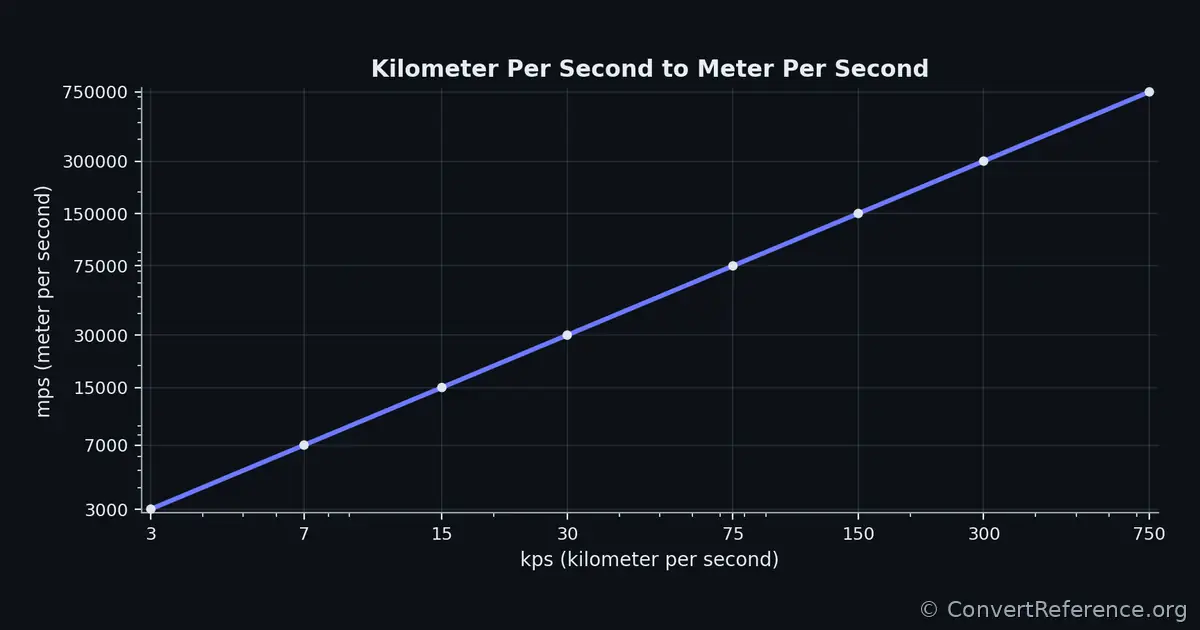
Kilometers per second and Meters per second Conversion Graph
Conversion graph showing the relationship between kilometers per second and meters per second.

Conversion Table For Kilometer Per Second And Meter Per Second

Common conversion values
Kilometers per second Meters per second
33000
77000
1515000
3030000
7575000
150150000
300300000
750750000

Values are rounded for display; internal calculations use the exact conversion factors between kilometer per second and meter per second (1000 and 0.001).

Dataset & API Access

Programmatic Access

Free JSON API with stable endpoints and predictable keys for automated bidirectional conversions.

Endpoint: https://convertreference.org/api/v1/convert/kilometer-per-second-to-meter-per-second.json

Content Type: application/json

Documentation: View API docs

Licensing

License: CC0 1.0 Universal (Public Domain)

See all datasets

Data & Editorial Process

All numerical values and formulas are generated from the Pint scientific unit library (v0.25), using constants consistent with the BIPM SI Brochure (9th Edition) and NIST Special Publication 811. Explanatory text is drafted with AI assistance and reviewed by ConvertReference editors for clarity and accuracy. This converter is completely free to use, and all calculations are performed locally in your browser and never sent to a server.

  • 2025-12-08 – Generated: Page created using Pint v0.25 verified constants.
  • 2025-12-08 – Reviewed: Verified by ConvertReference editors; no numerical changes required.