ConvertReference.org

Meter Per Second To Knot Converter

mps

Review And Reference Information

Verified by the ConvertReference Technical Standards Team

ConvertReference Technical Standards Team

All values and formulas are validated through our editorial review process and cross-checked against internationally recognized reference standards (NIST, BIPM, CODATA).

View Editorial Standards & Report Corrections

Last reviewed: December 08, 2025

Conversion Factors

1 meter per second = 1.9438444924406 knot
1 knot = 0.514444444444444 meter per second

(Exact factors: 1.9438444924406 and 0.514444444444444)

Sources: NIST · BIPM

About This Meter Per Second And Knot Converter

This quick tool helps you compare speeds in meters per second and knots. See the value in knots alongside the original meters per second. A swap button makes it easy to switch between units. Get fast, clear results for any quick speed check.

What Are Meters Per Second And Knots?

What Is A Meter Per Second?

Meter per second (m/s) is a derived SI unit of speed/velocity. It equals 1 meter divided by 1 second. It uses the SI base units meter (m) and second (s). System: SI. Symbol: m/s (or m s^-1). Real-world example: a person walking at about 1.4 m/s (~5 km/h).

What Is A Knot?

Knot (kn) is a unit of speed used at sea and in aviation. It equals one nautical mile per hour (1 kn = 1 NM per hour = 1852 m per 3600 s ≈ 0.51444 m/s). System: nautical speed units; symbol: kn (sometimes kt). Example: A small sailboat at 6 knots covers six nautical miles in one hour (about 11.1 km/h).

When To Use Meter Per Second Vs Knot

Meter Per Second Usage

Meter per second (m/s) is the SI base unit for velocity, used in science, education, meteorology, and data reporting across many countries. Primary users include the United States, United Kingdom, Canada, and Australia.

Knot Usage

Knots are used as a speed unit in several countries, notably the United States, United Kingdom, Canada, and Australia. It remains part of traditional speed measurements in these places, alongside metric units for general use.

How To Convert Between Meters Per Second And Knots

Conversion Formulas

Meter Per Second to Knot:
meter per second × 1.9438444924406 = knot

Knot to Meter Per Second:
knot × 0.514444444444444 = meter per second

Step-by-Step Guide

Meter Per Second to Knot

  1. Take your value in meters per second.
  2. Multiply by 1.9438444924406.
  3. The result is in knots.

Knot to Meter Per Second

  1. Take your value in knots.
  2. Multiply by 0.514444444444444.
  3. The result is in meters per second.

Example: Convert 1 meters per second to knots.

  • Exact: 1 × 1.9438444924406 = 1.9438444924406 knots.
  • Rounded: approximately 1.94384 knots.

Example: Convert 5 knots to meters per second.

  • Exact: 5 × 0.514444444444444 = 2.57222222222222 meters per second.
  • Rounded: approximately 2.57222 meters per second.

History & Context

Meter per second grew with the rise of the metric system in France, where scientists sought a universal length and a time standard to describe motion. The meter was tied to a physical length and the second to a time interval, so velocity meant how many meters move each second. The knot came from sailors who used a knotted rope and a simple time cue to judge speed at sea, giving a practical unit called the knot. This nautical measure stayed in ship logs and helped navigation, while meter per second became the precise scientific speed unit used in experiments and engineering.

Practical Use

Mariners often need to convert speed from meters per second to knots because navigation charts and speed limits are published in nautical miles per hour while sensors report metric speeds. For example, if a vessel's sensor shows 6 m/s, converting to knots helps the crew compare with charted limits and other ships. Conversely, when speed restrictions or traffic advisories are published in knots, converting knots to meters per second lets engineers adjust propulsion and engine settings accordingly.

Common Mistakes When Converting Between Meters Per Second And Knots

  • Confusing knots with miles per hour when converting from meters per second.
  • Applying the conversion in the wrong direction between meters per second and knots.
  • Relying on rough estimates instead of performing a precise conversion.
  • Ignoring that wind or current can affect speed over water.

Mental Shortcuts For Quick Conversions

Tip 1: To estimate m/s → knots, use 1 m/s ≈ 2 knots. Tip 2: To estimate knots → m/s, use 1 knot ≈ 0.5 m/s. Note: This is for estimation only; for accurate results, use a precise converter.

Meters Per Second And Knots Conversion Graph
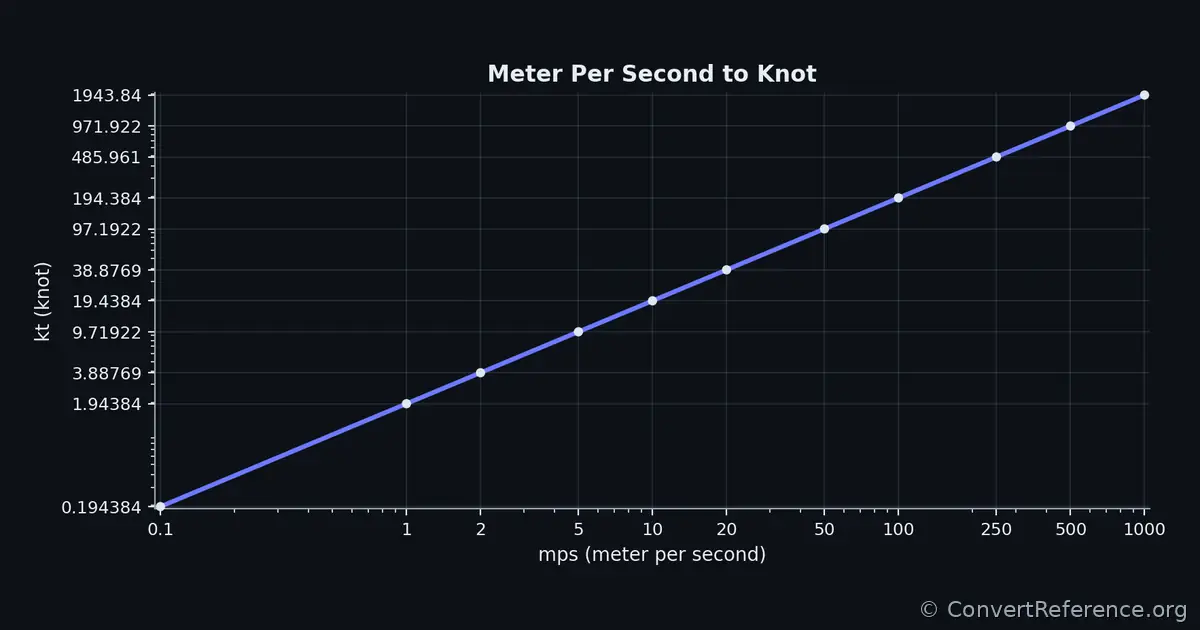
Meters per second and Knots Conversion Graph
Conversion graph showing the relationship between meters per second and knots.

Conversion Table For Meter Per Second And Knot

Common conversion values
Meters per second Knots
0.10.194384
11.94384
23.88769
59.71922
1019.4384
2038.8769
5097.1922
100194.384
250485.961
500971.922
10001943.84

Values are rounded for display; internal calculations use the exact conversion factors between meter per second and knot (1.9438444924406 and 0.514444444444444).

Dataset & API Access

Programmatic Access

Free JSON API with stable endpoints and predictable keys for automated bidirectional conversions.

Endpoint: https://convertreference.org/api/v1/convert/meter-per-second-to-knot.json

Content Type: application/json

Documentation: View API docs

Licensing

License: CC0 1.0 Universal (Public Domain)

See all datasets

Data & Editorial Process

All numerical values and formulas are generated from the Pint scientific unit library (v0.25), using constants consistent with the BIPM SI Brochure (9th Edition) and NIST Special Publication 811. Explanatory text is drafted with AI assistance and reviewed by ConvertReference editors for clarity and accuracy. This converter is completely free to use, and all calculations are performed locally in your browser and never sent to a server.

  • 2025-12-08 – Generated: Page created using Pint v0.25 verified constants.
  • 2025-12-08 – Reviewed: Verified by ConvertReference editors; no numerical changes required.