ConvertReference.org

Knot To Foot Per Second Converter

kt

Review And Reference Information

Verified by the ConvertReference Technical Standards Team

ConvertReference Technical Standards Team

All values and formulas are validated through our editorial review process and cross-checked against internationally recognized reference standards (NIST, BIPM, CODATA).

View Editorial Standards & Report Corrections

Last reviewed: December 08, 2025

Conversion Factors

1 knot = 1.6878098571012 foot per second
1 foot per second = 0.592483801295896 knot

(Exact factors: 1.6878098571012 and 0.592483801295896)

Sources: NIST · BIPM

About This Knot And Foot Per Second Converter

This fast tool makes it easy to compare speeds. See the equivalent in feet per second. Use the swap button to switch between knots and feet per second. Results are quick and clear every time.

What Are Knots And Feet Per Second?

What Is A Knot?

A knot is a unit of speed used in navigation. It equals one nautical mile per hour. One nautical mile is exactly 1,852 meters, so 1 knot = 1,852 meters per hour ≈ 0.514 m/s. System: nautical/maritime speed unit. Symbol/abbreviation: kn (often kt). Example: A ship at 6 knots travels 6 nautical miles in one hour (about 11 km).

What Is A Foot Per Second?

Foot per second (ft/s) is a speed unit in the Imperial/US customary system. It equals one foot (0.3048 m) every second, so 1 ft/s = 0.3048 m/s. Symbol: ft/s (also ft s-1). It is defined from the foot, with 1 ft = 0.3048 m. Real-world example: walking at about 3 ft/s (roughly 2 mph).

When To Use Knot Vs Foot Per Second

Knot Usage

Used as a traditional speed unit in a small number of countries, retained in some national standards. Primary users include United States, United Kingdom, Canada, and Australia.

Foot Per Second Usage

Foot per second is a velocity unit used primarily in the United States and Liberia, where feet and other customary units are common. It also appears in limited contexts in Canada and the United Kingdom, typically alongside metric values.

How To Convert Between Knots And Feet Per Second

Conversion Formulas

Knot to Foot Per Second:
knot × 1.6878098571012 = foot per second

Foot Per Second to Knot:
foot per second × 0.592483801295896 = knot

Step-by-Step Guide

Knot to Foot Per Second

  1. Take your value in knots.
  2. Multiply by 1.6878098571012.
  3. The result is in feet per second.

Foot Per Second to Knot

  1. Take your value in feet per second.
  2. Multiply by 0.592483801295896.
  3. The result is in knots.

Example: Convert 0.25 knots to feet per second.

  • Exact: 0.25 × 1.6878098571012 = 0.421952464275299 feet per second.
  • Rounded: approximately 0.421952 feet per second.

Example: Convert 5 feet per second to knots.

  • Exact: 5 × 0.592483801295896 = 2.96241900647948 knots.
  • Rounded: approximately 2.96242 knots.

History & Context

Knots arise from the age of sail with a log line. Sailors cast the log over the stern and let a rope with evenly spaced knots pay out while a sandglass marks a short span of time. They counted how many knots ran out in that span to judge ship speed, and the term knot grew from this practice, tied to nautical miles and hours used in navigation. Foot per second comes from using the foot as a unit of length and the second as a unit of time, a measure that grew with science, steam, and industry to describe motion in ships, engines, and experiments. These two units reflect a sea tradition and a broader tech age.

Practical Use

Mariners might need to convert knots to feet per second when they receive a vessel's speed in knots from GPS or AIS and want to compare it with engine performance charts published in feet per second. This helps in fuel planning, speed optimization, and aligning data from different instruments. Conversely, when meteorological reports or current measurements are given in feet per second, sailors convert to knots to estimate drift and plan routes using nautical charts.

Common Mistakes When Converting Between Knots And Feet Per Second

  • Confusing knots with miles per hour instead of nautical miles per hour.
  • Treating knots as directly convertible to feet per second without using the nautical mile per hour relation.
  • Using the same conversion factor in both directions instead of applying the reciprocal for reverse conversion.
  • Ignoring that knots are a maritime unit and applying a land-based mindset to the conversion.

Mental Shortcuts For Quick Conversions

Tip 1: Knot to ft/s — 1 knot ≈ 1.7 ft/s; multiply by 1.7. Tip 2: ft/s to knot — divide by 1.7 (≈0.59). For estimation only; use a precise converter in most situations.

Knots And Feet Per Second Conversion Graph
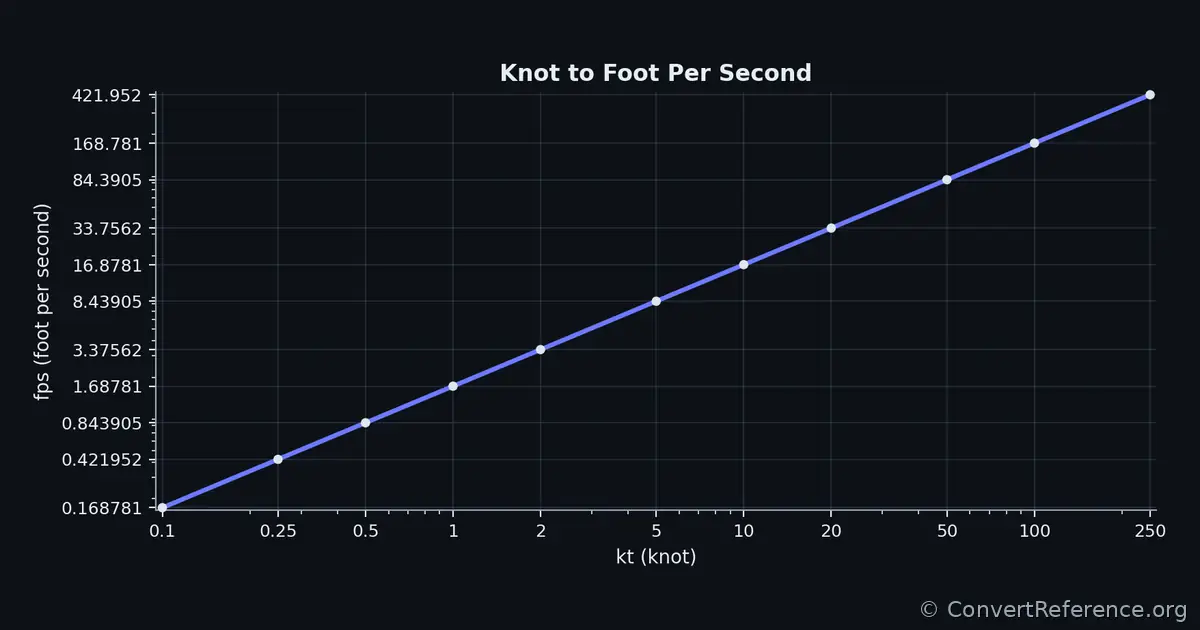
Knots and Feet per second Conversion Graph
Conversion graph showing the relationship between knots and feet per second.

Conversion Table For Knot And Foot Per Second

Common conversion values
Knots Feet per second
0.10.168781
0.250.421952
0.50.843905
11.68781
23.37562
58.43905
1016.8781
2033.7562
5084.3905
100168.781
250421.952

Values are rounded for display; internal calculations use the exact conversion factors between knot and foot per second (1.6878098571012 and 0.592483801295896).

Dataset & API Access

Programmatic Access

Free JSON API with stable endpoints and predictable keys for automated bidirectional conversions.

Endpoint: https://convertreference.org/api/v1/convert/knot-to-foot-per-second.json

Content Type: application/json

Documentation: View API docs

Licensing

License: CC0 1.0 Universal (Public Domain)

See all datasets

Data & Editorial Process

All numerical values and formulas are generated from the Pint scientific unit library (v0.25), using constants consistent with the BIPM SI Brochure (9th Edition) and NIST Special Publication 811. Explanatory text is drafted with AI assistance and reviewed by ConvertReference editors for clarity and accuracy. This converter is completely free to use, and all calculations are performed locally in your browser and never sent to a server.

  • 2025-12-08 – Generated: Page created using Pint v0.25 verified constants.
  • 2025-12-08 – Reviewed: Verified by ConvertReference editors; no numerical changes required.