ConvertReference.org

Kilometer Per Hour To Knot Converter

kph

Review And Reference Information

Verified by the ConvertReference Technical Standards Team

ConvertReference Technical Standards Team

All values and formulas are validated through our editorial review process and cross-checked against internationally recognized reference standards (NIST, BIPM, CODATA).

View Editorial Standards & Report Corrections

Last reviewed: December 08, 2025

Conversion Factors

1 kilometer per hour = 0.539956803455724 knot
1 knot = 1.852 kilometer per hour

(Exact factors: 0.539956803455724 and 1.852)

Sources: NIST · BIPM

About This Kilometer Per Hour And Knot Converter

Enter a speed in kilometers per hour to see its value in knots. This handy tool helps you quickly compare speeds in two units. Use the swap button to switch between kilometers per hour and knots. It's simple, fast, and easy to use for everyday needs.

What Are Kilometers Per Hour And Knots?

What Is A Kilometer Per Hour?

Kilometer per hour (km/h) is a unit of speed equal to traveling 1 kilometer in 1 hour. It is derived from base units: 1 km/h = 1000 m / 3600 s ≈ 0.2778 m/s. It belongs to the metric system (SI-derived). Common symbol: km/h (also kmh). Real-world example: at 60 km/h a car covers about 1 kilometer each minute.

What Is A Knot?

A knot is a unit of speed used in maritime and aviation. It equals one nautical mile per hour. One nautical mile is exactly 1852 meters, so 1 knot = 1852 m / 3600 s = 0.514444 m/s, about 1.852 km/h. System: non-SI, used in nautical and air navigation; symbol/abbreviation: kn (also kt). Example: A ship at 15 knots travels about 15 nautical miles per hour (≈27.8 km/h).

When To Use Kilometer Per Hour Vs Knot

Kilometer Per Hour Usage

Kilometers per hour is the standard unit for measuring road speeds in many countries. Primary users include Canada, Germany, France, and Australia. It is used on speed limit signs and in traffic regulations.

Knot Usage

Knot is a unit of speed used in the United States, United Kingdom, Canada, and Australia.

How To Convert Between Kilometers Per Hour And Knots

Conversion Formulas

Kilometer Per Hour to Knot:
kilometer per hour × 0.539956803455724 = knot

Knot to Kilometer Per Hour:
knot × 1.852 = kilometer per hour

Step-by-Step Guide

Kilometer Per Hour to Knot

  1. Take your value in kilometers per hour.
  2. Multiply by 0.539956803455724.
  3. The result is in knots.

Knot to Kilometer Per Hour

  1. Take your value in knots.
  2. Multiply by 1.852.
  3. The result is in kilometers per hour.

Example: Convert 2 kilometers per hour to knots.

  • Exact: 2 × 0.539956803455724 = 1.07991360691145 knots.
  • Rounded: approximately 1.07991 knots.

Example: Convert 5 knots to kilometers per hour.

  • Exact: 5 × 1.852 = 9.26 kilometers per hour.

History & Context

Kilometer per hour grew with the spread of the metric system after the French Revolution, when length was standardized and speed could be spoken with a common name across many lands. The kilometer is a metric unit of length and the hour is a traditional time unit, so together they describe speed in a clear way for roads, trains, and planes. The knot comes from sailors who measured how fast a ship moved by paying out a line marked with knots while watching a time reference. This practical method helped sailors judge speed at sea, and the term knot stayed in use as ships and later vehicles adopted the idea of distance traveled per hour.

Practical Use

Mariners planning a coastal voyage often encounter speed limits and weather data published in kilometers per hour, so they convert to knots to match nautical charts. In another common scenario, when a vessel receives wind and current reports in knots, crews convert to kilometers per hour to compare with engine specifications or inland speed data. Performing these conversions helps ensure accurate speed management and regulatory compliance during port approaches. Being able to swap between units supports safer, more precise navigation.

Common Mistakes When Converting Between Kilometers Per Hour And Knots

  • Confusing knots with kilometers per hour and treating them as the same unit.
  • Using the wrong conversion direction by applying a knots-to-km/h factor when converting from km/h to knots.
  • Rounding intermediate results too early, which leads to inaccuracies.
  • Assuming knots are miles per hour.

Mental Shortcuts For Quick Conversions

Km/h → knots: divide by 1.85 (1 knot ≈ 1.85 km/h). Knots → Km/h: multiply by 1.85. These are quick estimates; use a precise converter when accuracy matters.

Kilometers Per Hour And Knots Conversion Graph
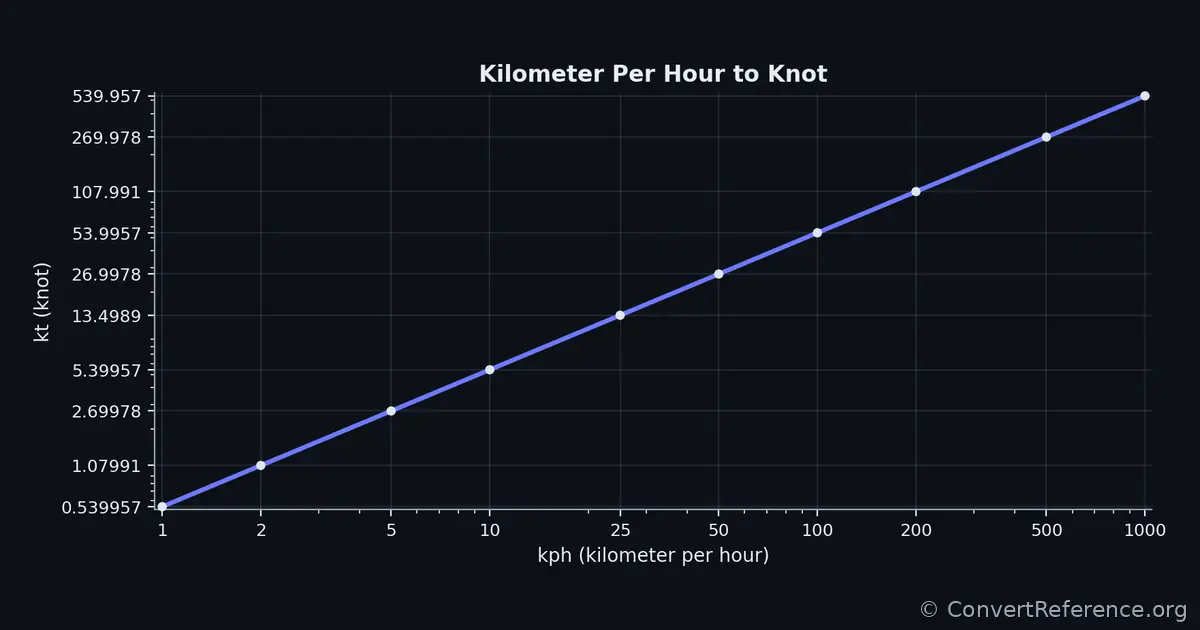
Kilometers per hour and Knots Conversion Graph
Conversion graph showing the relationship between kilometers per hour and knots.

Conversion Table For Kilometer Per Hour And Knot

Common conversion values
Kilometers per hour Knots
10.539957
21.07991
52.69978
105.39957
2513.4989
5026.9978
10053.9957
200107.991
500269.978
1000539.957

Values are rounded for display; internal calculations use the exact conversion factors between kilometer per hour and knot (0.539956803455724 and 1.852).

Dataset & API Access

Programmatic Access

Free JSON API with stable endpoints and predictable keys for automated bidirectional conversions.

Endpoint: https://convertreference.org/api/v1/convert/kilometer-per-hour-to-knot.json

Content Type: application/json

Documentation: View API docs

Licensing

License: CC0 1.0 Universal (Public Domain)

See all datasets

Data & Editorial Process

All numerical values and formulas are generated from the Pint scientific unit library (v0.25), using constants consistent with the BIPM SI Brochure (9th Edition) and NIST Special Publication 811. Explanatory text is drafted with AI assistance and reviewed by ConvertReference editors for clarity and accuracy. This converter is completely free to use, and all calculations are performed locally in your browser and never sent to a server.

  • 2025-12-08 – Generated: Page created using Pint v0.25 verified constants.
  • 2025-12-08 – Reviewed: Verified by ConvertReference editors; no numerical changes required.