ConvertReference.org

Meter Per Second To Kilometer Per Hour Converter

mps

Review And Reference Information

Verified by the ConvertReference Technical Standards Team

ConvertReference Technical Standards Team

All values and formulas are validated through our editorial review process and cross-checked against internationally recognized reference standards (NIST, BIPM, CODATA).

View Editorial Standards & Report Corrections

Last reviewed: December 08, 2025

Conversion Factors

1 meter per second = 3.6 kilometer per hour
1 kilometer per hour = 0.277777777777778 meter per second

(Exact factors: 3.6 and 0.277777777777778)

Sources: NIST · BIPM

About This Meter Per Second And Kilometer Per Hour Converter

This quick tool helps you work with meters per second and kilometers per hour. See results in the unit you choose. Use the swap button to switch between meters per second and kilometers per hour. Get quick, clear results with each change.

What Are Meters Per Second And Kilometers Per Hour?

What Is A Meter Per Second?

Meter per second (m/s) is the SI unit of speed or velocity. It is derived from base SI units: 1 m/s = 1 meter per second; meter and second are base units, so m/s is a derived SI unit. System: SI (International System of Units). Symbol: m/s (or m s^-1). Real-world example: a brisk walker travels about 1.4 m/s, so in one second it covers roughly 1.4 meters.

What Is A Kilometer Per Hour?

Kilometer per hour (km/h) is a unit of speed in the metric system. It equals distance of 1 kilometer traveled in 1 hour. In SI base units, 1 km/h = 1000 meters / 3600 seconds = 0.27778 m/s. It belongs to the SI metric system (symbol km/h, sometimes kph). Real-world example: a city car may travel at about 50 km/h in urban streets.

When To Use Meter Per Second Vs Kilometer Per Hour

Meter Per Second Usage

Meter per second (m/s) is the SI unit for speed. It is used in science, education, and everyday measurements in metric countries. You'll see it in weather data and motion data. Primary countries that use it include Canada, the United Kingdom, Australia, and India.

Kilometer Per Hour Usage

Kilometer per hour is the standard road-speed unit in many countries, appearing on road signs and vehicle speedometers. It is used in Canada, Germany, Australia, and Japan.

How To Convert Between Meters Per Second And Kilometers Per Hour

Conversion Formulas

Meter Per Second to Kilometer Per Hour:
meter per second × 3.6 = kilometer per hour

Kilometer Per Hour to Meter Per Second:
kilometer per hour × 0.277777777777778 = meter per second

Step-by-Step Guide

Meter Per Second to Kilometer Per Hour

  1. Take your value in meters per second.
  2. Multiply by 3.6.
  3. The result is in kilometers per hour.

Kilometer Per Hour to Meter Per Second

  1. Take your value in kilometers per hour.
  2. Multiply by 0.277777777777778.
  3. The result is in meters per second.

Example: Convert 0.05 meters per second to kilometers per hour.

  • Exact: 0.05 × 3.6 = 0.18 kilometers per hour.

Example: Convert 5 kilometers per hour to meters per second.

  • Exact: 5 × 0.277777777777778 = 1.38888888888889 meters per second.
  • Rounded: approximately 1.38889 meters per second.

History & Context

Meter per second and kilometer per hour have long histories in science and daily life. The metric system began in France during the age of revolutions, proposing the meter as a length unit and a standard time unit for science. In science, the meter per second became the common way to express speed, linking distance and time simply. The kilometer per hour grew with road and rail traffic, combining the kilometer and the hour for practical travel speed. International agreements later gave both units a firm place in the SI, with meter per second used in science and kilometer per hour in travel and regulation.

Practical Use

In a fitness app that tracks a jogger, you might convert meters per second to kilometers per hour to display your pace in familiar speed units. In a speed planning context for cycling or driving, you may convert kilometers per hour to meters per second when calculating stopping distances or time to cover a sprint. These conversions help users compare results with standard benchmarks. They also allow switching between unit systems without changing the underlying measurements.

Common Mistakes When Converting Between Meters Per Second And Kilometers Per Hour

  • Assuming meters per second and kilometers per hour have the same magnitude.
  • Failing to adjust the numeric value when converting between meters per second and kilometers per hour.
  • Using the wrong operation by multiplying when you should divide in the conversion.
  • Using a conversion factor from a different speed unit system.

Mental Shortcuts For Quick Conversions

Tip 1: m/s → km/h: multiply by 3.6 (1 m/s ≈ 3.6 km/h). Tip 2: km/h → m/s: divide by 3.6 (1 km/h ≈ 0.278 m/s). For estimation only; use a precise converter for accuracy.

Meters Per Second And Kilometers Per Hour Conversion Graph
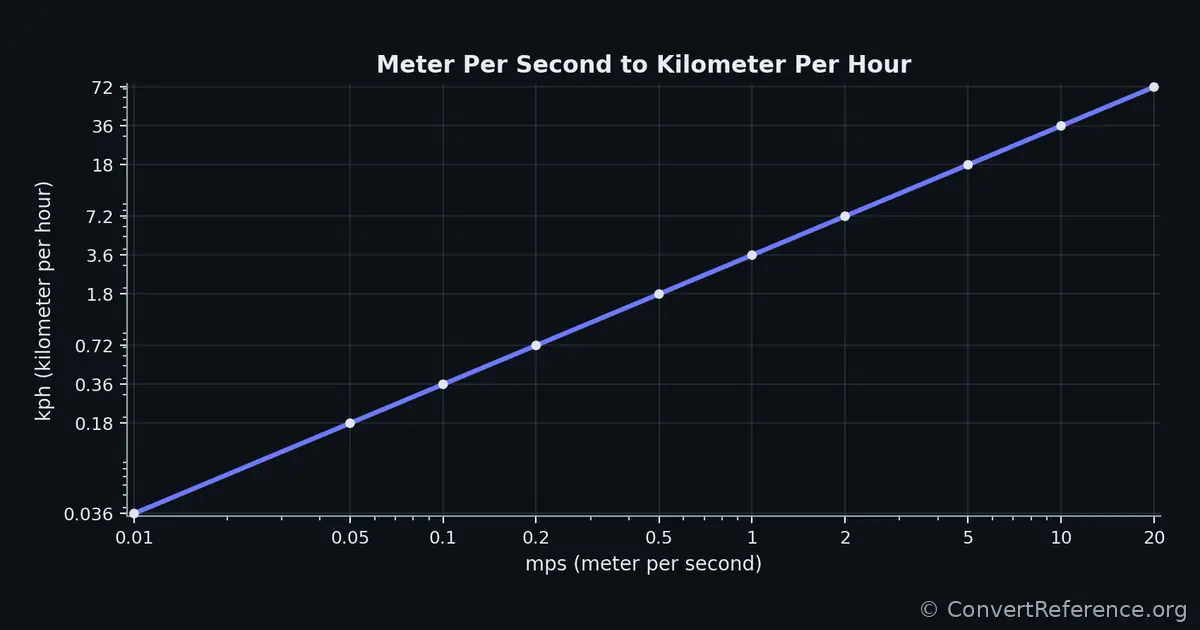
Meters per second and Kilometers per hour Conversion Graph
Conversion graph showing the relationship between meters per second and kilometers per hour.

Conversion Table For Meter Per Second And Kilometer Per Hour

Common conversion values
Meters per second Kilometers per hour
0.010.036
0.050.18
0.10.36
0.20.72
0.51.8
13.6
27.2
518
1036
2072

Values are rounded for display; internal calculations use the exact conversion factors between meter per second and kilometer per hour (3.6 and 0.277777777777778).

Dataset & API Access

Programmatic Access

Free JSON API with stable endpoints and predictable keys for automated bidirectional conversions.

Endpoint: https://convertreference.org/api/v1/convert/meter-per-second-to-kilometer-per-hour.json

Content Type: application/json

Documentation: View API docs

Licensing

License: CC0 1.0 Universal (Public Domain)

See all datasets

Data & Editorial Process

All numerical values and formulas are generated from the Pint scientific unit library (v0.25), using constants consistent with the BIPM SI Brochure (9th Edition) and NIST Special Publication 811. Explanatory text is drafted with AI assistance and reviewed by ConvertReference editors for clarity and accuracy. This converter is completely free to use, and all calculations are performed locally in your browser and never sent to a server.

  • 2025-12-08 – Generated: Page created using Pint v0.25 verified constants.
  • 2025-12-08 – Reviewed: Verified by ConvertReference editors; no numerical changes required.