ConvertReference.org

Meter Per Second To Mile Per Hour Converter

mps

Review And Reference Information

Verified by the ConvertReference Technical Standards Team

ConvertReference Technical Standards Team

All values and formulas are validated through our editorial review process and cross-checked against internationally recognized reference standards (NIST, BIPM, CODATA).

View Editorial Standards & Report Corrections

Last reviewed: December 08, 2025

Conversion Factors

1 meter per second = 2.2369362920544 mile per hour
1 mile per hour = 0.44704 meter per second

(Exact factors: 2.2369362920544 and 0.44704)

Sources: NIST · BIPM

About This Meter Per Second And Mile Per Hour Converter

Quickly convert speeds between meters per second and miles per hour. This tool is simple, fast, and easy to use. Use the swap button to toggle the units. Your result updates instantly for a seamless comparison.

What Are Meters Per Second And Miles Per Hour?

What Is A Meter Per Second?

Meter per second (m/s) is a SI unit of speed. It means one meter moved in one second. In base terms: m/s = m s^-1, since meter and second are base SI units. Symbol: m/s. Example: a person walking at about 1.4 m/s covers roughly 1.4 meters each second.

What Is A Mile Per Hour?

Miles per hour (mph) is a speed unit used in the Imperial/US customary system. It states how many miles are traveled in one hour. In SI base units, 1 mph ≈ 0.44704 m/s. Common symbol: mph or mi/h. Real-world example: at 60 mph a car travels about 1 mile every minute (roughly 97 km/h).

When To Use Meter Per Second Vs Mile Per Hour

Meter Per Second Usage

Meter per second (m/s) is the standard SI unit for speed and is used worldwide in science, education, and meteorology. It appears in weather reports, physics, and everyday measurement in SI-based countries. Primary users include the United States, the United Kingdom, Canada, and Germany, where wind, motion, and velocity are described in m/s in official contexts.

Mile Per Hour Usage

Miles per hour is used for road speeds in several countries, notably the United States, the United Kingdom, Liberia, and the Bahamas. In these places, speed limits and vehicle speeds are commonly expressed in mph on signs and dashboards.

How To Convert Between Meters Per Second And Miles Per Hour

Conversion Formulas

Meter Per Second to Mile Per Hour:
meter per second × 2.2369362920544 = mile per hour

Mile Per Hour to Meter Per Second:
mile per hour × 0.44704 = meter per second

Step-by-Step Guide

Meter Per Second to Mile Per Hour

  1. Take your value in meters per second.
  2. Multiply by 2.2369362920544.
  3. The result is in miles per hour.

Mile Per Hour to Meter Per Second

  1. Take your value in miles per hour.
  2. Multiply by 0.44704.
  3. The result is in meters per second.

Example: Convert 7 meters per second to miles per hour.

  • Exact: 7 × 2.2369362920544 = 15.6585540443808 miles per hour.
  • Rounded: approximately 15.6586 miles per hour.

Example: Convert 5 miles per hour to meters per second.

  • Exact: 5 × 0.44704 = 2.2352 meters per second.

History & Context

Meter per second and mile per hour are ways to talk about how fast things move. The meter was created in a period of scientific reform to be a universal unit of length, and the second is the time unit used with it; together they form the meter per second for speed in science and engineering. The mile grew from old English land measures and the need to describe travel on roads and by rail, especially in Britain and later in the United States. Both units spread with standardized measurement and the demands of science, while the mile per hour remains common for road speed and everyday use.

Practical Use

On an online unit converter page, a cyclist sees wind speed reported in meters per second and needs to convert m/s to mph to compare with local weather reports. A driver or trainer might then convert mph to m/s to translate a speed limit or treadmill pace into metric units for calculations or fitness plans. The page makes both conversions quick and easy in a single, practical tool.

Common Mistakes When Converting Between Meters Per Second And Miles Per Hour

  • Treating miles per hour and meters per second as interchangeable.
  • Applying the same numeric factor in both directions without using the reciprocal conversion.
  • Confusing miles with kilometers when converting speed units.
  • Neglecting to account for the time unit difference between seconds and hours when switching between units.

Mental Shortcuts For Quick Conversions

Tip 1: m/s → mph: rough rule is about 2.24 × m/s (roughly double, a bit more). Tip 2: mph → m/s: rough rule is about 0.45 × mph (roughly half, a bit more). These are estimation aids; for precise results, use a proper converter when accuracy matters.

Meters Per Second And Miles Per Hour Conversion Graph
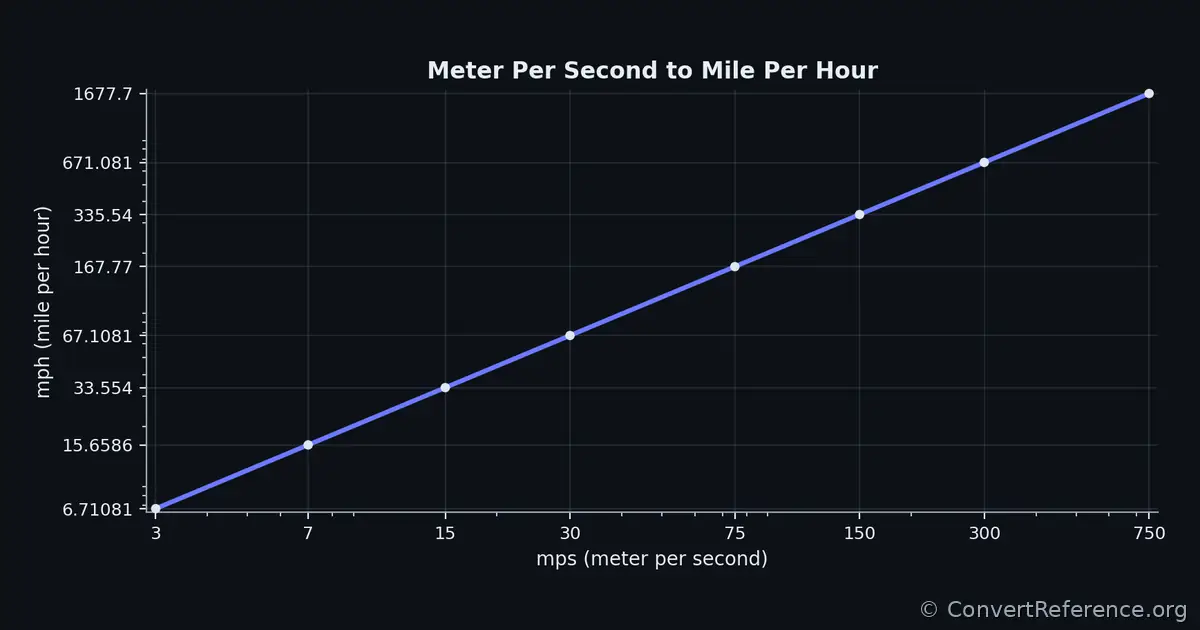
Meters per second and Miles per hour Conversion Graph
Conversion graph showing the relationship between meters per second and miles per hour.

Conversion Table For Meter Per Second And Mile Per Hour

Common conversion values
Meters per second Miles per hour
36.71081
715.6586
1533.554
3067.1081
75167.77
150335.54
300671.081
7501677.7

Values are rounded for display; internal calculations use the exact conversion factors between meter per second and mile per hour (2.2369362920544 and 0.44704).

Dataset & API Access

Programmatic Access

Free JSON API with stable endpoints and predictable keys for automated bidirectional conversions.

Endpoint: https://convertreference.org/api/v1/convert/meter-per-second-to-mile-per-hour.json

Content Type: application/json

Documentation: View API docs

Licensing

License: CC0 1.0 Universal (Public Domain)

See all datasets

Data & Editorial Process

All numerical values and formulas are generated from the Pint scientific unit library (v0.25), using constants consistent with the BIPM SI Brochure (9th Edition) and NIST Special Publication 811. Explanatory text is drafted with AI assistance and reviewed by ConvertReference editors for clarity and accuracy. This converter is completely free to use, and all calculations are performed locally in your browser and never sent to a server.

  • 2025-12-08 – Generated: Page created using Pint v0.25 verified constants.
  • 2025-12-08 – Reviewed: Verified by ConvertReference editors; no numerical changes required.